
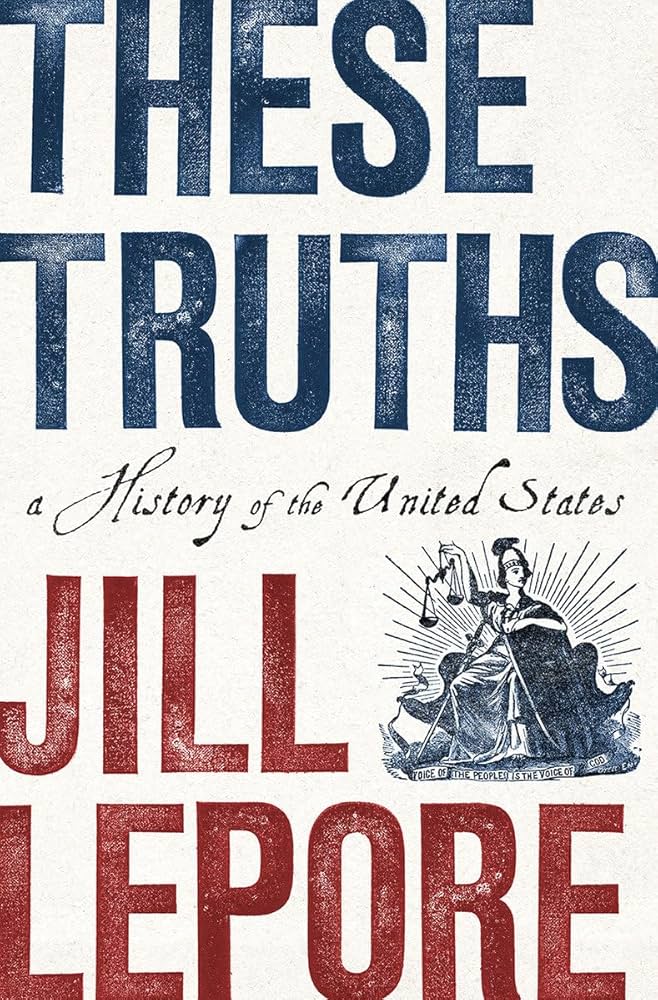


Short Summary
In These Truths, Jill Lepore takes readers through the good and the bad of American history.
My Takeaways
1️⃣ A Brief Timeline of U.S. History
What follows is a brief history of the United States. Of course, this is not an exhaustive list, but it gives a high-level overview of some of the major events that have occurred in this country.
- 1492 — Christopher Columbus “Discovers” the Americas
- 1620 — “Pilgrims” Cross the Atlantic Ocean Aboard the Mayflower; Arrive in Cape Cod/Plymouth, Massachusetts
- 1754-1763 — French-Indian War
- 1775-1783 — Revolutionary War
- July 4, 1776 — Declaration of Independence
- 1783 — Treaty of Paris Ends Revolutionary War
- 1787 — U.S. Constitution Is Born
- 1791 — Bill of Rights Introduced
- 1803 — Louisiana Purchase Doubles Size of U.S.
- 1812 — War of 1812 With Britain
- 1830s — Birth of Railroads Helps U.S. Expand West
- 1846-1848 — War With Mexico Over Texas Territory
- 1848-1855 — California Gold Rush
- 1861-1865 — Civil War Over Issue of Slavery
- 1863 — Emancipation Proclamation Frees Slaves in Confederate States (South)
- 1865 — Slavery Abolished With Passing of 13th Amendment
- 1865 — Abraham Lincoln Assassinated by John Wilkes Booth
- 1870 — 15th Amendment Prohibits Racial Discrimination in Voting
- 1870s — Jim Crow Laws (Segregation) Begin In Some States (Mostly Southern)
- 1898 — Spanish-American War
- 1914-1919 — World War I
- 1920 — 19th Amendment Allows Women to Vote
- October 1929 — Biggest Stock Market Collapse in U.S. History
- 1929-1939 — The Great Depression
- 1939-1945 — World War II
- December 7, 1941 — Attack on Pearl Harbor Brings U.S. Into WWII
- 1945 — United Nations Established to Serve as “Policemen” of World
- 1947-1991 — Cold War Between U.S. and USSR
- October 1957 — USSR Launches First Satellite Into Orbit (Sputnik)
- October 1962 — Cuban Missile Crisis
- July 1969 — U.S. Becomes First Nation to Land on Moon
- November 1989 — Berlin Wall Falls as Soviet Union, Communism Collapse
- 1950-1953 — Korean War Over Communism
- 1955-1975 — Vietnam War Over Communism
- 1954 — Brown v. Board of Education Ruling Ends Segregation in Public Schools
- 1963 — President John F. Kennedy Assassinated by Lee Harvey Oswald
- 1964 — Civil Rights Act of 1964 Signed Into Law; Jim Crow Laws (Segregation) Abolished
- 1965 — Voting Rights Acts of 1965 Signed Into Law to Fight Discrimination at Voting Polls
- 1968 — Martin Luther King Jr. Assassinated
- September 11, 2001 — Attack on World Trade Center; Twin Towers Collapse
- 2001-2021 — War in Afghanistan
- 2003-2011 — War in Iraq
2️⃣ Revolutionary War Era: We Started as Colonies and Became the United States of America
The story of how the United States came to be stretches back well before 1776. Although Native Americans had been living on the continent for thousands of years prior, Christopher Columbus is widely recognized as the man who “discovered” the Americas on his 1492 voyage across the Atlantic Ocean from Spain.
In the mid-1400s, monarchs in West Europe became tired of the Islamic world’s monopoly on trade and began looking for alternative routes to Asia and Africa that wouldn’t require sailing across the Mediterranean Sea. At the time, the known world included Europe, Asia, and Africa — that’s it. Columbus first presented his idea of sailing west to get to Asia to the king of Portugal in 1484, but it was rejected. He later took his proposal to the king and queen of Spain, who eventually approved the voyage. In 1492, Columbus set sail from Spain and accidentally landed in the Bahamas. Thinking he had arrived in Asia, Columbus didn’t consider the lands he came across to be new territory. Instead, it was an Italian named Amerigo Vespucci who wrote extensively about these lands in the Americas and described them as new continents during his own voyage across the Atlantic around 1503. Years later, mapmakers needed to add this new utopia to the three known territories of Africa, Asia, and Europe. In a nod to Amerigo Vespucci, they called the new continent “America,” which included what we now know as North and South America.
When Columbus returned in 1493, a Spanish-born pope granted all of the lands on the other side of the ocean to Spain. Unsurprisingly, the heads of England, France, and the Netherlands took issue with this. With a whole New World available to them, a mass migration of Europeans to the Americas began. The Spanish were first on the scene: Spanish warriors first set foot in North America in 1513 and quickly conquered all of what became Mexico and half of what became the continental United States. Their conquest was extremely violent; led by Hernan Cortes, armies of Spaniards brutally murdered thousands of Native Americans as they marched across North America.
It wasn’t until the late 1500s that England became interested in the New World. Unlike the Spanish, the English mostly came in peace and merely wanted to settle alongside the Indians. England first claimed Virginia, which stretched from what is now South Carolina all the way to Canada. This was England’s first “colony” overseas. The English went on to establish 12 other “mainland colonies” in North America, with all people living in these territories answering to the King, just like the Englishmen in England. One of these other new colonies was New England, which was settled in 1620 by a group of dissenters who thought the King was abusing his powers and wanted to discover a “New England.” These “pilgrims,” as they were called, sailed over to America on the Mayflower. The Mayflower pilgrims were just the beginning. Upset with the King’s dissolving of Parliament in 1629, a huge number of Englishmen fled to the colonies. A spirit of rebellion against the King’s rule started to form. They felt he had too much unchecked power.
Eventually, there came a need for the 13 mainland colonies in North America — and the 1.5 million people living in them — to unite. France and Spain still occupied territory in the Americas, fights were breaking out with Native Americans, and slaves were rebelling. Benjamin Franklin attempted to bring the colonies together under the Crown. In 1754, he organized the “Albany Congress” and proposed his Plan of Union, a system where representatives of the colonies would come together to form a government under English rule that would have the power to pass laws, make treaties, and form a military. It failed. The colony assemblies rejected it, and the British government disapproved of it.
What eventually brought the colonies together was the aftermath of the French-Indian War. English settlers began moving further and further into territory occupied by Indians but claimed by France. To stop them, France positioned forts along their borders. In May 1754, a small force of militiamen and Indian allies led by George Washington ambushed one of the French camps in the Ohio Valley, and the war began soon after. England sent troops to support the colonies in the fighting, but the Crown promised to pay for all expenses of the war. It was the breaking of this promise — and the layering of new taxes on the colonies — that eventually led the colonists to break away from England.
The French-Indian War (1754-1763) left Britain nearly bankrupt and doubled its debt. To pay for the war, Britain began a series of taxes on the colonies that caused uproar. It began with the Sugar Act of 1764. Colonists were furious, primarily because they felt Parliament had no right to tax them when the colonies didn’t have any representatives in Parliament (“taxation without representation”). The 1765 Stamp Act caused more rage and led a group of colonists to establish the Sons of Liberty. The colonists refused to pay the taxes. The Stamp Act was repealed the next year, but Parliament in 1767 passed the Townshend Acts, taxes on lead, paper, paint, glass, and tea. Riots and boycotts ensued. Then came the 1773 Tea Act. That fall, three British ships loaded with tea arrived in Boston. Dozens of colonists disguised as Indians boarded the boat and dumped the tea into the harbor (the Boston Tea Party). Parliament responded by passing the Coercive Acts, which closed the Boston Harbor.
At this point, the 13 mainland colonies wanted to break free from British rule. They established a Continental Congress and agreed to boycott all British imports. The Revolutionary War — a fight for independence — began in 1775 after British forces fired on colonial minutemen while trying to confiscate weapons and ammunition at Lexington and Concord in Massachusetts. The Continental Congress voted to establish a Continental Army, and George Washington was named commander. The Articles of Confederation were formed by the Continental Congress to unite the colonies — now states — for their common defense, and Thomas Jefferson in 1776 drafted the Declaration of Independence to declare that the states were now free from British rule and were officially fighting for their independence. The Declaration of Independence was made on July 4, 1776.
Despite being heavily outclassed by the British Army, Washington and the Continental Army held their own. A key victory at the Battle of Saratoga allowed Benjamin Franklin and John Adams — serving as diplomats — to secure support from France in 1778 and Spain in 1779. An alliance with France and Spain in hand, a huge victory over General Cornwallis at Yorktown in Virginia in 1781 ended the fighting in North America. The British decided to give up America and instead focused on maintaining the colonies they had established in the Caribbean. Franklin led peace negotiations in Paris, and, in 1783, the Treaty of Paris was signed. The treaty ended the war and the British agreed to recognize the independence of the United States.
The Constitutional Convention took place in 1787, where 75 delegates from the newly independent United States met from May-September to establish a national government and a Constitution. James Madison primarily led the drafting of our Constitution. Notably, slavery was not abolished in the Constitution; the document doesn’t mention it directly one time. Instead, it mostly left the issue up to the states. By 1787, slavery had been abolished in New England and heavily contested in other northern states. It was mainly the South that continued to abuse slavery — a divide that would later cause the Civil War. Representation in Congress was a heavily debated issue at the convention. It was ultimately decided that each state would receive two senators and proportionate representation in the House of Representatives. Although it was hotly debated, the Constitution was eventually ratified and George Washington was elected as the country’s first president. Finally, the Bill of Rights was drafted by Madison and ratified in 1791. The document came with 10 amendments to the Constitution that provided a list of powers Congress DOES NOT have.
3️⃣ Civil War Era: Fighting Over Slavery Led to Civil War
The United States grew tremendously in the 1800s. The First Industrial Revolution in the U.S. (1790-1850) saw a transition from agricultural farming to manufacturing, as an explosion of machines, factories, textile mills, steam engines, telegraphs, canals, and railroads burst onto the scene.
These manufacturing and transportation innovations were needed to support America’s rapid growth and expansion West. The sheer size of the United States doubled practically overnight when President Thomas Jefferson authorized the Louisiana Purchase from Napoleon of France in 1803 for $15 million, opening up nearly a million square miles west of the Mississippi. Hundreds of thousands of Americans began moving West in the decades that followed, and the U.S. went on to secure much more land in the Southwest (the Texas Territory) and Northwest (the Oregon Territory). Immigration significantly added to the population as millions of Europeans moved to the U.S. The single biggest wave of immigration in the period came between 1845-1849, when Ireland endured a potato famine. This famine is why Boston has such an Irish influence — by 1850, one in every four people in Boston were Irish.
A true democracy also emerged in this period. In the Founders’ Era (i.e. the first handful of elections) only a small number of people could vote — usually white men who owned property — because the conservatives of that period feared the country would be destroyed if a majority of people were allowed to vote. But beginning in the 1820s, that began to change. Andrew Jackson’s presidential victory over John Quincy Adams in 1828 marked the birth of the Democratic Party — the party of the people, the common man. By that time, all white men, whether they owned property or not, were awarded the right to vote. The right of the people to control the direction of the nation became a popular idea, and the U.S. grew into a true democracy — the first large-scale democracy in the history of the world. With that democratic system emerged a two-party system backed by campaigns, rallies, conventions, and partisan newspapers to help secure the majority vote in elections. Later on, the passing of the 15th Amendment in 1870 allowed black men to vote, though this was often violently suppressed.
But what really defined this period in U.S. history was the growing divide over slavery. By the 1830s, the northern states had mostly abolished slavery, while the southern states were slave states. The South promoted slavery because growing, selling, and exporting commodities like tobacco, sugar, and cotton was very profitable, and these resources grew naturally in the southern states. Plantation owners used slaves to help produce their products. Most people agreed that slavery was immoral, but the Constitution had failed to resolve it, leaving the issue up to the states to decide. As America expanded West, new-found states had to decide their stance on slavery before entering the Union. This created great tension. As the author writes, “the battle over slavery was a battle over the West.”
The War with Mexico is an example. In the 1830s, the Texas territory — which included what we now know as Texas, Arizona, New Mexico, Colorado, and Utah — belonged to Mexico. In 1835, Americans in Texas, led by Sam Houston, rebelled against Mexican rule and declared Texas’s independence, with Houston serving as president (hence – Houston, Texas). Houston asked the U.S. to annex Texas, which it eventually did in 1845. The next year, a skirmish broke out between American and Mexican forces during annexation, and the U.S. declared war on Mexico. A congressman named David Wilmot suggested that any peace negotiation treaty should include a proviso stating that no territory acquired from Mexico will allow slavery. It didn’t pass, fueling more tension over slavery between the North and the South. The war formally ended in 1848, with Mexico giving up more than half its land. The top half of Mexico became the bottom half of the U.S. The Louisiana Purchase had doubled the size of the U.S.; the war with Mexico grew the nation by another 64%.
More tension came with the Kansas-Nebraska Act. In the 1850s, the U.S. began building a transcontinental railroad that would go through Chicago to the Pacific Ocean, but in the way was a Permanent Indian Territory. A bill organizing this territory into the states of Kansas and Nebraska was introduced into Congress and once again brought the hot-button issue of slavery in new states to the forefront. Left to decide whether they would enter the union as free or slave states, fighting broke out in Kansas. Southerners moved into Kansas to vote for slavery; northerners moved into Kansas to vote against it. Eventually, they began shooting each other.
These and many other factors caused tension between the northern and southern states, but the tipping point finally came with the Supreme Court’s ruling in the Dred Scott v. Sandford case. Scott, born into slavery in Missouri, had been carried into a free state and had sued for his freedom. The court ruled that Black Americans were not citizens and that Scott did not acquire freedom by being taken into a free state because his status was determined by the laws of Missouri, where they forced him to return to a life of slavery. While there is no evidence to support it, the Chief Justice tried to justify the court’s ruling by arguing that the men who wrote the Constitution considered African Americans “inferior.” The decision caused an uproar among anti-slavery factions. Jubilant slave owners said the case settled the question of slavery for good.
The election of Republican Abraham Lincoln finally launched the U.S. into Civil War over the issue of slavery. Lincoln ran on the belief that whites and blacks were equal and entitled to the same rights, and slavery was unconstitutional. When he was elected president in 1860, the South revolted. Eleven southern states voted to repeal their ratification of the Constitution, essentially withdrawing from the U.S. to form the Confederate States of America. The Confederate States (South) believed blacks were not equal to whites and that slavery was right; the Union States (North) held the opposite viewpoints. The two sides engaged in a bloody Civil War over slavery; a four-year battle in which more than 750,000 Americans died. The turning point in the war came on July 1, 1863 at the Battle of Gettysburg in Pennsylvania. After three days of brutal fighting, the Confederates lost their foothold and began to retreat. Four months later, Lincoln delivered his world-famous Gettysburg Address to honor the dead Union soldiers and urge America to begin anew with equality at the forefront.
With the Union’s victory in sight, Lincoln on January 1, 1863 delivered the Emancipation Proclamation, which freed nearly all slaves held in the Confederate States (most Union states had already abolished slavery). This was a major step forward, but it didn’t fully end slavery. Finally, on January 31, 1865, Congress passed the 13th Amendment, which at last prohibited slavery in the U.S. Slavery had lasted centuries; finally it was over in America. Less than two months later, on April 9, 1865, the Civil War ended after the Confederates surrendered. Five days later, John Wilkes Booth — upset with the new direction the U.S. was headed — assassinated Lincoln in Ford Theatre, a playhouse six blocks from the White House.
4️⃣ WWI and WWII Era: Destruction in Europe, Continued Progress at Home Made the U.S. the World Leader
Following the destruction of the Civil War came a period of attempted Reconstruction. The Reconstruction Amendments involved the passing of the 13th, 14th, and 15th Amendments, and the Reconstruction Acts divided the Confederate states into five military districts, each occupied by a Union general. The 13th Amendment (1865) abolished slavery, the 14th Amendment (1868) granted citizenship to all people born or naturalized in the U.S., and the 15th Amendment (1870) allowed all male citizens to vote, regardless of race or color. All three Reconstruction Acts were designed to establish civil and legal rights for Black Americans, and the Confederate states were required to ratify the 14th Amendment to return to the Union.
Reconstruction looked promising, until it all came crashing down. In 1877, the Republican Party agreed to withdraw military occupation in the South in exchange for Democratic Party support for Republican Rutherford B. Hayes to become president. For a minor political win over the Democratic Party, Republicans committed electoral fraud and abandoned a century-long fight for civil rights. As soon as federal troops withdrew, white Democrats took control of state governments in the South, and Black Americans were terrorized by the Ku Klux Klan and others. With Reconstruction in the dirt, the Klan for decades organized violent harassment and lynchings throughout the South.
Making matters worse, Jim Crow laws were established in many southern states beginning in the 1870s, requiring segregation between whites and blacks in public spaces. The Supreme Court’s decision to uphold Jim Crow laws in the landmark Plessy v. Ferguson case of 1896 only added fuel to the segregation fire. Slavery had ended, but segregation was just beginning. Jim Crow laws weren’t abolished until the 1960s. Black Americans were mistreated everywhere, including at the polls. The 15th Amendment had given Black men the right to vote, but groups like the Ku Klux Klan patrolled the polls, violently preventing them from exercising their right to vote. As a result, black voter registration dropped from 130,000 in 1898 to 730 by 1910. Eventually, and understandably, Black Americans migrated away from the South by the thousands. At one point, 90% of Black Americans lived in the South; by the 1930s, that figure dropped to roughly 50%.
Black Americans had plenty of places to choose from. The U.S. expansion West raged on following the Civil War, and so too did industrialization. Manufacturing and machines continued to take off. The late 1800s and early 1900s witnessed the arrival of big business, big banking, and big railroads. Practically everything got bigger and better, including the economy. U.S. Steel became the first billion dollar company. Automobiles were invented and became mainstream, with Henry Ford and his Ford Motor Company leading the way. The Wright brothers were beginning to assemble the world’s first airplane. Between 1922-1928, industrial production increased by 70%; Gross National Product (GNP) by 40%; and per capita income by 30%. The U.S. economy quickly became the largest in the world, with America producing 42% of the world’s output. Steel production and railroad income led the way. This period also saw the birth of electricity and a power grid, bringing light and electricity to homes across the country. Radio was invented, and NBC and CBS began broadcasting in the 1920s. To help keep the rapidly rising economy and business landscape in check, more regulation was needed. The federal government developed several new agencies, including the Federal Reserve Bank, and installed new measures like the federal income tax. Business was booming in the U.S. — it was an incredibly prosperous time in America.
Not even World War I could put a damper on the momentum. War broke out in Europe in 1914 after Archduke Franz Ferdinand of Austria-Hungary was assassinated by a Serbian national. Austria-Hungary blamed the Serbian government for the attack and declared war on Serbia. When it was all said and done, WWI was by far the deadliest war the world had ever seen: 40 million people died and another 20 million were wounded. Machines were primarily responsible for the carnage; bigger and better weapons created unprecedented destruction. At first, the U.S. stayed out of the war — in fact, Woodrow Wilson’s campaign for the presidency in 1916 ran on the idea of keeping America out of the conflict. But things changed in 1917 after German U-boats sank three American ships. The U.S. entered the war. Fortunately for us, the major European powers absorbed most of the damage. The U.S. suffered just 115,000 casualties, while Germany lost 1.8 million lives, France lost 1.6 million lives, and Britain added 800,000 deaths. The war left Europe in ruin. Europe splintered from 17 countries to 26, and the map of the continent had to be redrawn during peace negotiations. Eventually, in 1919, the Treaty of Versailles ended WWI for good. In addition to redrawing the European map, the treaty also created the League of Nations.
The war battered Europe and catapulted many of its countries into a crippling economic depression. With Europe down, the U.S. became the undisputed world leader in the 1920s. The economy was churning and the stock market was hitting record highs. It felt like nothing could bring America down. Then 1929 came. In October 1929, the greatest stock market crash in our nation’s history launched an all-out panic, with the Dow Jones Industrial Average spiraling from 326 to 198 in three weeks. At first President Herbert Hoover did nothing, hoping the markets would recover on their own. But eventually the panic caused him to panic — he convinced Congress to pass the 1930 Tariff Act, which enacted tariffs on European imports. Other nations retaliated with reciprocal tariffs on U.S. goods, setting fire to the problem. Between 1929-1932, one in five banks failed. Unemployment skyrocketed to 23% as 12 million Americans found themselves out of work. Factories and farms closed. People starved. The Great Depression was underway.
The nation blamed Hoover for the Great Depression and elected Franklin D. Roosevelt to the presidency in 1933. Roosevelt was just what the nation needed — a decisive decision maker who came in with a plan to turn things around. He called his plan for economic and social reform the “New Deal” and began implementing it almost immediately. Through his series of New Deal initiatives, FDR stabilized and reformed the banking system, regulated the economy through government planning, provided economic relief through public assistance programs, reduced unemployment through a public works program, and allowed farmers to keep their farms by securing better resources. Part of these reforms led to the birth of Social Security and the Securities and Exchange Commission (SEC). Overall, FDR’s plan revolved around the idea that government planning was necessary for recovery. And it worked, but it wasn’t the only thing that resurrected us from the Great Depression — World War II also played an important role in kickstarting our economy.
As bad as our economic depression was, the one Germany faced after WWI was even worse. That’s because their depression created a set of conditions that allowed Adolph Hitler and the Nazi Party to come to power. Desperate for change, the Germans appointed Hitler to Chancellor in 1933. He immediately asked the German government to pass the Law to Remedy the Distress of People and Reich, a piece of legislation that essentially abolished its own authority and granted Hitler the right to make law. Hitler followed that up by outlawing all parties but the Nazi Party. In 1935, now in complete control, he stripped German Jews of their citizenship and began targeting them. Nazis began terrorizing Jews — killing them, arresting them, burning their shops, and throwing them into concentration camps. Before it was all said and done, Nazis murdered more than 6 million Jews.
But Hitler was just getting started. He began invading countries across Europe, and it was his invasion of Poland in 1939 that sparked World War II. Two days after he entered Poland, Britain and France declared war on Germany. Nevertheless, Hitler’s German army proved to be difficult to stop. He took control of every European country until only Britain remained. On the other side of the world, Japan, one of Germany’s allies, had overtaken nearly half of China. Just like WWI, the U.S. tried to stay out of the mess. All of that changed on December 7, 1941, when Japan launched a surprise attack on America’s Pacific fleet stationed in Pearl Harbor. The U.S. immediately declared war on Japan and was strongly considering declaring war on Germany too. That’s when Hitler made a major miscalculation — he declared war on the U.S. All of the sudden, the U.S. entered the war in both Europe and Asia. With the U.S. now involved, the U.S., Britain, China, and the Soviet Union adopted a “Declaration by United Nations,” which essentially turned them into Allies. An alliance now forged, they developed a military strategy to beat Germany.
On June 6, 1944, the Allies turned the war by invading Nazi-occupied France in a day known as D-Day. They entered the country by fighting along a 50-mile stretch of the Normandy coastline as fleets of bombers and fighter planes assisted from above. Aided by French forces inside the country, the Allies defeated Germany and retook France. From there, the war began to wind down as the Allies closed in further on Germany and Italy. In April 1945, Mussolini of Italy was taken out by Italian partisans. Two days later, Hitler killed himself in his bunker in Berlin. Germany signed a surrender agreement on May 7, 1945. With Germany and Italy taken care of, Japan was the final adversary left. President Harry Truman, who had taken over for FDR following his death, dropped atomic bombs on Hiroshima and Nagasaki on August 6 and August 9, 1945. The bombs — nicknamed “Little Boy” and “Fat Man” — had been developed by J. Robert Oppenheimer and his Manhattan Project team. Japan surrendered, and the war ended. More than 60 million people died in WWII.
It was ultimately a combination of FDR’s New Deal and WWII that brought the U.S. out of the Great Depression. Gross Domestic Product (GDP) doubled as the nation became busy producing everything needed to fight in the war. GNP rose from $91B to $166B. Mobilization for the war acted as a massive public works program. The economy boomed, and the Great Depression finally came to an end. The U.S. also led the formation of the United Nations, which involved an agreement among peaceful nations for a world of free trade, international security, arms control, social welfare, economic justice, and human rights. For the U.S., the idea behind the formation of the United Nations was that peace at home requires peace abroad. In other words, the world was in need of a group of “policeman” to prevent major global conflicts like WWII from ever happening again.
5️⃣ Modern Times: The Fight Against Communism, the Civil Rights Movement, and the War on Terror
The period spanning the conclusion of World War II to present day has primarily been defined by three broad themes: the fight against communism, the civil rights movement, and the War on Terror in Afghanistan and Iraq.
The fight against communism is a good place to start. Communism — an economic and political system where all property, resources, and means of production (like factories and farms) are owned by the government, not individuals — had been around in many nations well before WWII. But the destruction of WWII completely wiped out much of Europe and Asia and opened up opportunities for new regimes to form. Ruthless communist leaders like Joseph Stalin (Soviet Union) and Mao Zedong (China) used these opportunities to exert their influence on both regions of the world.
Understandably, this was a major concern for the U.S., a capitalistic economy and society. The U.S. wanted to stop the spread of communism, both at home and abroad. The battle between communism and capitalism was the central issue in the Cold War, a conflict between the U.S. and USSR that began not long after WWII and lasted for nearly 50 years (1947-1991). The U.S.’s response to the threat of communism abroad involved a few maneuvers: through the Marshall Plan, it put billions of dollars toward rebuilding nations in West Europe; it beefed up its defenses, tripling military spending between 1949-1951; and it sought alliances abroad by helping establish the North Atlantic Treaty (NATO), a military alliance with Western Europe that acted as a front against the USSR. At home, Congress passed the 1947 National Security Act, which established the CIA and the NSA (National Security Agency).
Many Americans were paranoid about communism at home, and Senator Joseph McCarthy had a lot to do with it. McCarthy was at the center of what was known as the “Red Scare,” a period of intense anti-communist paranoia in the U.S. driven largely by fears of communist subversion and Soviet espionage. McCarthy stirred up fear and anxiety by manipulating the media and wrongfully accusing many Americans of having communist ties. He was a vulgar conspiracy theorist who was so out of control that Congress voted to censure him in 1954. He died three years later.
During the Cold War, the U.S.and USSR competed with each other in nearly every area. In 1957, the Soviets became the first nation to launch a satellite into orbit (Sputnik), but the Americans later beat them to the moon. They were also locked into an arms race, with both nations stockpiling nuclear warheads. Things nearly became catastrophic during the Cuban Missile Crisis, a 13-day political and military standoff in October 1962 between the U.S. and USSR over the installation of nuclear-armed Soviet missiles in Cuba, just 90 miles from U.S. shores. Triggered by the discovery of these missiles via U-2 spy plane photos, President John F. Kennedy instituted a naval “quarantine” of the island to prevent further shipments, bringing the world to the brink of nuclear war. The crisis ended when Soviet leader Nikita Khrushchev agreed to dismantle and remove the weapons in exchange for a U.S. promise not to invade Cuba and a secret agreement to remove American missiles from Turkey.
The Cold War between the two nations lasted until 1991. By the late 1980s, communism was beginning to lose its grip in Eastern Europe. Soviet leader Mikhail Gorbachev began pursuing a policy of glasnost and perestroika, which both essentially aimed to open society and restructure the Soviet Union’s collapsed economy. Communism began to crumble all around the Soviet bloc and Eastern Europe, leading to the collapse of the Soviet Union (an empire that had lasted 69 years) and the end of the Cold War. In 1987, both nations agreed to dismantle most of their intermediate and short range missiles, reducing the threat of nuclear war. The iconic image of individuals tearing down the Berlin Wall in 1989 symbolizes the fall of communism, the collapse of the Soviet Union, and the end of the Cold War.
The Vietnam War (1955-1975) was another conflict between communism and capitalism. After WWII, the U.S. viewed the spread of communism in Southeast Asia with great alarm. Vietnam, led by communist revolutionary Ho Chi Minh, declared its independence from French colonial rule. When the Vietnamese began trying to overthrow the French, the U.S. backed France. France eventually lost in 1954, and Vietnam was split in two: North and South Vietnam. Minh and the communists ruled North Vietnam, while the U.S.-backed Catholic nationalist Ngo Dinh Diem led South Vietnam. Communists from North Vietnam eventually began to infiltrate South Vietnam, and war erupted between the two. By the end of 1963, Diem was dead and 16,000 U.S. troops were in Vietnam fighting against the spread of communism in Southeast Asia.
Things escalated quickly from there. Fearing a loss and a complete communist takeover of Vietnam, President Lyndon B. Johnson doubled down. In March 1965, the U.S. began bombing North Vietnam and more than 184,000 U.S. troops were on the ground fighting. By 1967, close to 500,000 U.S. troops were in Vietnam. When the bombings finally ended in 1973, the U.S. had dropped on Vietnam and its neighbors more than 7.5 million tons of bombs, three times the number of explosives deployed in WWII. In 1973, the U.S. finally withdrew troops because public support for the war was so low, and the country had lost trillions of dollars and hundreds of thousands of lives in the conflict. Two years later (1975), North Vietnam overtook South Vietnam. The communists won. The Korean War (1950-1953) occurred prior to the Vietnam War and served as another example of the fight against communism. North Korea, supported by the communist countries of China and the Soviet Union, clashed with South Korea, which was backed by the United Nations, particularly the United States. The war concluded without a clear resolution, however, leaving the nation as divided as it was before the conflict.
While the fight against communism was going on, an equally important battle for civil rights was occurring in America. Although members of the African American community had been fighting for greater civil rights for centuries, real legislative progress began to occur in the 1950s and 1960s, beginning with the Supreme Court’s decision in Brown v Board of Education in 1954. The Supreme Court’s ruling in this case outlawed segregation in public schools and was a major step toward finally ending Jim Crow laws. Slowly, civil rights began to take center stage, thanks to the work of Martin Luther King, Jr., Rosa Parks, and many others. In 1955, Parks was arrested after refusing to give up her seat to a white man on a bus in Montgomery, Alabama. At a time where lynchings, police violence, extreme poverty, and other forms of racism and prejudice continued to devastate the African American community, Parks’s arrest sparked outrage and led to dozens of boycotts and protests.
But the face of the Civil Rights movement in this period was Martin Luther King, Jr., who constantly risked his life by leading speeches, rallies, protests, and boycotts. By the end of the 1950s, 90% of American homes owned a television, allowing King’s message to reach a broad audience. His world-famous “I Have a Dream” speech came in August 1963 on the steps of the Lincoln Memorial in Washington D.C. The speech was part of a massive “March on Washington” organized by African American leaders to raise awareness around civil rights and commemorate the 100th anniversary of the Emancipation Proclamation. In front of an audience of 300,000 people, King honored Abraham Lincoln and condemned racism, segregation, and violence against blacks. The speech united the Civil Rights movement and served as a catalyst for change. Unfortunately, King was assassinated five years later, in 1968, on a hotel balcony in Memphis, TN.
Thanks to the work of King and many others before him, President Lyndon B. Johnson — who had taken over for the assassinated John F. Kennedy and went on to be elected in 1964 — eventually signed into law the Civil Rights Act of 1964 and the Voting Rights Act of 1965. Together, these bills essentially ended the era of Jim Crow segregation. The Civil Rights Act outlawed discrimination based on race, color, religion, sex, or national origin; gave the Attorney General power to enforce desegregation, and more. The Voting Rights Act was designed to enforce the 15th Amendment (i.e. all citizens can vote) by eliminating racial discrimination in voting. It abolished literacy tests and implemented federal oversight of registration in discriminatory jurisdictions, allowing for immediate increases in black voter registration. Prejudice, discrimination, and racism continued on, and they still exist today. But, together, these two bills did a lot to bring equal rights to Black Americans.
The final major event of the modern era was the War on Terror. On September 11, 2001, al Qaeda — a terrorist group led by Osama bin Laden — crashed two planes into the World Trade Center in New York City, and flew another one into the Pentagon. On October 7, the U.S. declared war on Afghanistan. Its first priority was to defeat al Qaeda and take out bin Laden; its longer-term goal was regime change in Afghanistan: it wanted to replace the Taliban with a democratically-elected, pro-Western government. The war with Afghanistan (2001-2021) went on to be the longest war in U.S. history. In 2003, the U.S. opened a second front in the War on Terror by going to war with Iraq. Once again, regime change was the motivation: the U.S. wanted to replace Iraqi leader Saddam Hussein with a democratic, pro-Western government. To justify a war with Iraq, U.S. officials claimed Hussein was in possession of weapons of mass destruction. This turned out to be false.
Public support for both wars was strong following the terrorist attacks of 9/11. Support for the war with Iraq (2003-2009) began to wane after it became clear that the country didn’t have any weapons of mass destruction and wasn’t involved in the events of 9/11. Hussein was captured almost immediately, and the U.S. spent the remaining years of the war trying install a new government. The efforts didn’t really amount to much, and the dissolution of the Iraqi military ultimately allowed the terrorist group ISIS to rise to power. In 2011, President Barack Obama withdrew the last American troops stationed in Iraq. In Afghanistan, U.S. forces found and killed bin Laden in 2011. Although major military combat operations essentially ended in 2014, the last seven years of that war were spent trying to train Afghan military members and establish a democratic government. Just like in Iraq, these efforts basically failed: as soon as the U.S. exited Afghanistan in 2021, the Taliban overthrew the government and regained control of the country.
6️⃣ There's a Dark Side to U.S. History: Slavery, Segregation, Inequality, and Native American Removal
Since declaring its independence in 1776, the United States has achieved remarkable success. It is celebrated for founding the first successful large-scale democracy in history and is widely recognized as the world’s leading power. The things we’ve accomplished in just 250 years or so are truly mind-blowing. But, just like any nation, we have a dark side to our history. Not everything has been sunshine and rainbows. Things like slavery, segregation, inequality, and the displacement and removal of Native Americans have left stains on our record.
Slavery is the darkest part of our history. Although it existed in other parts of the world, the United States was among the last to abolish it. As the country grew, slaves were used to cultivate and manufacture tobacco, sugar, and cotton, particularly in the Southern states. These commodities were most naturally prevalent in the South, which is why these states practiced slavery for much longer than Northern states. Eventually, this divide over slavery caused the Civil War. Even before that, Harry Washington, one of George Washington’s slaves, escaped and fought for Lord Dunmore and the British during the Revolutionary War after Dunmore promised freedom for any slave who fought for England. More than 500 slaves took him up on the offer.
The history of slavery in the U.S. is littered with contradictions, and it shows that we were not perfect. A few include:
- Our Constitution sought ratification from the people through newspapers that were simultaneously advertising the sale of slaves
- In the 1600s, many English colonists came to America and took land from Native Americans while also engaging in slavery. The irony: while many of these people were complaining about the overreach of the King and their lack of freedom — grievances that ultimately led America to declare its independence — they owned slaves.
- The Declaration of Independence includes language like “all men are created equal” — yet slavery was actively practiced. The man who wrote the Declaration of Independence, Thomas Jefferson, owned slaves.
- The Constitution did not abolish slavery; instead, it allowed the issue to be decided by the states
- 19 of the 75 delegates at the Constitutional Convention owned slaves, including the man who was most responsible for drafting the Constitution: James Madison
- In his 50s, George Washington’s teeth were so rotten that they had to be replaced with dentures made from ivory and from nine teeth pulled from the mouths of his slaves
- George Washington and many of our Founding Fathers owned slaves. When he died in 1799, Washington and his wife owned 300 slaves.
- At age 46, Thomas Jefferson had a child with one of his slaves, 16-year-old Sally Hemings. She went on to have seven children by Jefferson.
- In the 1830s, Virginia made it illegal to teach slaves how to read and write after a few slave rebellions took place
- Thomas Jefferson was elected president in 1800. It’s possible he may not have defeated John Adams in that race without the Three-Fifths Clause, which counted enslaved people toward representation and gave Southern states more power in elections. Jefferson received 12 crucial electoral votes from these 3/5 states in the South. Although historians debate whether these votes really changed the outcome, the author states it more bluntly: “Thomas Jefferson rode to the White House on the shoulders of slaves.”
Even after slavery was finally abolished by the Emancipation Proclamation and the 13th Amendment, the passing of Jim Crow laws in some states led to segregation and ensured that Black Americans continued to experience severe discrimination and inequality. Jim Crow laws lasted for nearly 100 years, until the Civil Rights Act of 1964 and Voting Rights Act of 1965 put an end to segregation. Even then, the African American community continued to endure horrific racism and discrimination, particularly from organizations like the Ku Klux Klan. Martin Luther King Jr.’s work and leadership led to significant progress in the Civil Rights movement, but it took centuries of effort to grant minorities and women equal rights. Women were not written into the Constitution at all because the Founding Fathers didn’t consider them equal to men. As a result, they fought inequality for centuries.
Finally, the U.S. routinely moved Native Americans out of their homelands, despite the fact that many Indian tribes had lived in the Americas for thousands of years. Indian removal was one of Andrew Jackson’s top priorities when he became president in 1829. He passed the Indian Removal Act. As the U.S. expanded West, the federal government kept pushing Indians out their territories to make room for railroads, companies, and U.S, citizens moving West. In 1887, Indians held 138 million acres; by 1900, they held half of that. This practice of Indian removal wasn’t exclusive to the U.S., though — Europeans engaged in this behavior for centuries, dating back to the Spanish conquistadors who violently plowed through Indians in the 1500s after first arriving in North America.
The takeaway here is that American history is both remarkable and complicated. It includes extraordinary achievements as well as serious injustices, and understanding both the good and the bad is important.
7️⃣ The Constitution Is Often Open to Interpretation
The Constitution remains one of the most important foundations of the United States. It is remarkable that a document written in 1787 continues to guide the nation today. The Founding Fathers could not have possibly predicted the scale and complexity of the modern world, yet the Constitution they created remains our North Star.
Because parts of the Constitution are broad, vague, open to interpretation, or silent on major issues such as slavery and women’s rights, its actual meaning on some major issues has often been defined over time through the courts, particularly the Supreme Court. Landmark cases such as Dred Scott v. Sandford (which ruled that Black Americans were not considered citizens at the time), Plessy v. Ferguson (which upheld racial segregation under the “separate but equal” mindset), Brown v. Board of Education (which declared school segregation unconstitutional), and Roe v. Wade (which recognized a constitutional right to abortion before being overturned in 2022) have set the precedent on certain issues that aren’t clearly addressed in the Constitution.
The same is true of the 2nd Amendment, which states: “A well regulated Militia, being necessary to the security of a free State, the right of the people to keep and bear Arms, shall not be infringed.” This amendment has been fiercely debated over the years. People and organizations who support the right of citizens to bear arms — like the NRA — argue that the amendment protects a person’s ability to possess guns. People and organizations who believe citizens should not be allowed to possess guns argue that the amendment is referring to the right to bear arms during periods of war. The Supreme Court has made several rulings on this issue over the years, and the interpretation of the amendment continues to be intensely debated.
There are many parts of the Constitution like this that are not perfectly clear and are open to interpretation. This gives the Supreme Court a lot of power and influence when deciding on how the Constitution applies to key issues in our modern world. It’s just the natural result of following a document that was written more than two centuries ago.