

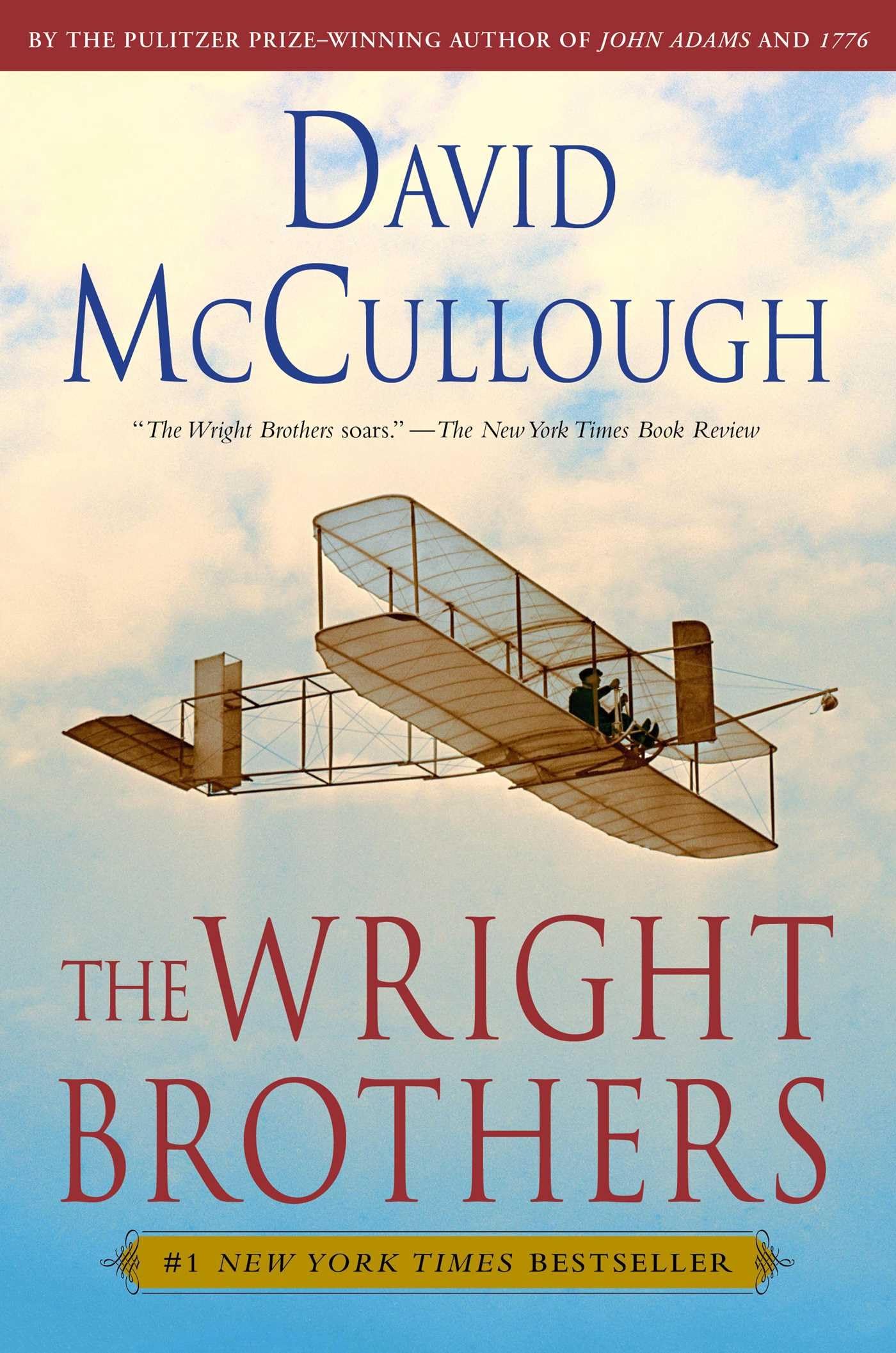
The Wright Brothers
David McCullough
 GENRE: History
 PAGES: 336
 COMPLETED: July 23, 2025
 RATING:
Short Summary
In The Wright Brothers, Pulitzer Prize-winning author David McCullough shares the story of Wilbur and Orville Wright, two brothers from Dayton, Ohio who became the first humans to achieve controlled, powered flight. Drawing from personal letters and journals, McCullough details the brothers’ journey from bike mechanics to aviation pioneers.
Key Takeaways
1️⃣ Failure and Skepticism Around Aviation
Wilbur (1867–1912) and Orville (1871–1948) Wright were two of seven children born to Milton and Susan Wright. The two brothers grew up in Dayton, Ohio, and were nearly inseparable. Throughout their lives, they were known for their strong work ethic and love of reading.
In 1892, Wilbur and Orville opened a small bicycle business called the Wright Cycle Exchange, later renamed the Wright Cycle Company. Bicycles had become the sensation of the time — people everywhere were riding them. The brothers initially sold and repaired bicycles and eventually began designing and building their own models. While the shop provided their livelihood, their true passion was flight.
The idea of manned flight had fascinated people for centuries, but no one had succeeded in achieving controlled, powered flight. Many prominent engineers, scientists, thinkers, and inventors tried, and some even lost their lives in the process. It was a mystery that remained unsolved. In fact, the repeated failures caused many people in the early 1900s to believe that manned flight was never going to happen. Some respected scholars went as far as to call the idea a complete sham.
Wilbur became particularly interested in flight around 1896 after reading about the death of Otto Lilienthal, a German glider pioneer. The event sparked the brothers’ curiosity, and they began reading everything they could find about aeronautics, especially bird flight. In 1899, they built their first flying experiment — a five-foot-wide kite used to test their ideas about flight control. As they learned and conducted more experiments, their aircrafts got bigger and more sophisticated.
2️⃣ Flight Tests at Kill Devil Hills
Between the years 1900-1903, Wilbur and Orville made four trips from their home in Dayton, Ohio to Kitty Hawk, North Carolina, where they experimented with their aircrafts. Their selection of Kitty Hawk was strategic: the area featured the strong, consistent wind patterns they needed for takeoffs/flight and plenty of sand hills and beaches ideal for safe landing. The town was also almost completely deserted, allowing them to focus and work in privacy and without distraction. There were no real roads and only about 50 homes, which mostly belonged to fisherman. Overall, Kitty Hawk was a perfect place to experiment with flying.
The brothers established a basic camp during their first visit in 1900 and continued to improve it each year. Conditions were often harsh; storms and mosquitoes sometimes kept them confined to their tent for days at a time. Their flight tests took place primarily at Kill Devil Hills, a group of large sand dunes located about four miles south of Kitty Hawk. Eventually, they built a hangar at Kill Devil Hills so they could avoid dragging equipment from Kitty Hawk.
Every single year, Wilbur and Orville’s aircraft improved. Their first builds were designed purely as “gliders” without a motor. These gliders depended on the wind alone and were meant to help the brothers figure out how to balance an aircraft in the air. The gliders were launched by starting from the top of a dune and running into the wind. Wilbur often flew the glider lying flat on his stomach, while Orville assisted from the ground. The wingspans were large — over 17 feet in their first model — and the gliders weighed under 50 pounds.
The brothers learned from every crash, and they used their time back in Dayton to study birds and other material that could help them improve their next build. One major turning point came in 1901 back in Dayton. There, they built a homemade wind tunnel above their bike shop and tested around 40 different wing shapes using small metal models to measure lift and drag more accurately than anyone had before.
These studies and measurements in the wind tunnel led to a major breakthrough on their third trip to Kitty Hawk and Kill Devil Hills in 1902. During their two months at Kill Devil Hills, they made nearly 1,000 glides with their third aircraft. This third glider had a tail for stability and movable rudders for better control. For the first time, they felt they had solved the major, major problem of balancing an aircraft in flight. This was the problem that had caused so many issues for others who tried to fly. The next step was to add an engine.
3️⃣ Takeoff: The Day the World Changed
December 17, 1903 is the day the aviation age took flight and the world changed forever. This was the day Wilbur and Orville Wright completed the world’s first successful, sustained, powered, and controlled airplane flight. To pull this off, the brothers had built a fourth model of their aircraft that featured twin propellers and an engine. They called it The Flyer. They also built a 60-foot wooden track that served as a launch rail for The Flyer.
The distance flown on this historic first flight — which was piloted by Orville — was 120 feet, less than half the length of a football field. The total flight time was 12 seconds. It may not seem like much, but it was a real flight. A few hours later, Wilbur gave it a shot. His flight went 175 feet. Orville then went again and flew 200 feet. Finally, the final flight of this historic day, piloted by Wilbur, went about a quarter mile (852 feet) and lasted 59 seconds.
This was a day that changed the world forever. As author David McCoullough writes, “What had transpired that day in 1903, in the stiff winds and cold of the Outer Banks in less than two hours time, was one of the turning points in history, the beginning of change for the world far greater than any of those present could possibly have imagined. With their homemade machine, Wilbur and Orville Wright had shown without a doubt that man could fly and if the world did not yet know it, they did. Their flights that morning were the first ever in which a piloted machine took off under its own power into the air in full flight, sailed forward with no loss of speed, and landed at a point as high as that from which it started.”
Crazy enough, when the brothers sent a telegram back home alerting everybody to what they had just accomplished, nobody really cared. The local and national press didn’t give it any attention. Nobody outside their loved ones really believed them. Even the American government and military sort of dismissed it. This was in large part because the flight was carried out in almost complete privacy at Kill Devil Hills. There were almost no witnesses to it. It took years, and many more successful flights, before the press and American government took the Wright brothers seriously.
4️⃣ Wright Brothers vs. Langley: The Race to Flight
Maybe the most impressive part of Wilbur and Orville’s accomplishments is that they had absolutely no formal training or experience working on gliders and aircrafts. They didn’t have any people or government bodies funding their experiments and builds. They didn’t even have a college education to lean on — they were ordinary bicycle mechanics. Everything they did was on their own. It was their own will, drive, and single-minded passion for solving the mystery of flight that allowed them to become the first humans to soar.
This wasn’t the case for people like Samuel Pierpont Langley, the brothers’ biggest rival in the race to flight. A highly successful astronomer and physicist, Langley was the head of the Smithsonian Institution — America’s most prominent scientific institution — and was backed by the financial support and resources of the government and other public donors. Langley and his team were building aircrafts and running flight tests at the same time as the Wright brothers. All of Langley’s flight attempts failed miserably, and they were really the only blemishes on what was a highly successful and decorated career.
Why did the Wright brothers — with no experience or public financing — succeed while Langley — with all kinds of resources and support — failed? Many people have pointed to their drastic differences in approach. For one, Langley built his aircrafts around engine power and speed while the Wright brothers focused on first solving the problem of balance and control in the air. Second, Langley was primarily in it for the fame and recognition, while the Wright brothers were driven by their passion for flight. Evidence for the latter: Langley made sure reporters and spectators were present for his flight attempts, which usually took off from atop his houseboat on the Potomac River. The Wright brothers, on the other hand, were operating in complete isolation out in Kill Devil Hills. It took days for everybody to find out that they had completed the world’s first airplane flight. They didn’t care about recognition — they were simply driven by something bigger than themselves.
In total, Langley’s project had cost nearly $70,000, while the Wright brothers’ total expenses for everything from 1900-1903 came to less than $1,000. Langley never got over the defeat and humiliation of his failed flight attempts and died three years later.
5️⃣ Continued Success at Huffman Prairie
The triumph at Kitty Hawk and Kill Devil Hills only further motivated the Wright brothers. They knew they had to take things to the next level. Rather than continuing to travel back and forth between Ohio and North Carolina, the brothers conducted their next flight tests at an 84-acre cow pasture called Huffman Prairie located eight miles from their home in Dayton. Like almost everybody else at the time, even Torrence Huffman, the owner of the prairie, thought the brothers were lunatics. Huffman told his neighbor, “They’re fools.”
Huffman was wrong. The brothers enjoyed even more historic success at Huffman Prairie. Here, they built The Flyer II and The Flyer III, aircrafts that featured improved wings, engines, and rudder placement for better control. They also developed a catapult that helped them launch their aircrafts into the air more efficiently during takeoff. On August 13, 1904, Wilbur flew more than 1,000 feet, which was further than any of the flights at Kitty Hawk. On September 15, 1904, he flew a half mile and completed a half-circle, a major achievement. On September 20, 1904, Wilbur flew in a complete circle. Together, the brothers made a whopping 105 flights in 1904 in The Flyer II.
In 1905, the brothers debuted The Flyer III. This was the “first practical airplane in history” and allowed the brothers to travel through the air for very long periods of time. In this aircraft, which weighed 900 pounds, they mastered takeoff, landing, circles, S-shaped courses, and more. Just as importantly, they flew further than ever. By the end of 1905, they were flying 25 miles or more at a time.
Despite their success at Huffman Prairie, the public still showed almost no interest in what the brothers were accomplishing. Amazingly, it wasn’t until Amos Root wrote an article about the brothers in Gleanings in Bee Culture in January 1905 that people began to show some early interest. Eventually, during their public demonstrations beginning in 1908, all newspapers began to pick up the story, and the brothers became world-famous.
After enjoying great success with The Flyer III, the brothers knew it was time to go to market with their aircraft. They wrote two letters to the U.S. War Department detailing their accomplishments and their desire to sell The Flyer III to the American government for potential military use. Both were ignored. That’s when the brothers decided to explore their options overseas. In 1906 and 1907, they had some interest from Germany and were in very serious negotiations with the French government, but those talks eventually fizzled out. In 1908, the U.S. Army finally came to its senses. In February of that year, the Army struck a deal with the brothers for one Flyer III aircraft. The brothers also secured a deal with a French syndicate.
6️⃣ Public Demonstrations
With contracts from the U.S. Army and a French syndicate secured, the brothers now had to show what their new Model A Flyer — which was based on the Flyer III — could deliver on its promises. They had tested their newest aircraft extensively in private at Kitty Hawk and Huffman Prairie and felt prepared to conduct public demonstrations.
From the years 1908-1909, the brothers put on hundreds of public demonstrations on both sides of the Atlantic Ocean. Wilbur’s demonstrations were primarily held in Europe — the airfield in Le Mans, France in particular. Orville’s demonstrations were primarily held in the Washington D.C. area. By this time, the Flyer III had been modified to carry two operators sitting side by side rather than lying flat. This allowed the brothers to take people up in the air with them. During these years, their passengers included all kinds of people, including Kings and high-ranking officials. As part of their agreement with the French syndicate, Wilbur also used the passenger seat to train a few young French pilots.
Wilbur was the first to put on a public demonstration. On August 8, 1908, he flew about two miles for a roaring crowd in Le Mans. The flight stunned the skeptical European public and aviation experts, who had previously accused the Wright brothers of lying about their ability to fly. Less than 24 hours later, the successful flight was headline news all over the globe and instantly made the brothers a household name. From then on, both brothers enjoyed massive crowds at all of their demonstrations. On December 31, 1908, his last day flying in Le Mans, Wilbur won the Michelin Cup with a flight of 2 hours and 20 minutes that covered 77 miles.
Orville’s first public demonstration came on September 3, 1908 in Fort Myer, Virginia near Washington D.C. He was demonstrating The Flyer III for the U.S. Army, which had conditionally agreed to purchase an aircraft for military use. The flight lasted about 1 minute and 11 seconds, and it impressed both the military and the gathered public by showing the aircraft’s control and potential. Eventually, both Wilbur and Orville were making flights of more than an hour. Orville continued to make flights until September 17, when he crashed violently. Orville was seriously injured, and the crash killed Lt. Thomas Selfridge, who was Orville’s passenger on the flight. Selfridge became the first casualty in the history of powered flight.
Wilbur eventually put on additional public demonstrations in Pau, France; Rome, Italy; Berlin, Germany; and New York. His flight that circled the Statue of Liberty in New York amazed the world. His flight up the Hudson River also made headlines. After his crash, Orville didn’t resume flying again until 1909. On July 30 of that year, he flew a 10-mile route from Fort Myer, Virginia to Alexandria, Virginia in which he reached 45 miles per hour. The flight secured the brothers’ deal with the U.S. Army.
These public demonstrations made the brothers world-famous, and they were celebrated nearly everywhere they went, especially in France and in their hometown of Dayton, Ohio. They received prestigious accolades from the Aero Club of France, Aero Club of America, the U.S. Congress, and more. The media covered them extensively.
7️⃣ Aftermath
Having invented the airplane, the brothers eventually gave up their bicycle business to start the Wright Company, which manufactured airplanes and was based in their hometown of Dayton, Ohio. Orville later sold his interest in the Wright Company in 1915 and later contributed to the creation of the Wright Aeronautical Laboratory in Dayton, where he supported scientific research in aviation.
Wilbur died of typhoid fever on May 30, 1912 at just 45 years old. Orville died of a heart attack on January 30, 1948 at age 77. Orville lived long enough to witness amazing advances in the invention he and Wilbur had created. He saw airplanes advance from fragile wooden structures to powerful jet-propelled machines that broke the sound barrier, were launched into space as rocket ships, and were used by the U.S. military to drop atomic bombs on Japan.
All of it started with two brothers from Dayton, Ohio who had a passion for flying and an unrelenting drive to conquer the skies. Together, they changed the world.