
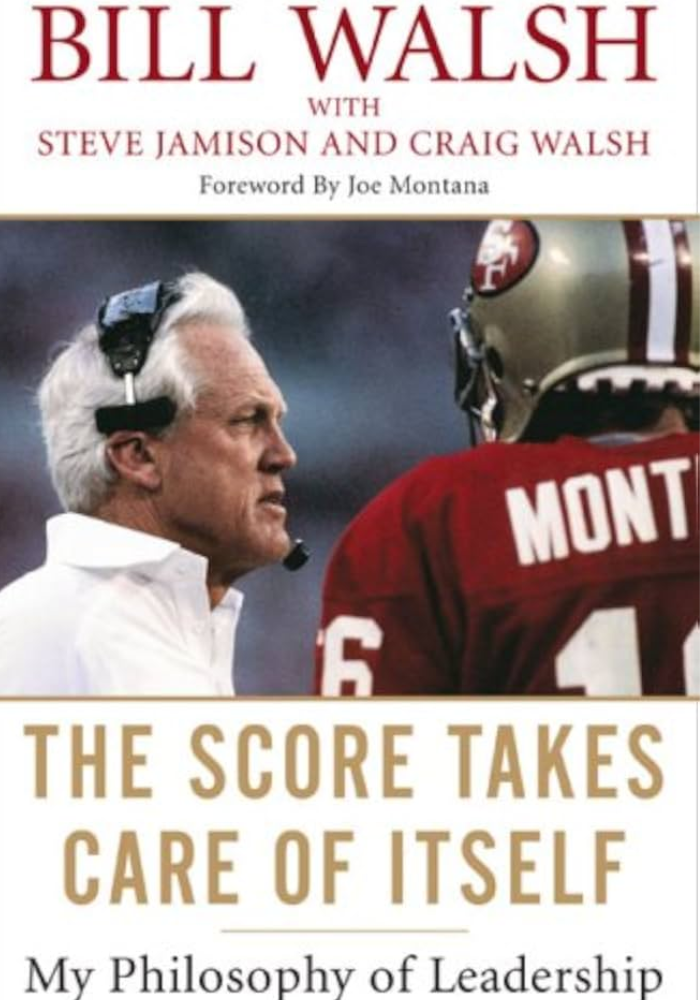
The Score
Takes Care of Itself
by Bill Walsh
- 245 pages
- September 21, 2026
- ⭐️ ⭐️ ⭐️ ⭐️
- 245 pages
- Completed on September 21, 2026
- 245 pages
- September 21, 2026
- ⭐️ ⭐️ ⭐️ ⭐️
Short Summary
Leadership is about demanding excellence out of yourself and those around you. In The Score Takes Care of Itself, legendary San Francisco 49ers head coach Bill Walsh discusses his approach to leadership and how it helped him build one of the greatest dynasties in NFL history.
My Takeaways
1️⃣ Be Process-Driven vs. Outcome-Driven: When You Work Hard Every Day, You Can Live With the Results
It’s human nature to fixate on end results. We all want to win the game, earn the promotion, secure the big business deal, and so on. But getting the results you want will never happen without a bullet-proof daily process.
That’s why you need to be process-driven, not outcome-driven. When you establish the right daily habits and have the discipline to execute those habits every day, you can live with the results — good or bad. Or, as Bill Walsh writes in this book, “the score takes care of itself.” Walsh served as head coach of the San Francisco 49ers from 1979-1988, winning three Super Bowls during that span. Although he’s remembered for building the 49er dynasty and revolutionizing football by developing the West Coast Offense, people forget that he inherited one of the worst franchises in the NFL in 1979. San Francisco was coming off a 2-14 season, yet Walsh led the 49ers to a Super Bowl title in just his third year.
Walsh accomplished this by implementing what he called his Standard of Performance, a sort of code of conduct that focused on daily improvement and demanded excellence from every member of the organization — including non-players. He didn’t care about wins and losses; he strictly wanted everyone in the organization to focus on improving every single day. He wanted his players and coaches to strive for perfection in everything they did. He believed that the team would eventually accomplish all of its goals if every individual committed to daily excellence and carried themselves the right way. His system clearly worked. Walsh writes: “I directed our focus less to the prize of victory than to the process of improving — obsessing, perhaps, about the quality of our execution and the content of our thinking; that is, our actions and attitude. I knew if I did that, winning would take care of itself.”
There’s a lesson to be learned from Walsh and the 49ers. When you set the right daily habits, remain extremely disciplined to those habits, pay attention to the details, go the extra mile, outwork everyone around you, be accountable and never blame others, aim for lifelong learning, have a positive attitude, operate with high focus at all times, strive to get 1% better every day, aim for perfection and learn to hate mistakes, hold yourself to a high standard in all areas, sacrifice, strive to be “first class” in everything you do, push your comfort zone, operate with a sense of urgency, and treat everybody with respect and kindness, the results will take care of themselves in all areas of your life. Better yet, carrying yourself in this manner every day will allow you to come out on top more times than not.
That’s because most people are not doing these things. As Michael Jordan said, “Winning has a price.” Most people are not willing to pay the price and do what it takes to succeed and achieve their goals. By committing to a daily process that involves learning, working hard, pushing yourself, improving, and getting as much done as possible, you will put yourself in position to have great outcomes in everything you do. Most importantly, you can look yourself in the mirror at the end of the day and know that you gave a maximum effort. When that’s the case, you can live with the results — good or bad.
This mindset also applies to performance. Whether it’s giving a speech, leading a meeting, interviewing for a job, making a basketball shot in front of a crowd, or anything else — our anxiety and fear come from fixating on the end result. We want a great outcome badly, and it causes a lot of tension. But the best performers are loose and care-free. The best way to approach any kind of performance-related task: prepare, prepare, prepare — then, when it comes time to perform, don’t care one bit. Do everything you can to get ready for the moment in the weeks and months prior, then let your training and preparation take over. As you go into the performance, do not care one bit about the result. Have fun with it. Trust your preparation and let the results be what they may.
2️⃣ Before You Can Lead a Team, You Need to Develop the Right Personal Qualities
You can’t effectively lead a team if you don’t have a good handle on yourself.
Great leaders are obsessed with improvement, and they take that mentality to their team. It’s crucial that you constantly strive to learn more about your field and enhance your skills. People simply don’t respect a leader who doesn’t know what they’re doing or talking about, and they can sniff it out from a mile away. It has to be clear to those you’re leading that you know your stuff cold. People can tell when you don’t know what you’re doing or talking about. And when they sense it, they won’t follow. As a result, you must constantly look to learn and develop your skills. As Bill Walsh writes: “The greater your expertise, the greater your potential to teach, the stronger and more productive you can be as a leader. Without it, you are disabled and will garner less and less respect from your team because they will sense that you’re not on top of things, let alone able to teach them something meaningful.”
In addition to trying to get 1% better every day, here are a few more tips for developing into a leader:
- Control What You Can Control — Outside of your attitude and effort, there’s not a lot you have control over. Control the things you can control, and don’t stress about the rest. Worrying about things you have no control over drains your energy and is a waste of time.
- Have a ‘Next Play’ Mentality — When you fail or something doesn’t go the way you wanted, move forward immediately. On to the next play. Never dwell on something; pouting accomplishes absolutely nothing and prevents you from moving on.
- Be Yourself — Be your authentic self. Don’t try to be somebody that you’re not. Lean into your strengths and personality, whatever they may look like.
- Be Committed to Excellence — At all times, in all ways, your focus must be on doing things at the highest possible level. Aim for excellence in everything.
- Be Positive — Maintain a positive environment and vibe. Nobody wants to be around a person, or a team, that’s constantly negative.
- Be Prepared — You can’t control outcomes and results, but you can always control how you prepare. Always be extremely prepared.
- Be Detail-Oriented — Do the ordinary, extraordinarily well, every day. Most people do not pay attention to details. You don’t need to be a genius to be successful — doing the small, ordinary stuff at a really high level will set you apart. Master the details. Master the ordinary.
- Be Organized — Great organization is the trademark of a great organization. Be organized in everything you do. This goes back to mastering the details.
- Be Accountable — Never make excuses, never blame, and never complain. Hold yourself accountable when you mess up. Be accountable to others. Be someone others can trust and rely on.
- Be Near-Sighted and Far-Sighted — All decisions should be made with both the short and long-term in mind
- Be Fair — Treat people well. Be clear in your mind as to what you stand for, then stand up for it.
- Be Firm — Hold people accountable to your expectations. When they aren’t performing or are cutting corners, hold them accountable.
- Believe in Yourself — To a large degree, a leader has to “sell himself” to the team. You have to sell yourself and your vision in order to get buy-in. This is impossible without self-confidence. Have belief and confidence in yourself, your skills, and your vision. People can sense a lack of confidence, and it will negatively impact your ability to lead them.
- Be a Leader — As a leader, you need to know where you’re going and how you plan to get there. You have to be passionate about teaching others how to execute their job at the highest level. You have to care about people and help them care about each other and the team’s goals.
- Have a Sense of Urgency — Have a sense of urgency in all that you do, and instill this in your team. The work environment should not be laid-back and “fun” all the time. There’s a time and place for that, but you should always be operating with a sense of urgency. Set tough deadlines and try to meet them.
- Control What You Can Control — Outside of your attitude and effort, there’s not a lot you have control over. Control the things you can control, and don’t stress about the rest. Worrying about things you have no control over drains your energy and is a waste of time.
Finally, you need to have a healthy ego to be an effective leader. That’s right. Having an ego means you have confidence and belief in yourself. Egotism, on the other hand, is when your ego gets out of hand — you don’t want that. The truth is, you need to have confidence to be an effective leader. It’s absolutely crucial, because people will not respect you if they sense that you lack confidence and conviction. An ego is simply a deep belief in yourself that you can get the job done. You earn that confidence by pouring it on and working hard every single day. As Bill Walsh writes: “Here’s what a big ego is: pride, self-confidence, self-esteem, self-assurance. Ego is a powerful and productive engine. In fact, without a healthy ego, you’ve got a big problem.”
3️⃣ Hold Your Team to a High Standard, Then Lead With a Collaborative Style
As a leader, you set the tone for your team. It’s important that you’re clear right from the jump that you expect high performance and you won’t settle for anything less. Be as clear and direct about this as possible.
That’s exactly what Bill Walsh did when he took over the San Francisco 49ers in 1979. The franchise was floundering at the time of his arrival. He immediately came in and established what he called his Standard of Performance. Walsh demanded excellence from everybody in the organization, and that mindset helped lay the foundation for everything else. Players and coaches who didn’t want to commit to excellence were removed from the team. He wanted total and complete buy-in, and those who weren’t willing to meet those expectations were booted.
One of the keys to leading a strong team is setting crystal clear expectations about performance and establishing the overall “philosophy” of your team. You must be clear that going through the motions and poor performance will not be tolerated, then hold people accountable when they don’t meet expectations. The clearer you are about this, the easier it is to hold people accountable. As Bill Walsh writes: “Employees can thrive in an environment where they know exactly what is expected of them – even when those expectations are very high. When it comes to telling people what you expect from them, don’t be subtle, don’t be coy, don’t be vague.”
Once you’ve established the right philosophy and expectations for your team, here are a few tips for leading:
- Get the Right People On the Bus — Your people are everything. More so than qualifications on a resume, look for the right mindset. Does the person work hard and consistently push themselves to improve and learn every day? Is the person highly disciplined? Does she seem to show accountability? Is he a good teammate? Does this person consistently go the extra mile? Is this person self-motivated, both at work and outside of work? When you find somebody who has the right personal philosophy and mental makeup, hire them on the spot and invest time into helping them reach their full potential.
- Encourage Collaboration — You want people to feel like they have a voice and can contribute to the team. Encourage opinions and collaboration. Be open to change. The last thing you want is a culture where people feel they don’t have a voice and that their opinions aren’t taken seriously. That said, at the end of the day you as the leader are paid to make final decisions.
- Set a Vision — Set a big overall goal that the team is always striving for. That’s your vision. Significant time and resources will be spent pursuing your vision, so make sure it’s a good one.
- Hold People Accountable — When somebody is consistently cutting corners, going through the motions, and not performing at the standard you expect, you have to do something about it. As a manager, you can’t be friends with people on your team. Yes, it’s important to develop relationships, but you need to remain distant enough that you can hold somebody accountable if needed. When you don’t, high performers will lose respect for you, they’ll begin to resent you, and they will leave.
- Address Issues Right Away — When you have an issue with someone on your team — or you sense that they have a problem with you — address it right away with good, honest conversation. Toxic animosity builds when you don’t address problems with strong communication. Be direct with people and don’t beat around the bush (scene from Moneyball). Lag time is a killer in any relationship.
- Bring Passion and Enthusiasm — To be a great leader, you have to have a passion for teaching and helping others achieve their full potential. This is non-negotiable. You must love to teach. You also MUST bring energy. Your team feeds off of you. Bring enthusiasm and positive energy to every meeting and interaction. Enthusiasm and passion are infectious. Bill Walsh writes: “I came to understand over my years as an assistant coach that when the audience is bored, it’s not their fault. And when they’re plugged in and excited, it’s because of you, the person in charge.”
- Treat People Well — Aim to be “first class” in how you treat people and take care of them. Show your appreciation.
- Build Around Proven Talent — When you identify someone who is talented, works hard, performs at a really high level, is organized, pays attention to detail, and is disciplined and committed, make sure you invest in and build around that person. Prioritize individuals who are proven in these areas. These are the people you want to build around.
- It Takes Everyone — It’s true that your most talented people will drive where your team goes, but the “bottom 20%” are equally important. Your goal as a leader is to get the most out of everyone on your team, and that includes the folks who aren’t top performers. Try to build these people up and help them understand what an important role they play on the team. They need to take pride in their roles.
- Hard On Yourself, Lenient With Others — If you’re in a position of leadership, it’s likely because you’re a high performer who pushes hard all the time. You live in this world and in this mindset, but the reality is that most other people don’t. You have to remember this and strike the right balance between pushing your team really hard — as you push yourself — and allowing some slack in the line so your team doesn’t get burnt out. You have to know when to push people and when to let off the gas. You need to know what projects need maximum focus and effort from your team, and which do not. It’s a fine line that you must balance.
- Walk Around — Building a team requires building connections with your people. You can’t do that sitting in your office all day with the door closed. A way to encourage connection and collaboration on your team is to walk around and talk to people. Ask them about their job, their life outside of work, and more. Show a genuine interest in them as people. All great organizations and teams have leaders who do this; it’s crucial for building the right culture. As Bill Walsh writes: “If you are uncomfortable walking around your team’s workplace, awkward and out of place, you are a disconnected leader – not really part of the team. Sitting in your office with the door closed and issuing edicts from on high is not communication, and it is certainly not collaborative leadership.”
- Outwork Everyone — You set the tone for the rest of the team. When they see you working hard, they’ll feel the need to step up their game to meet the example and expectations you’re setting. Bill Walsh writes: “I believe it is safe to say there is no single individual in the organization – player, assistant, coach, trainer, staff member, groundskeeper, or anyone else – who could accurately say he or she outworked me. . . I never asked anyone to do more than I was willing to do, nor what I wasn’t willing to do.”
Finally, as a leader it is crucial that you create chemistry and connection within your team. The best teams “play for each other” — in other words, every member of the team truly cares about the person beside them. All great organizations have this: An environment where people put the team ahead of their individual interests. The last thing you want is a team of “individuals.” Work hard to create a sense of family on your team — that’s how you generate the best performance across the board. One way to do this is group outings.