

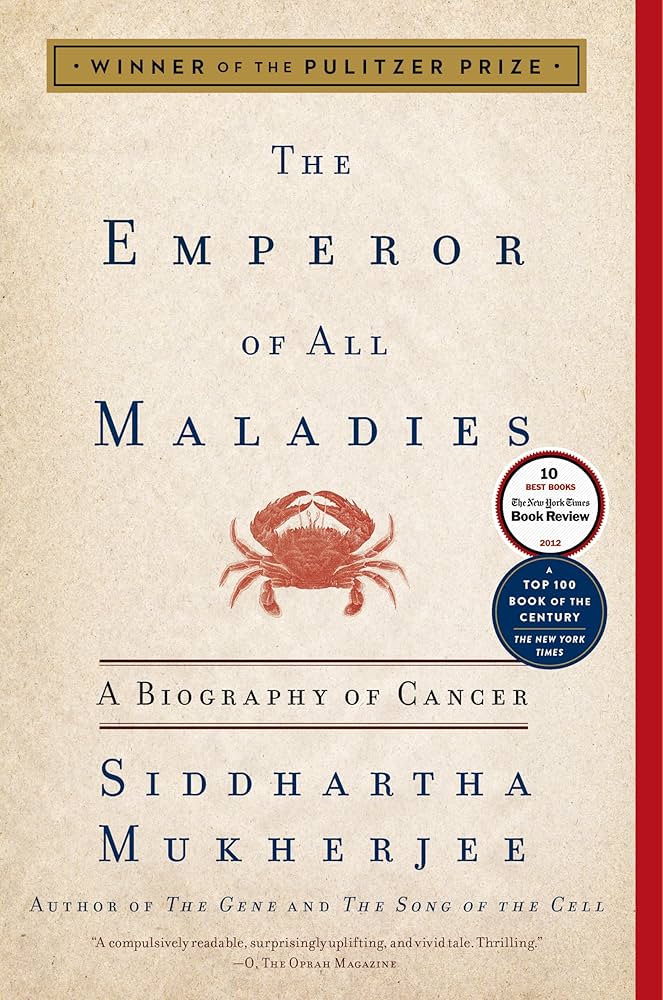
The Emperor of All Maladies
Siddhartha Mukherjee
 GENRE: Health & Wellness
 PAGES: 608
 COMPLETED: February 23, 2026
 RATING:
Short Summary
Once labeled “the king of terrors,” cancer has proven to be one of the most formidable enemies humans have ever encountered. In The Emperor of All Maladies, Siddhartha Mukherjee explores the science and history of this terrifying disease, highlighting cancer’s remarkable resemblance to our own cells and its frightening ability to grow, adapt, and spread uncontrollably.
My Takeaways
1️⃣ The Biology of Cancer: Gene Mutations Cause Cancer
A physician once referred to cancer as “the king of terrors,” and for good reason. A shape-shifting, elusive, and relentless disease, cancer is one of the most terrifying illnesses humans have ever encountered. But how does it form?
At its core, cancer is a disease of genetic mutations. It begins when a single cell incurs mutations in a few very important genes that specifically regulate cell division and growth. When these mutations take place, all hell breaks loose. The malignant cell divides, grows, and spreads uncontrollably until it has overcome its host.
To fully understand how cancer develops, though, it’s important to revisit some of the basics of cell biology. Located in the nucleus of every cell (except red blood cells), our DNA is made up of many things, including sections of genes. Like a Lego manual, our genes carry very specific directions to build proteins, which carry out so many functions in our cells and body. To actually build a protein, the following sequence generally takes place:
- Our DNA and genes are “copied” into a molecule called RNA
- The RNA copy takes the genetic instructions to one of the ribosome stations inside our cells
- Following the genetic instructions, the ribosome cranks out the correct chain of amino acids until a protein has been created
- The protein then carries out whatever functions were encoded by that particular gene
- So, essentially: DNA (genes) > RNA > Ribosome > Amino Acids > Protein
Unfortunately, our cells are not immortal or bulletproof: billions of them die every day after they’ve served us, and various environmental factors can damage our DNA. When DNA is copied during cell division to replenish dead cells, a copying error occasionally generates an accidental change in genes. Likewise, damage to our cells and DNA via things like radiation, the sun’s UV rays, and carcinogens like tobacco smoke, cause our genes to change. These alterations to our genes are called Mutations.
Now, there are certain genes specifically responsible for keeping our cell division and cell growth in check. When mutations to these key genes occur, a cancer cell is born. And all it takes is one single runaway cell to change a life. The small number of genes capable of causing cancer if mutated are called Oncogenes and Anti-Oncogenes (“Tumor Suppressor Genes”):
- Oncogenes — In normal cells, oncogenes accelerate cell division, but only when the cell receives an appropriate growth signal. But when mutated, these genes cause the cell to divide uncontrollably — like a “jammed accelerator” in a car. The “on” switch is permanently activated.
- Anti-Oncogenes — In normal cells, anti-oncogenes (also called “tumor suppressor genes”) provide the “brakes” and shut down cell division when the cell receives the appropriate signals. But when mutated, these genes are inactivated — the “stop” signal has been broken. The “off” switch has been permanently deactivated. Fortunately, it takes two independent mutations to the same anti-oncogene to fully deactivate it. That’s pretty rare.
When oncogenes are activated and anti-oncogenes are deactivated by mutations, it’s like a car speeding down the road with a jammed accelerator and no brakes to stop it. The result is uncontrollable cell growth and division. Eventually, the body is simply overwhelmed and overtaken. If there’s any good news here, it’s that there are roughly 20,000 genes in a typical cell, meaning it takes a series of rare, unfortunate, and independent mutations to a relatively small number of oncogenes and anti-oncogenes to turn a normal cell into a cancerous one. Barring some kind of event that causes major DNA damage and accelerates the timeline, the transition generally happens slowly over years and decades: one oncogene mutation here, another one there, and so on.
Once fully awakened, cancer cells fire molecular on/off switches, unlocking additional gene mutations and pathways that give them unusual powers. They become like crooked pirates overtaking a ship. These additional mutations grant them the ability to spread to other parts of the body where they shouldn’t be (metastasis), evade the immune system, become resistant to drugs and chemo, acquire networks of nutrients, blood flow, and oxygen, and ignore programmed signals that tell a normal cell to die (apoptosis). In other words, they almost become immortal and superhuman — and this is why cancer is so hard to treat.
Below is a summary of the “hallmarks of cancer” that differentiate cancer cells from normal cells:
- Rapid Growth — Cancer cells acquire an autonomous drive to proliferate uncontrollably, thanks to activation of key oncogenes
- Inability to Stop Growing — Cancer cells inactivate anti-oncogenes (tumor suppressor genes) that normally stop growth
- Immortality — Most cells serve us, then die. Cancer cells suppress and inactivate genes and pathways that normally enable cells to die. They’re immortal.
- Limitless Division — Cancer cells activate specific gene pathways that allow them to divide forever, even after generations of growth
- Own Channels of Blood and Oxygen — Cancer cells acquire capacity to draw out their own supply of blood and blood vessels
- Metastasis — Cancer cells acquire the capacity to migrate to other organs, invade other tissues, and spread across the body
- Evasion of Immune System — Cancer cells can acquire the ability to remain undetected by the immune system, allowing them to avoid detection and execution
- Penchant for Glucose — Most of our cells burn glucose for energy, but cancer cells gorge on it. This voracious appetite for glucose, called the Warburg effect, fuels their rapid growth. Some early research has shown that fasting or limiting glucose in the diet helps slow the rate of growth of some cancers.
One of the most frightening realities of cancer is that it’s literally “loaded” into our genome, just awaiting activation. All of us possess these subsets of oncogenes and anti-oncogenes that, if activated via mutations, would transform a normal cell into a cancerous one. And all it takes is one. The older we get, the greater chance we experience these mutations via repeated cell division over time, as well as DNA damage from environmental factors and carcinogens. There’s a reason cancer risk and age are so closely linked.
2️⃣ Age, Environment, Carcinogens, and Family Genetics Increase Cancer Risk
At its core, cancer is a disease of genetic mutations. Alterations to key oncogenes and anti-oncogenes cause a normal cell to transform into a malignant cancer cell capable of nearly unstoppable growth and replication. The cancer becomes “a body within a body.” This malignant body fights our own cells for critical resources — in short, a war breaks out.
But how does one “get” cancer? Unlike bacteria and viruses, cancer cells are not foreign invaders in our body. These cells are distorted, genetically altered versions of ourselves. As a result, one doesn’t “catch” cancer as one catches the flu. Every mutation in a key oncogene or anti-oncogene brings a cell closer to its cancerous self. The key, then, is DNA. Old age, environmental factors and carcinogens that cause damage to our DNA, and our family genetics each have a major impact on our risk of getting cancer.
Let’s begin with age. Because these independent gene mutations accumulate gradually over time, cancer is closely linked with age and is far more common in older adults than in younger people. The reason for this is that the cells in older people have undergone many more cycles of natural division, increasing the likelihood of occasional gene copying errors and mutations in oncogenes and anti-oncogenes. They’ve also had more exposure to environmental and lifestyle-related factors that can damage DNA, including radiation, ultraviolet (UV) rays from the sun, and a wide range of carcinogens encountered in everyday life (e.g. tobacco smoke and air pollution). To see this age-cancer link in action, consider that, in the early 1900s, tuberculosis was by far the leading cause of death in America, with cancer lagging fairly far behind. But improvements in sanitation, hygiene, water quality, and medicine throughout the 1900s helped extend our lifespans by more than 20 years. As our lifespans extended, cancer charged up the list: by the 1940s, cancer clocked in at No. 2 on the list behind heart disease, mostly because the proportion of people older than age 60 — the age when most cancers begin to strike — nearly doubled.
Anything that damages DNA accelerates the risk and rate of genetic mutations in our cells, and this is where environmental factors play a big role. Radiation, chemicals, and UV rays from the sun (e.g. skin cancer) can damage our DNA and cause mutations in our genes. As mentioned, older folks — in addition to having more time to experience cycles of natural cell division — have had more exposure to things in our environment that could damage their DNA.
Carcinogens also accelerate our risk of getting cancer. Carcinogens are substances, chemicals, and mixtures that have been shown to cause genetic mutations in our DNA. Tobacco is one of the first that comes to mind. Alcohol is another. Asbestos is yet another. But chemicals and substances are not the only carcinogens. For example, chronic inflammation in the liver caused by the Hepatitis B virus can also cause cancer. The reason? Inflammation causes cycles of injury, death, and repair in our cells. This is part of the reason why obese people tend to get cancer at a higher rate — their body is riddled with inflammation. What’s scary about cancer caused by Hepatitis B is that, because it’s a virus, it can be transmitted to other people via blood, sex, and needles.
Similarly, pollution is another carcinogen that has been proven to cause cancer due to the inflammation it creates in our body. The quality of our air has degraded over time as big chemical and industrial plants pollute the air with their toxic waste. It’s an especially prevalent issue in major cities around the world. Recent research has found that when we breathe in these toxic chemicals, they can “awaken” cancer cells that have already mutated and are lying dormant in our body. The toxic air, then, isn’t necessarily causing genetic mutations; rather, it’s inciting so much irritation and inflammation that it activates these sleeping cancer cells. In a sense, pollution acts as a “promoter” of cancer. This explains why an increasing number of people who have never smoked a cigarette in their life are getting lung cancer. Similar research indicates that “forever chemicals” — commonly known as PFAs — found in a wide variety of products like diapers, food wrapping, water bottles, cookware, and firefighting equipment, might also be “promoter” carcinogens. More on “forever chemicals” in my Count Down book notes.
Finally, one’s family history with cancer matters. Because cancer is a disease of genetic mutations, people with a family history of certain cancers may be genetically predisposed to mutations in key oncogenes and anti-oncogenes associated with that particular cancer. Women with a family history of breast cancer are an example — the genes BRCA-1 and BRCA-2 are anti-oncogenes of breast cancer. Genes are inherited, so parents who have experienced cancer may pass on the same genes, which could potentially mutate at some point in their child’s life.
3️⃣ No Two Cancers Are Alike
Cancer is not a single disease but many diseases. There are lots of forms it can take — breast, lung, skin, blood, bone, and more — but they are all called “cancer” because they share a fundamental trait: the uncontrolled growth and spread of abnormal cells. Looking only at their physical nature, cancers are often grouped into two categories:
- Solid Tumors — Cancers that form masses in organs or tissues (such as breast, lung, prostate, colon)
- Blood Cancers — Cancers of the blood, bone marrow, or lymphatic system (such as leukemia and lymphoma)
Even within a single category of cancer, there are dozens of subtypes, each with distinct biological behavior. One of the reasons cancer is so difficult to treat is that even when two patients have the same type of cancer (e.g. breast cancer), the actual genetic mutations driving each tumor can differ dramatically. One tumor might have 100 mutations; the other might have 38. These differences in mutations cause cancers to behave differently and respond somewhat unpredictably to treatment — which is why modern medicine increasingly focuses on personalized therapies specifically tailored to the genetic makeup of each patient’s tumor.
That said, below are some of the general forms of cancer we see:
Leukemia is a cancer of the blood. It’s cancer in one of its most explosive forms, usually characterized by an abundance of large, malignant white blood cells in the bone marrow, where nearly all blood cells are made. As the number of white blood cells skyrockets, red blood cell counts drop sharply — meaning a patient’s blood is often not able to carry its full supply of oxygen to the cells of their body. They become anemic. This usually leads to headaches, fatigue, and other related symptoms as the body experiences difficulty getting enough oxygen. The patient also bruises easily because platelet counts in the blood drop as a result of the huge proliferation of white blood cells.
Lymphomas are cancers of the lymphatic system, which is a network of lymph nodes and vessels that help us fight off infections. They typically appear as solid tumors in your lymph nodes. One major type, Hodgkin Lymphoma, has historically been among the most curable forms of cancer because it tends to spread in a predictable, orderly pattern from one lymph node region to the next, making it highly responsive to combination chemotherapy and radiation.
Breast Cancer forms in breast tissue, most commonly in the milk ducts. It is one of the most common cancers worldwide. Some breast cancers are driven by hormones such as estrogen, which is why hormone-blocking therapies can be effective treatments.
Prostate Cancer represents a full third of all cancer incidents in men, six times that of leukemia and lymphoma. In the 1920s, scientists discovered through experiments with dogs that prostate cells are highly dependent on the hormone testosterone for their growth and survival. When testosterone was deliberately removed from dogs bearing cancer tumors, their tumors dwindled away. Prostate cancer cells, it turns out, are addicted to testosterone — and, as the author writes, “the withdrawal of testosterone acts like the most powerful therapeutic drug conceivable.” This is why hormone therapy is one of the go-to treatments for prostate cancer. Treatment usually involves reducing testosterone levels or blocking its effects. This process was once called “chemical castration” and strips most men of their physical abilities. Papa Bud is an example.
Colon Cancer develops in the large intestine. Most cases begin as small, noncancerous growths called polyps that gradually accumulate genetic mutations over many years and can become malignant. Because this progression is usually slow, screening methods like colonoscopies can detect and remove precancerous polyps before they turn into cancer, making colon cancer one of the most preventable forms of the disease.
Skin Cancer, including melanoma, arises from cells in the skin and is strongly linked to ultraviolet radiation exposure from the sun. Melanoma is particularly dangerous because of its ability to spread rapidly if not caught early.
4️⃣ Traditional Cancer Treatment Options
We have thrown the kitchen sink at cancer. Treating this disease usually involves a combination of approaches, depending on the type of cancer and how aggressive it is. A mixture of treatment approaches is usually required because cancer has shown itself to be incredibly resistant to drugs. When a drug attacks cancer, the cells create mutated versions of themselves that can resist the attack. The fittest cancer cell survives, and that survivor then continues replicating uncontrollably. It’s an endless cycle of struggle.
It’s not an exhaustive list, but below is a summary of the major treatment options at our disposal:
- Surgery — In the late 1800s, two technological breakthroughs — antisepsis and anesthesia — led to the rise of surgery as a top option for addressing cancer. Surgeons began attacking cancer by opening the body and removing tumors. Today, surgery remains a cornerstone for localized tumors, often combined with radiation or chemotherapy to address cancer that surgery alone cannot remove. Back in late 1800s and early 1900s, however, we didn’t understand the biology of cancer. Some surgeons, not realizing that cancer can spread to any part of the body, disfigured patients in an effort to fully eradicate the disease. One surgeon removed three ribs, a shoulder, and a collarbone from the body of a woman with breast cancer. Yikes.
- Radiation — Alongside surgery, another mainstay in the treatment of localized cancers is radiation. In the late 1800s, scientists discovered a penetrating form of light that they called X-rays. They later found that certain natural, radioactive materials like uranium and radium emitted invisible rays capable of carrying radiant energy through and into human tissues. These elements damage DNA and cause mutations in our genes, which is why they can cause cancer and we need to avoid them. Unfortunately, some of the pioneers in this field learned the lesson the hard way: a few of them experienced physical deformities while experimenting with these radioactive elements, and many eventually died of cancer. When harnessed, though, they discovered that radium could be deposited directly into tumors to help kill cancer.
- Chemotherapy — Once a cancer has spread, we have to dig deeper into our bag. This is typically where chemo comes into play. Put simply, chemotherapy involves using a variety of drugs (poisons, really) to kill cancer cells. It’s chemical warfare on cancer. The problem is that these drugs are not discriminate — they kill both cancer cells and our normal, healthy cells. It’s like a grenade going off in the body. This explosion of cells is why many cancer patients experience grueling symptoms, including extreme nausea, agonizing pain, lack of energy, loss of hair, and many others. Immune cells are also caught in the wreckage, which is why cancer patients are highly susceptible to ordinary bacterial and viral infections. Everything they come into contact with — from the inside of their room to the food they eat — has to be sterilized. Ironically, one of the first chemo drugs ever invented was inspired by war. In World War I, a variety of chemicals were combined to form mustard gas. One night in 1917, mustard gas was lobbed at British soldiers, killing or injuring 2,000 of them. It went on to kill thousands of troops during the war. Studying some of the survivors of mustard gas, scientists discovered that it was effective at killing cancer cells in the bone marrow. The gas was later harnessed and used to treat cancer — today, it is known as “nitrogen mustard” and is used to treat many kinds of cancer.
- Combination Chemo — Most chemotherapy regimens involve a combination of poisons, primarily because many cancers become resistant when attacked with just a single drug. Some of these combination chemo treatment plans are hellacious, characterized by intimidating acronym names like VAMP, MOPP, and STAMP. One of the reasons combination chemo is so aggressive is that it’s trying to treat cancer that has spread to other areas of the body. During chemotherapy research in the 1960s, scientists learned that it’s very difficult to treat cancer that has spread to the brain. The brain and spinal cord are protected by the “blood–brain barrier” — a tight cellular shield that prevents foreign substances, including most drugs, from entering the brain. Because of this barrier and the brain’s sensitive structure, cancers that metastasize to the brain can be difficult to treat with chemo. That said, combination chemo is one of our best weapons and has been highly effective in curing cancers like Hodgkin Lymphoma and acute leukemia.
- Hormone Therapy — Scientists in the early-to-mid 1900s discovered that hormones play a critical role in the growth and survival of some cancers, notably prostate cancer in men and breast cancer in women. To address prostate cancer, hormone therapy strips men of their testosterone typically by blocking it or disrupting its effects. Their physical abilities take a big hit, but the therapy keeps the cancer at bay. Papa Bud is an example.
- Bone Marrow Transplant — The bone marrow is where blood is made. Red blood cells, white blood cells, platelets — they are all created here. Because blood cells are constantly dying after being pumped around the body — 300 billion blood cells are replenished every day — the bone marrow is an extremely busy cellular factory in a healthy body. But in patients with leukemia, the bone marrow is in overdrive, pumping out an unbelievable amount of white blood cells until it eventually becomes diseased and dysfunctional. The bone marrow in leukemia patients also takes a ton of damage from chemo treatment. One of the many ways this type of cancer is addressed, then, is through a bone marrow transplant. These transplants can also be helpful for patients enduring endless rounds of chemo for other forms of cancer. The explosive damage brought on by chemo tends to dramatically reduce blood cell counts, causing the bone marrow to break down. Transplantation can give the patient a boost.
In some cases, every single one of these therapies will be used in an effort to stop a patient’s cancer. Because every cancer is different, it’s critical to intimately know the profile and genetic makeup of the cancer the patient is fighting. That information guides the treatment plan.
5️⃣ Modern Treatments Like Immunotherapy Offer Promise
The methods we developed to treat cancer prior to the 1980s were largely born from urgent attempts to provide some kind of answer to cancer. We really didn’t understand the biology of cancer in those days; we just understood that we had a massive problem on our hands and we needed to do something to help. The result was procedures like surgery, radiation, and chemotherapy — treatments that certainly do kill cancer cells but don’t always address the deeper biological drivers of cancer.
Things have changed a bit since then. We began to gain a better understanding of how cancer cells work in the 80s and 90s, and that knowledge has led to a trove of novel treatments. Although surgery, radiation, and chemo remain staples of our cancer treatment toolbox, new procedures like immunotherapy have offered hope because they disrupt the core biological processes that help cancer thrive.
Unlike bacteria and viruses, cancer cells don’t display foreign-looking antigens or proteins on their surface, allowing them to go undetected by the soldiers of our immune system. As mentioned in the first takeaway, cancer cells arise from mutations in our normal cells. As a result, the antigens and proteins they display are so genetically similar to our normal cells that it’s difficult for our immune system to locate the threat and mount an attack. This is one of the major challenges cancer presents. One of the ways scientists have tried to counter this feature of cancer is to weaponize our immune cells. Immunotherapy is essentially the process of genetically modifying our immune cells to wipe out cancer cells.
In the 1990s, scientists discovered several molecules on T cells that act as “brakes” on their behavior and prevent them from attacking our normal cells. These molecules and proteins were later called “immune checkpoints” because they act as “checks” on immune activation. For example, the protein CTLA-4 calms T cells, telling them to relax. Another called PD-1 tells T cells to hold their fire when they meet a “friendly” cell. These signals help prevent autoimmune conditions where the immune system mistakes normal cells as threats and attacks them. But cancer cells find ways to express proteins that exploit these checkpoint signals and render them “invisible” to the soldiers of the immune system.
Scientists began to play around with these immune checkpoints and discovered ways to modify and remove the brakes on T cells, essentially making cancer cells visible. A storm of new “checkpoint inhibitor” drugs emerged from these discoveries. Many of these medicines have been highly successful in treating some cancers, notably melanoma and bladder cancer. But the field is still very much in its infancy, and there’s a lot of mystery around why some patients respond well to the treatments while others do not. Cancer cells have shown that they can create mutations that help them reactivate their “cloaks” and become invisible to the immune system again. In other words, they’ve found ways to resist these checkpoint inhibitor treatments.
These checkpoint therapies represent just one lever in the rapidly growing discipline of immunotherapy. Another promising immunotherapy treatment involves drawing blood from a patient’s body, genetically altering the patient’s T cells to recognize and attack the specific cancer in their body, then infusing the modified cells back into the patient’s body. Although cancer cells don’t display clearly foreign antigens like bacteria and viruses, they do have molecular targets on their surface that T cells can bind to if instructed to do so via gene therapy. In the early 2000s, scientists pinpointed a molecule called CD19 that lives on the surface of certain cancers of white blood cells, including many types of lymphomas and leukemias. They then began designing T cells to target CD19. These genetically modified T cells were named CAR-T cells.
In 2003, one of the first leukemia patients to undergo CAR-T immunotherapy treatment nearly died days after being transfused with her own altered T cells, but she pulled through and is still alive today. She was cured by this form of immunotherapy. Today, dozens of CAR-T protocols that target other forms of cancer are in clinical trials or have cleared FDA approval. The long-term effectiveness of CAR-Ts is still under investigation, but the early results have been highly promising. As usual with cancer, some patients respond well to this treatment, and some don’t. This goes back to the fact that every cancer is different — no two cancers have the same exact set of mutant genes.
CAR-T cells and checkpoint inhibitors represent new frontiers of modern cancer therapy. The long-term verdict is still out on immunotherapy, but the early results have been very optimistic.
6️⃣ Early Detection Is Critical, But Screening Isn't Perfect
Given that various treatment methods have turned in mixed results and we lack any kind of definitive cure, prevention and early detection are our best defenses against cancer. While everybody should screen for cancer early and often, there are some limitations that should be kept in mind.
Before getting into the limitations, there’s no doubt that preventative measures like the Pap Smear (named after its creator, George Papanicolaou), mammogram, colonoscopy, liquid biopsies, MRIs, CT scans, and others like these have saved many lives. It is critical to catch and remove cancer before it spreads throughout the body, and these scans and procedures can help do that. The author points out, however, that the success of screening tests in terms of a reduction in cancer mortality (the gold standard) has been less than stellar. There are a few reasons for this.
For one, even if a scan finds a tumor somewhere inside the body, it can’t tell you the mind of the cancer. In other words, the scan can’t tell you the tumor’s biology and genetic makeup (i.e. its mutations). The mutations and genetic programming of the cells dictate the cancer’s behavior, including its speed of growth and whether or not it has, or will, spread to other parts of the body. They also dictate the approach to treatment. Even if the tumor is small, it’s possible that the cancer has already metastasized, or will in the near future. As the author writes, “seeing a ‘small’ tumor and extracting it does not guarantee our freedom from cancer — a fact we still struggle to believe.” Conversely, large tumors may be genetically benign and harmless, unlikely to spread. The scan simply can’t tell you these things. Further investigation is needed.
Second, the rate of false positives and false negatives associated with some screening tests is alarmingly high. The technology simply isn’t perfect. Let’s say an MRI or CT scan does find the presence of a tumor inside the body. Not only are men and women who experience these results thrown into a spiral of anxiety and terror, they often, understandably, take immediate action in the form of expensive and invasive surgeries, radiation, and chemotherapy regimens in an effort to treat or acquire a biopsy of the cancer to determine its genetic makeup. Months later, it’s entirely possible that the biopsy could confirm that they’ve been chasing a mirage — a false positive. The patient suffered anxiety, endless hospital visits, costly medical procedures, and more. That’s better than doing nothing to follow up, but still not ideal. The consequences of a false negative are even worse; these patients often find out that their cancer was missed only after it’s too late.
False positives and false negatives are far more common than anyone would like to believe. As the author writes, “the rate of over-or-underdiagnosis is unacceptably high.” Here’s a sense of the magnitude of the problem (taken directly from the book): in 2021, according to one estimate, the U.S. spent roughly $43 billion on cancer screenings. On average, there were 9 million “positives” of which 8.8 million turned out to be false positives. This means we screened, retested, and biopsied 9 million to find 200,000 true positives (i.e. real cancers) of which an even smaller fraction, less than a third, was curable through localized treatments. To sum this up, for every one true positive, there were 43 false positives.
Third, because of these issues, screening benefits have been modest. One study showed that 1-in-500 colorectal cancers would be prevented if men and women underwent regular colorectal cancer screenings. Another study found that only 14% of cancers are detected through standard preventive screenings. For breast cancer and mammography, a recent analysis wrote: “Repeated screening starting at age 50 saves about 1.8 lives over 15 years for every 1,000 women screened . . . 2,970 women must be screened once to save one life.” Mammography has been shown to be even more ineffective in women under the age of 50, with false positives being fairly common.
None of this means we shouldn’t be proactive about prevention. Early detection remains one of our strongest tools, and for certain cancers — such as cervical and colorectal cancer — screening has dramatically reduced mortality. But screening reduces risk; it does not eliminate it. Understanding both its power and its limitations allows for more informed and realistic expectations.
7️⃣ A Little Skepticism Is OK: Corruption In the Tobacco Industry
In the mid-1900s, tobacco and cigarette companies engaged in some seriously shady behavior as mounting evidence began to show that smoking causes lung cancer. Their actions are a reminder that companies are out to make a profit, and many of them don’t truly care about the consumer.
Smoking was at its peak in the mid-1900s. Cigarettes — shipping containers for hits of tobacco and nicotine — were extremely popular and addictive. Movie stars, artists, and everyday people were smoking. But in the 1960s, landmark research began to overwhelmingly prove that tobacco was a carcinogen with direct causal ties to lung cancer.
This was not good news for tobacco and cigarette companies. To protect their businesses and bottom lines, these companies began to lie and conceal hard facts. Cigarette makers not only knew about the cancer risks of tobacco and the potent addictive properties of nicotine, but they also lied to the public about these properties in memos, ads, and announcements promoting their products. The industry conspired to conceal the risks of smoking from consumers, while simultaneously engaging in aggressive marketing strategies and lobbying politicians to prevent the development of effective anti-tobacco policies.
These companies even pushed for Congress to oversee the handling of cancer warnings on their products instead of the Federal Trade Commission (FTC). Why? Because the companies had enormously deep pockets and often used bribes and payoffs to control members of Congress. Fortunately, a landmark legal victory over tobacco companies in the 1970s allowed for anti-tobacco commercials and ads. This essentially ended their dominance; the last cigarette commercial aired in 1971. By 1994, the per capita consumption of cigarettes in America had dropped for 20 straight years.
Eventually, a few states sued several tobacco companies to recover billions of dollars from health-care costs incurred by the states from smoking-related illnesses. In 1998, 46 states signed the Master Settlement Agreement (MSA) with four of the largest cigarette manufacturers (since 1998, 46 other cigarette manufacturers have joined the agreement). The MSA represents one of the largest liability settlements ever reached and is the greatest public admission of collusion and guilt in the history of the tobacco industry. It also explains why cigarette prices are so expensive today — the companies involved in this agreement basically have a monopoly and can conspire on price points.
The takeaway here is that it’s okay to be skeptical of the world around you sometimes. The world is run by human beings, and human beings have biases, ambitions, and motivations that don’t always align with the best interests of the general population, especially when money is involved. Corruption — whether in the form of lying, cheating, or stealing — is nothing new. I often think of Big Food and Big Pharma. Investigations have identified a “symbiotic relationship” where large food corporations create processed, sugar-laden products with terrible ingredient profiles that inevitably lead to chronic illnesses like obesity and diabetes. At the same time, many executives and shareholders at these food companies sit on Food and Drug Administration (FDA) advisory committees and profit from pharmaceutical drugs that treat those resulting illnesses.
This tobacco company case study is just a reminder to do your own research and maintain a healthy level of skepticism.