
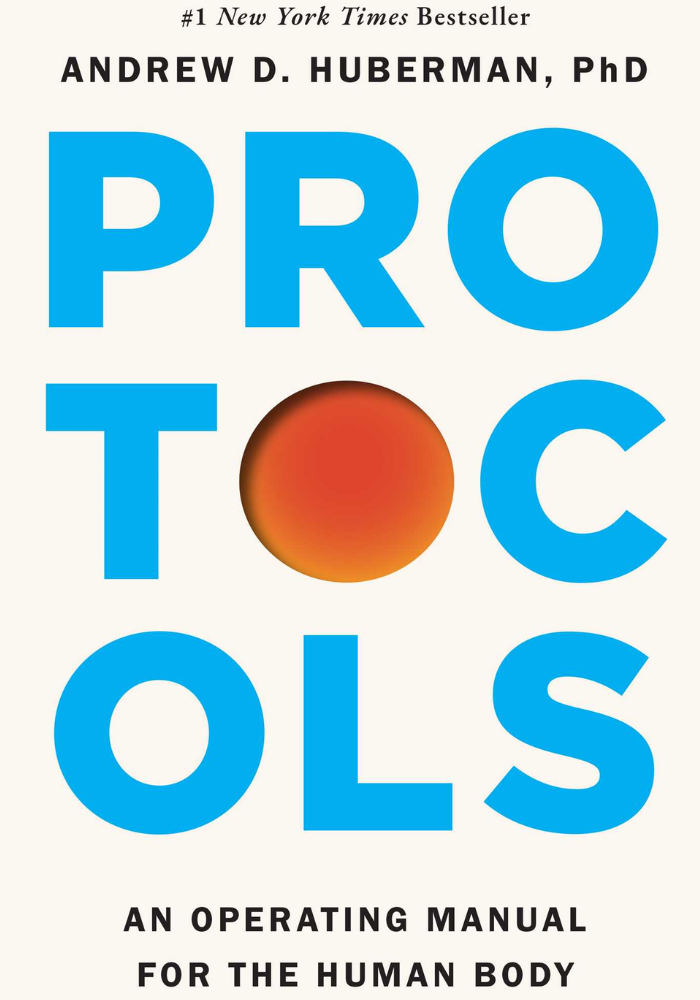
Protocols
by Andrew Huberman
- 573 pages
- October 19, 2026
- ⭐️ ⭐️ ⭐️ ⭐️ ⭐️
- 573 pages
- Completed on October 19, 2026
- 573 pages
- October 19, 2026
- ⭐️ ⭐️ ⭐️ ⭐️ ⭐️
Short Summary
The human brain and body are complex, but understanding how they work can help us feel and perform our best. In Protocols, Andrew Huberman offers a practical toolbox of science-backed strategies for improving sleep, exercise, stress management, focus, and more.
My Takeaways
1️⃣ Sleep Protocols: Circadian Rhythm and Sleep Pressure (Adenosine Buildup) Trigger Sleep
Sleep is the foundation of everything. It significantly impacts our mental, physical, and emotional health every day, and it has a major influence over how we feel. Sleep deprivation has been linked to basically every bad health outcome imaginable. If you want to live a long and healthy life, you must prioritize sleep. Aim to sleep well 90-95% of your nights.
When it comes down to it, there are really two main drivers of sleep: Circadian Rhythm and Sleep Pressure.
- Circadian Rhythm — Your internal 24-hour biological clock. Sunlight, exercise, hydration and caffeine, and a meal all act as cues to help establish your circadian rhythm in the morning.
- Sleep Pressure — The buildup of adenosine in the brain and body over the course of the day drives sleep pressure
The protocols below help you understand the science behind why these two drivers play such an important role in getting good sleep and how you can master them.
Sleep Protocol #1: View Sunlight as Soon as Possible After Waking, and Lower Your Cortisol at Night. The goal here is to look in the direction of the sun for at least 5-10 minutes each morning sometime within the first 30-60 mins of waking up. Viewing sunlight in the morning has a powerful effect on your mood, energy, focus, alertness, and your sleep — and it changes the state of your entire brain and body for many hours after.
This protocol works because it helps lock in your circadian rhythm in the morning. Located in the hypothalamus of the brain is the Suprachiasmatic Nucleus, or SCN. The SCN is your master circadian clock. Its job is to coordinate the activities of your cells and organs into a coherent 24-hour rhythm so some parts of your body are more active, and some parts are less active, depending on the time of day. Things like our body temperature, the release of certain hormones, and your sleep-wake cycle all follow a 24-hour circadian rhythm controlled by the SCN. The question is: how does your SCN consistently know when to kickstart the 24-hour rhythm of your cells, and when to wind them down? Well, there are a few ways we can tell our SCN to kickstart our circadian rhythm, but none are more important than viewing morning sunlight.
When we view sunlight — or simply daylight if it’s a cloudy day — in the first 30-60 minutes of waking, it goes through our eyes and into our SCN, which “wakes up” certain cells in our body while also triggering the release of various hormones like cortisol and the catecholamines — epinephrine (adrenaline), dopamine, and norepinephrine — that make us feel more focused, alert, and energized. The sunlight essentially synchronizes our brain and body. Any kind of sunlight is great, but viewing the sun when it’s low in the sky is best. That’s because the longer wavelengths of light (red, yellow, and orange) tend to have the biggest impact on our circadian rhythm. And these are the wavelengths that reach us early in the morning and late in the evening. White sunlight is full spectrum, meaning it’s comprised of all wavelengths of light: red-orange-yellow-green-blue-indigo-violet (ROYGBIV). It’s the scattering of light by molecules and things in the air that creates the colors we see in the sky. That’s why our sunrises and sunsets tend to be red and orange — sunlight has to travel further to reach our eye, meaning the molecules in the atmosphere scatter and redirect the shorter wavelengths, allowing the longer ones to get through. Another benefit of low-angle sunlight: many of its UV rays are also scattered, so you get lower UV ray exposure.
Morning sunlight viewing is the best way to increase our morning and daytime energy levels. It does this in three ways. First, it suppresses any residual melatonin in your brain. Melatonin is the primary hormone that promotes sleepiness. Second, viewing sunlight suppresses the action of adenosine, a chemical that builds up in your brain over the course of the day to make you increasingly tired. Third, it spikes your cortisol, which is what you want in the first 30-60 minutes of waking. This happens via the HPA Axis: the SCN in the hypothalamus commands the pituitary gland – a part of your brain that releases hormones into the bloodstream – and the adrenal glands – which reside on top of your kidneys – to release both cortisol and adrenaline. This dramatically increases your alertness and energy.
This cortisol surge is key. If you were to chart your cortisol levels on a graph, you would want to see a big, towering spike in the early morning because this induces a steady, gradual decline the rest of the day. Low cortisol in the evening and nighttime is essential for good sleep — it cannot happen without it. By using morning sunlight to spike your cortisol levels in the first 30-60 minutes of waking, you set yourself up for low cortisol levels when it matters most. You also sort of prevent huge spikes in cortisol later in the day. Thinking back to the graph, what you don’t want to see is a small bump in cortisol in the morning that sort of stays level throughout the day and night. You also don’t want to see the peak occur in the afternoon. One of the reasons ASMR is so effective for sleep is that it can dramatically lower your cortisol levels.
Sleep Protocol #2: Avoid Viewing Bright Lights and Screens in the Final Hour Before Bedtime. Limit your nighttime light exposure after sundown and consider buying a pair of blue and green light blocking glasses. Two essential keys to getting good sleep are to (i.) get your cortisol levels as low as possible and (ii.) elevate your melatonin as much as possible. Indoor lights, computers, phones, and TVs — all of which are illuminated by LED lights that primarily emit short blue and green wavelengths — destroy both of those quests by both increasing cortisol and reducing melatonin. They also simply stimulate your brain in a way that counters the calm that we need to fall asleep. Avoid these bright LED lights in the evening as much as possible.
Sleep Protocol #3: Be Consistent With Your Bedtime and Wake-Up Time. Aim for 6-8 hours of sleep and be consistent about your bedtime and wake-up time. Having a consistent sleep and wake time allows you to set your circadian rhythm consistently and complete the most amount of sleep cycles. There are two major types of sleep involved in a typical sleep cycle, and they are both important: REM Sleep (rapid eye movement) and Non-REM Sleep (slow-wave sleep).
- Non-REM Sleep — Consists of three phases that we enter one after the other: N1, N2, and N3. Deep, slow-wave sleep occurs in N3.
- N1 — This is light sleep that lasts 5-10 minutes. It’s easy to be woken up in the N1 stage. During this stage, your body begins to generate some ATP, the energy currency of cells. Proteins that are damaged during our waking hours also begin to repair themselves. Additionally, proteins that help build memories are created.
- N2 — A slightly deeper sleep that lasts about 20 minutes. Here, our body temperature drops, our heart rate slows, and sleep spindles are formed. These spindles are vital for learning.
- N3 — This is deep, slow-wave sleep. This stage is very restorative. Our heart rate slows way down, growth hormone is released from our pituitary gland into the bloodstream, and muscle and body tissue repair take place. For example, this is the stage of sleep responsible for rebuilding the muscles we tore down in the gym and repairing cuts to our skin. N3 is also when something called Glymphatic Washout of our brain occurs. This is essentially a nightly “cleaning” that removes waste products and cellular debris accumulated from all the BS you face in a day. It plays a big role in helping you feel restored in the morning.
- Non-REM Sleep — Consists of three phases that we enter one after the other: N1, N2, and N3. Deep, slow-wave sleep occurs in N3.
- REM Sleep — After the N1, N2, and N3 stages are complete, you move into REM Sleep. During REM Sleep, your brain becomes more active than it ever was during the day, and this is where dreaming takes place. In fact, your body actually “paralyzes” itself to prevent you from acting out your dreams. During this hyperactive sleep stage, your brain sorts through everything you learned and experienced from the day and keeps only the most meaningful experiences and information. As part of this process, it also unloads all of the emotional burdens from your daytime experiences. This is why, after a highly emotional day (anxious, sad, fearful, etc.), you will often wake up feeling much better from an emotional perspective. As you complete 90-minute sleep cycles through the night, you spend a larger percentage of time in REM Sleep during each cycle. This is why our most vivid dreams typically take place in the early morning hours, after a few cycles have been completed. One other note about REM Sleep — when we don’t sleep well for a night or two, we miss a lot of the REM Sleep that we would have otherwise gotten. This leads to “REM rebound,” where you will enter REM Sleep earlier in your sleep cycles, and experience more REM Sleep overall, as your body attempts to catch up.
Each stage of sleep acts as a gate to the next one. The more N1>N2>N3>REM sleep cycles we complete, the better we feel and perform the next day, which is why it’s so important to give yourself enough time in bed — preferably 6-8 hours. Relatedly, your bedtime and wake time play a crucial role in keeping your circadian rhythm dialed, as your SCN relies on consistency. Try to go to bed and wake up at the same time every day, plus or minus 30 minutes.
Sleep Protocol #4: Lower Your Core Body Temperature at Night. Your core body temperature must drop by 1-2 degrees in order to sleep well. It’s a prerequisite, partly because melatonin is released in sync with your nightly drop in body temperature. You can help make this happen by maintaining a cool sleep environment and by taking a hot shower or warm bath before bed. A hot shower works because heating your periphery acts as a trigger: When the surface of your body heats up, the hypothalamus — which controls your internal thermostat — thinks you are in a warm environment and responds by lowering your core body temperature to compensate. A side note on body temperature — this is another important feature of your circadian rhythm. During the early morning and early afternoon, it rises; in the evening and night, it falls. That’s why it’s perfectly normal to feel a little sleepy in the afternoon as your core body temperature starts to drop.
Sleep Protocol #5: Try to Avoid Naps. Sleep results from two processes: your circadian rhythm and sleep pressure from adenosine. The circadian rhythm has been covered. Regarding sleep pressure, the longer we are awake, the more adenosine mounts in our brain and body. Adenosine is the downstream product of burning ATP (Adenosine Triphosphate), which is the main energy currency of our cells. As our cells burn ATP throughout the day via mental and physical work, we accumulate more and more adenosine — and adenosine makes us tired. A good night of sleep clears adenosine completely. But if you don’t sleep well, you’ll begin the next day with more adenosine in your system than you would have had otherwise. After consecutive poor nights of sleep, the amount of adenosine, or sleep pressure, in your brain will be so overwhelming that it will almost force you to sleep. Adenosine comes into play when considering a nap. A 20-30-minute nap isn’t the worst thing in the world, but it will clear some of the adenosine building in your brain and body. For the most part, we actually want a lot of adenosine buildup by nighttime because it creates enough sleep pressure for us to fall asleep fairly easily. A nap can prevent us from building enough sleep pressure by bedtime.
Sleep Protocol #6: Use Non-Sleep Deep Rest (NSDR) to Offset Sleep Deficits. NSDR can be done in 10-30 minutes and has immediate and long-term benefits for your brain state while improving focus and learning. It can be done any time of day and is often used to manage stress or power through your day after a rough night of sleep. It isn’t a nap and it isn’t meditation. It’s a great way to simply reset any time of day. Following a guided tutorial, NSDR brings your body into a relaxed but active state by shifting your Autonomic Nervous System into a parasympathetic state using breathing techniques and focused attention. NSDR is based on a technique called yoga nidra. Of NSDR, Huberman writes: “Among all the protocols that I have shared on the Huberman Lab podcast, NSDR is in the top ten of those that people have told me have changed their lives.”
Sleep Protocol #7: Consider Supplements to Support Sleep. There is no pill that can ever replace poor sleep habits. However, it’s worth trying to find a supplement or two to aid you in your sleep routine. Magnesium L-Threonate is one worth looking into. Magnesium L-Threonate increases brain magnesium, which may improve learning and memory. A few studies have found that this supplement improves quality of sleep and also cognitive performance during the day. As for supplemental melatonin, there’s really not any clear evidence showing that it is effective for most people. Again, melatonin is a hormone our body produces at night to make us feel sleepy. Our natural melatonin works well on its own — there’s really no need to supplement.
Sleep Protocol #8: Adjust Your Caffeine Schedule. Try to avoid caffeine in the 8-10 hours before bed. Caffeine is a psychoactive stimulant with a very long half-life, meaning it lingers in your system for a while and can disrupt your sleep. Contrary to popular belief, caffeine doesn’t give you energy. It works by temporarily blocking adenosine from reaching its receptors in the brain. This makes us more alert and focused. When the caffeine begins to wear off, all of that built-up adenosine hits you at once, leading to the “caffeine crash” many people experience. If you drink caffeine too late in the day, it can make it harder to fall asleep. You also spend less time in the REM sleep stage. Because caffeine gives us greater capacity for focus and physical effort, it’s great to take early in the morning before a workout. Overall, it’s great to consume caffeine — just try to avoid having it in the afternoon or evenings. Additionally, make sure your last bite of food is at least 2-3 hours before your bedtime.
Sleep Protocol #9: Avoid Alcohol Within 8 Hours Before Sleep. Alcohol is interesting because it’s a sedative that makes it easier to fall asleep initially, but it also completely wrecks the overall quality of your sleep cycles by causing you to get significantly less N3 deep sleep and REM Sleep. It’s a REM Sleep suppressor. It also has many, many other downsides — try to avoid drinking it at all!
2️⃣ Exercise Protocols: A Combination of Resistance Training and Cardiovascular Training Produce Innumerable Health Benefits
The benefits that come with exercise are too many to count. If you could compress all the outstanding mental, physical, and emotional benefits of consistent exercise into a pill, people would be lining up around the block to get it. Exercise has such a profound impact on your health and your longevity.
When we talk about exercise, we’re primarily talking about both resistance and cardiovascular training. If you want to feel your best and increase your lifespan, you need to do both. With both of these forms of exercise, your training serves as a stimulus. Your body reacts to that stimulus by adapting — and that’s where the growth comes.
Like many people, I used to work out for the aesthetics. We all want to build a strong, fit body. But over time, I slowly began to realize that I felt so much better in every way on days that I exercised. Today, my primary motivation for working out isn’t to look good — it’s to feel good. On days that I exercise, I feel so much more focused, alert, and energized. It turns out this is the case because exercise increases the release of both serotonin and the catecholamines — dopamine, epinephrine (adrenaline) and norepinephrine — in the brain and body. I’m also happier and less irritable, thanks to the dopamine and endorphins released during exercise. My mood is better and I feel significantly less anxious, too. Even on days where I sleep horribly, I notice that I feel considerably better if I can drag myself to the gym.
What’s more, there’s even recent research that indicates exercise can directly facilitate neuroplasticity, meaning exercise improves our ability to learn. From a longevity perspective, exercise helps us retain muscle, bone density, and cognitive function as we get older — all of which are critical to maintain in our twilight years. By burning ATP, and therefore creating more adenosine, exercise also helps us build more sleep pressure and improves our quality of sleep at night. The list of benefits goes on and on. Put simply, movement is medicine and you’ll never regret exercising. As Huberman writes: “Exercise is extremely potent medicine and, as with sleep, it’s one of the best investments you can make towards your mental and physical health. The benefits start the minute you begin each workout.”
Below are a few protocols for exercise, with the primary focus on resistance and cardiovascular training. The plan Huberman recommends — and the one he has followed for 35 years — consists of three days of resistance training and three days of cardio. Here it is:
- Day 1: Cardiovascular Training, 45-75 Minutes, Low Intensity/Long Duration
- Day 2: Resistance Training, Legs (Calves, Quads, Hamstrings, Glutes)
- Day 3: Rest
- Day 4: Resistance Training, Torso (Chest, Back, Abs/Core)
- Day 5: Cardiovascular Training, 25-30 Minutes (Moderate Intensity/Moderate Duration)
- Day 6: Cardiovascular Training, 6-17 Minutes, High Intensity/Brief Duration
- Day 7: Resistance Training, Shoulders and Arms (Shoulders, Biceps, Triceps, Abs/Core)
Exercise Protocol #1: Walk 10,000 Steps Every Day. People underestimate the power of walking. Simply getting 10,000 steps per day (or more) is one of the best things you can do to protect yourself against illness and improve your overall health. Do not think of walking as simply an add-on to your fitness routine! It should be a staple of your regiment. The research on walking continues to be impressive. Studies have shown that walking 10,000 steps per day significantly reduces your all-cause mortality risk. Walking has been tied to reduced risks of depression, diabetes, heart disease, hypertension, cancer, cognitive impairment, death by pneumonia, mental health issues, and more.
One of the reasons walking is so beneficial is that it requires repeated muscle contractions. This activates an enzyme called AMPK that is involved in stimulating glucose uptake into muscle cells. Walking also helps us clear glucose from our bloodstream after a meal — the mitochondria in our cells immediately blend the glucose with oxygen to create ATP, which is then used as energy to power our walk. Our calf muscles in particular burn a lot of glucose when they contract; in fact, simply doing calf raises after a meal can help clear glucose from our bloodstream. An added benefit: Walking outside also produces certain eye movements that have been shown to suppress activity in our Amygdala, known as the “fear center” of the brain that is responsible for detecting threats. This helps explain why walking reduces stress and anxiety.
Exercise Protocol #2: Resistance Train Three Times Per Week, and Focus on Failure and Progressive Overload. There are a lot of different ways to lift weights, but here is what Huberman recommends:
- Frequency — Lift three times per week; ideally, workouts should be 60 minutes or less
- Sets — 2-3 (usually 2) working sets per exercise and 4-9 working sets per muscle group (i.e. back, shoulders, biceps, etc.). Spread the 4-9 sets per muscle group across 2-3 (usually 2) different exercises.
- Repetitions — Most ranges will work as long as you are training to failure, but 8-10 is a good target for most exercises. Mix in a few 4-6 rep ranges to train strength. For isolation work, use 10-12. It’s beneficial to use low rep ranges on some exercises because different rep ranges stimulate different muscle fibers.
- Rest Duration — 3-5 minutes
There are two nonnegotiables when it comes to resistance training: Progressive Overload and Failure. Progressive Overload is essential. You must track your numbers and strive to increase either the weight or the number of reps every week for every exercise. You won’t always be able to do this, but you have to try as hard as you can. If you consistently fail to surpass your previous numbers, consider reducing the number of working sets you’re doing. Yes, reduce the volume!
Training to failure ensures you apply the maximum amount of stress on the muscle. When you inflict maximum damage on the muscle, your body is forced to rebuild it and make it stronger. Train to failure — do not leave any reps in the tank. Those last few reps where it starts to burn are exactly what you’re in the gym for. Make sure you push hard in those moments. Get the most out of the muscle. From a technique perspective, focus on feeling the muscles you’re trying to train as you lift. Mind-muscle connection.
A few notes on recovery. Understand that your body gets stronger on the rest days in between sessions, and mostly during your sleep (N3 deep sleep). If you truly train to failure and strive for Progressive Overload, you don’t need a high volume of sets per exercise or muscle group. In fact, too many sets and too many sessions of resistance training in a week can hurt your progress. The key is high-quality sets where you train to failure and increase your reps and/or weight over time. It truly doesn’t take a lot of high-quality sets to trigger muscle growth. Train really hard, then get out of there and recover while you live your life. Aim for fewer sets with higher intensity. Because training taxes your entire nervous system, plan a de-load week once every 10 weeks or so. Either take the entire week off, or reduce all sets by one and use 60% of your typical weight. These rest/de-load weeks shouldn’t be ignored; they allow your body and nervous system to recover, and injuries are able to heal. They also provide a wonderful mental break. Overall, take recovery seriously.
An interesting fact about resistance training: the burning sensation you feel in your muscles toward the end of a set is primarily caused by the accumulation of hydrogen ions inside the muscle cells. This is brought on by the fact that the muscle cells are running out of oxygen to create the ATP needed to lift the weight. Again, the mitochondria in our cells burn glucose and oxygen to create ATP, which is the energy currency of cells. At the end of our set, we aren’t able to get enough oxygen into our cells. We eventually fail.
Exercise Protocol #3: Do Cardiovascular Training Three Times Per Week. Resistance training is great, but to build a program that produces maximum health and longevity benefits, it needs to be paired with a strong cardiovascular training plan. Aim for three sessions of cardio every week.
- Session 1 — One long, low-intensity workout lasting 45-75 minutes. This workout should be done at an easy, Zone 2 pace where you could hold a conversation with someone if you had to.
- Session 2 — One medium, moderate-intensity workout lasting 25-30 minutes after a 5-10 minute warmup. During this workout, strive to keep your heart rate between 75-85% of your maximum heart rate.
- Session 3 — One short, intense workout lasting about 25-30 minutes total, including a 5-10 minute warmup. One option for this workout is to pedal, run, or row as hard and as fast as you can for 30 seconds, then rest or slow down for 60 seconds. Do this for 6-12 cycles, HIIT cardio style. Another option: try to run your best mile time. Run a mile and try to set a new personal best every time. This is one of Huberman’s favorite workouts. The adrenaline created during this third cardio session will leave you feeling energized.
All three of these cardio workouts increase your heart’s efficiency in delivering blood (and thus oxygen and vital nutrients) to the rest of the body. Consistent cardio also helps you increase the number and size of the mitochondria inside your cells, which allows you to create and burn ATP more efficiently. This is ultimately how you get in good shape — when you enhance your mitochondria, you can run farther, faster, and longer. This happened for me during marathon training. Further, these cardio sessions all elevate levels of the catecholamines: dopamine, epinephrine (adrenaline), and norepinephrine — allowing you to feel more focused, alert, and happy. All together, these cardio sessions take about two hours per week. Considering the immediate and long-term benefits, that’s a great return on investment.
3️⃣ Stress Control Protocols: Balance Your Autonomic Nervous System Seesaw to Manage Stress
Stress is part of life. We all know that. But what’s interesting about stress is that, regardless of the stressor, our brain and body’s stress response is always the same: Cortisol and a host of other hormones like epinephrine (adrenaline) and norepinephrine flood our system in an effort to help us address the problem at hand. All of these chemicals change the way our brain and body work: Heart rate, blood pressure, and breathing rate increase; it becomes difficult to think because the areas of the brain involved in language and communication slow down; and we become completely fixated on whatever it is that’s stressing us out.
Stress itself isn’t necessarily bad. Stress becomes problematic when the intensity of our stress response far exceeds the stressor itself. Chronically high levels of cortisol and adrenaline in the body lead to consistently elevated blood pressure and heart rate, poor sleep, and other shifts in our brain and body that are detrimental to our health. When stressors persist, you experience wave after wave of adrenaline and cortisol. Eliminating stress from our lives is unrealistic. Instead, we need to manage our stress better and there are two ways we can do this:
- Reign In Our Stress Response — We need to be able to adjust the intensity and duration of our stress response so we can better handle stress in the moment. In other words, we need to master our stress response by learning to quickly control and subdue it when it hits.
- Increase Our Stress Threshold — We need to do hard things. We don’t want a rush of cortisol and adrenaline releasing over every little thing that happens. Doing hard things helps build that stress threshold. For someone who fears public speaking, for example, joining a Toastmasters group can help increase their stress threshold.
In addition to the cortisol, adrenaline, and other hormones released by our HPA Axis (hypothalamus, pituitary gland, adrenal glands), at the heart of the stress response is the Autonomic Nervous System — autonomic means “automatic.” It controls all of our unconscious, involuntary, and automatic functions like breathing, digestion, blood pressure, and heart rate. The Autonomic Nervous System has two arms: the Parasympathetic Nervous System (PNS) and Sympathetic Nervous System (SNS). When it comes to reigning in our stress response, it can be helpful to look at stress as an Autonomic Nervous System seesaw, with the PNS on one end and the SNS on the other end. Arousal is the thing we need to focus on if we want to deliberately lessen our stress response, and the balance of activities between the PNS and SNS combine to determine our arousal level.
Arousal determines how our seesaw is positioned moment-to-moment. When arousal is high and we’re pumped up with adrenaline, cortisol, and norepinephrine, the SNS side of the seesaw is high and the PNS side is low. When arousal is low and we’re nice and calm, the PNS side is high and the SNS side is low. When the PNS side is fully tilted, we sleep; when the SNS side is fully tilted, we’re in full-blown panic. The great news is that in times where we are aroused and stressed, we can tap into our PNS to help tilt the seesaw. How? Breathing.
Breathing has a direct impact on our Autonomic Nervous System. Inhales reduce PNS activity and increase SNS activity, creating more arousal. Exhales directly increase PNS activity, reducing arousal. This is demonstrated in your heart rate as you breathe: inhales increase your heart rate and exhales reduce it. You can’t make cortisol, adrenaline, and norepinephrine go away with positive self-talk — you have to do something to calm your Autonomic Nervous System and reduce the intensity of the stress response. Breathing helps you do this.
Techniques for reigning in your stress response and increasing your stress threshold are covered in the following protocols.
Stress Control Protocol #1: Do Physiological Sighs to Reduce Stress Fast. The way we breathe has the power to change our state of mind and body by shifting our Autonomic Nervous System seesaw toward the PNS end. A physiological sigh involves taking a deep inhale through the nose until your lungs are full, then sharply inhaling a second time, also through the nose, to maximally inflate your lungs. Then slowly exhale through your mouth until your lungs are empty. Repeat this as many times as you want to instantly help reduce arousal.
Why is the physiological sigh more effective than other breathing techniques? A deep inhale, followed by a second sharp inhale, ensures you get the maximum amount of oxygen into your lungs. That oxygen then enters the bloodstream and reaches the cells of your body and brain, while the slow exhale helps reduce your heart rate. When we overbreathe, or hyperventilate, we expel too much carbon dioxide, which causes anxiety, dizziness, and confusion because CO2 helps deliver oxygen to the brain. This is why you’re sometimes advised to briefly breathe into a paper bag when having a panic attack — the bag helps you recapture some of the carbon dioxide you’re rapidly expelling. The physiological sigh helps maintain the right oxygen-to-CO2 balance in the brain and bloodstream during a stress response.
Huberman writes: “Once you learn the relationship between breathing and heart rate, and deploy the physiological sigh to reduce your heart rate on the spot, it gives you a significant feeling of confidence in dealing with stress, and uncertain circumstances too. You no longer have to be afraid you will get stuck in an anxiety response in a key moment, or any moment for that matter. . . . Physiological sighs are the fastest way to consciously tilt your seesaw to the PNS side of your Autonomic Nervous System. Do it before public speaking or a hard conversation . . . Do it anytime you’re feeling stressed.”
Stress Control Protocol #2: Use Cold Exposure to Increase Stress Threshold. The idea here is to increase your stress threshold by deliberately putting yourself in cold water for 1-3 minutes, 3-7 times per week. This can be done using an ice bath or a cold shower, and the recommended water temperature is 40-50 degrees Fahrenheit. Don’t do this in the six hours after resistance training, as there are studies indicating that cold exposure reduces strength and hypertrophy adaptations that would otherwise occur. Instead, do cold exposure on rest days or cardio days.
Cold exposure offers tremendous benefits because it shifts your state of mind and body both in the moment and for hours afterward.
- In the Moment Benefits — When you expose yourself to cold water, the rush of adrenaline you experience in the first two seconds sharply tilts your Autonomic Nervous System seesaw toward the SNS end. In response to the cold, your body immediately increases the levels of circulating cortisol and catecholamines — adrenaline, norepinephrine, and dopamine — in your brain and body. These increases immediately improve your mood and make you more alert and focused.
- Hours Afterward Benefits — When you get out of the cold water, your Autonomic Nervous System seesaw tends to come to a perfect balance and you enter a state of “alert but calm” for many hours afterward. That’s because the elevated levels of catecholamines you induced — dopamine in particular — stay with you for hours afterward, giving you a heightened sense of motivation, focus, and optimism.
But maybe the most important benefit of deliberate cold exposure is its ability to increase your stress threshold. Put simply, you increase your stress threshold by doing hard things, and cold exposure definitely fits the bill. Doing it a few times a week will increase your capacity to deal with other forms of stress.
Stress Control Protocol #3: Do NSDR to Buffer Against Stress. NSDR, or yoga nidra, is covered in detail in one of the sleep protocols above. As it pertains to stress control, NSDR’s main benefit is its ability to swing your Autonomic Nervous System seesaw to the PNS end immediately. This technique is a very good tool to use against stress. Huberman writes: “I often get asked, ‘What is something you wish you had known when you were younger?’ and my answer is always, ‘I wish I had known about yoga nidra (NSDR).’”
Stress Control Protocol #4: Do Micro Meditations. Similar to NSDR, doing five minutes of mindfulness meditation once per day can help tilt your Autonomic Nervous System seesaw to the PNS end. Try to be consistent and do it daily. Sit or lie down, then breathe in and out through your nose. Put your focus on your breath, and bring it back if your mind wanders. In addition to calming you down, mediation helps you sleep better, feel happier, and improves your ability to focus. Huberman writes: “For the time investment needed, what meditation provides in terms of ability to focus, along with stress reduction, better mood, and improved sleep is extraordinary.”
Stress Control Protocol #5: Spike Your Cortisol and Catecholamine Levels In the Morning. The science behind why spiking your cortisol and catecholamines in the morning is beneficial for many areas of your health was covered in the sleep section above. As Huberman writes: “If I could impart just one message about how to improve your health, it would be this: Strive to get your morning cortisol high and your nighttime cortisol low.”
But what exactly does cortisol do? Known as the body’s top stress hormone, cortisol’s main function is to ensure there is enough energy in the form of glucose to power you through your day. Cortisol causes glucose to get released into the bloodstream from your liver and muscles, and it stimulates the liver to make more glucose. When you need energy to get through a workout, or, yes, some kind of stressor, the HPA Axis (hypothalamus, pituitary gland, adrenal glands) increases cortisol levels to facilitate the release of glucose into the bloodstream from the liver and muscle cells. This is often why cortisol tends to be higher when we’re stressed — your body is trying to give you energy to overcome the problem. It’s also why you want cortisol levels to be lowest at night — when your cortisol spikes at night due to LED light or some kind of stressful situation you’re obsessing about, it makes it much harder to fall asleep.
A few hours before you wake up, your cortisol levels and body temperature both begin to gradually rise, and adenosine slowly begins to clear from your system. Eventually, your cortisol levels hit a certain threshold and it forces you to wake up. This is why we often wake up around the same time, even when we don’t set an alarm — our cortisol levels and body temperature gradually rise in the morning hours until they almost force us out of sleep mode. Now, once you’re awake, cortisol continues to increase until it hits a peak for that 24-hour cycle, and it then slowly declines throughout the day. We want our peak to occur within 30-60 minutes of waking, as this cortisol pattern is ideal for our overall health, energy, and sleep.
As it pertains to stress control, deliberately spiking your cortisol and catecholamines in the morning ensures that levels of these chemicals steadily decline the rest of the day, even if you face significant stress later on. What you want to avoid is a cortisol chart that is relatively flat throughout the day, because that increases your chances of being chronically stressed and makes it harder to sleep at night. To ensure you peak within the first 30-60 minutes of your day, stack 3-4 of the following pro-cortisol and pro-catecholamine triggers in the morning:
- Sunlight — Get sunlight in your eyes in the morning. Viewing sunlight can boost your morning cortisol peak by 50%. As mentioned in the sleep section, this also helps train your circadian rhythm.
- Hydrate — Drink 16-32 ounces of water and consume 100-400 mg of caffeine in the first two hours of the day. Caffeine helps increase cortisol.
- Exercise — Get a workout in soon after waking. Physical stress leads to increases in cortisol. A workout will also help increase your body temperature, which is key for training your circadian rhythm.
- Cold Exposure — Take a cold shower or ice bath. This too increases cortisol.
4️⃣ Nutrition Protocols: Eat Lots of Protein and Fiber, and Avoid Processed Foods
To both look and feel your best, exercise isn’t enough — nutrition also plays a vital role. From a body composition standpoint, your goal should be to maintain or increase muscle mass, along with bone mass, while reducing your body fat. You can use nutrition to help achieve this.
Body weight is ultimately a calories game. To gain muscle, you need to be in a 200-400 calorie surplus. To lose weight, aim for a 300-500 calorie deficit. Resistance training becomes even more crucial when cutting weight — you need to lift heavy weights to maintain as much muscle as possible as you become smaller. The more muscle you have on your body, the better. Muscle is more metabolically demanding than fat, meaning muscle cells burn more calories than fat cells as they go about their daily responsibilities. In other words, if you have a lot of muscle on your body you can eat the same or more while staying lean.
When thinking about diet, there are three macronutrients that you need to pay attention to:
- Protein — One gram of protein contains four calories. Protein is rich in amino acids, which are compounds our body needs to make its own proteins. There are 20 amino acids found in the human body, but nine of those are ones we cannot make on our own. We must get those nine from outside dietary protein sources. These nine amino acids are called “essential amino acids,” and foods that contain them are called “complete proteins.” You get the nine essential amino acids primarily from animal-based food sources, like red meat, poultry, fish, dairy (Greek yogurt), and eggs. Whey protein also contains all nine. Most plant-based foods do not have all nine essential amino acids, which is why a plant-based diet isn’t the best. One of the great things about protein is that it keeps you full; it’s very satiating. Why? Unlike carbohydrates, our body needs protein to survive. It needs these nine essential amino acids. When you eat enough complete protein, your brain and body feel satisfied. When you don’t, your brain triggers hunger hormones to encourage you to seek food that contains these nine amino acids. This is why eating a sugary meal full of carbs, like donuts, doesn’t keep you full for long — you’re not giving the body anything that it really needs. We need protein, and we should aim to consume about one gram of protein per pound of body weight every day.
- Carbohydrates — One gram of carbs contains four calories. Unlike protein and fats, our body does not need carbs to survive. Our diet could contain zero carbs and we would be fine, and some diets like the keto diet aim for very low carb intake. In fact, many people actually feel better and sharper on a low-carb diet. This has to do with the effects of carbs on blood sugar. Carbs are easily converted into glucose in the bloodstream, raising blood sugar. When we eat a bunch of carbs, our glucose/blood sugar spikes quickly and usually crashes just as hard not long afterward as our pancreas pumps out insulin to pack the glucose onto our liver and muscle cells. It’s that crash in glucose/blood sugar that makes people feel terrible. Low-carb diets avoid these spikes and crashes, which allows you to feel much better and more focused throughout the day. Some doctors are even prescribing keto diets to improve mental health. If you’re going to eat a lot of carbs, the best time to do it is both before and after your workout — before to load up your glycogen stores and after to help replenish those glycogen stores. Exercise demands a lot of energy in the form of glucose and depletes glycogen stores in your liver and muscle cells, so consuming some carbs/glucose afterward helps replenish those reserves while helping muscle cells recover. There are two broad categories of carbs:
- Complex Carbohydrates (Starches and Fiber) — Complex carbs can be broken down into two more categories: starchy complex carbs and fiber. Starchy carbs are prevalent in both good and bad food items. For example, they are in chips, bread, donuts, pastries, and many other foods that aren’t good for us. But they are also in clean food sources like rice, oatmeal, pasta, potatoes, beans, and more. Clean complex carbs are better for you because they are converted into glucose much more slowly, meaning you don’t experience as big of a blood sugar spike. Fiber is extremely important for our health and longevity, and the best sources are vegetables and fruits. Because it can’t be broken down by our cells, fiber trains our gut bacteria and helps us maintain a healthy digestive tract. As a general rule, diversity is the most important feature of a healthy gut microbiome. Diet plays a huge role, ensuring that our gut hosts a wide range of healthy bacteria, and fiber has long been a focus in this endeavor to ensure a healthy gut microbiome. Researchers have found that the gut and brain are connected, and disruptions to the gut microbiome can affect mood and mental health.
- Simple Carbohydrates (Sugar) — Simple carbs are often referred to as sugars. Sugar from sources like fruit and vegetables aren’t bad, but refined sugars in packaged food items are stripped of their fiber contents and are extremely bad for us. In general, we should aim to consume as few processed foods as possible.
- Carbohydrates — One gram of carbs contains four calories. Unlike protein and fats, our body does not need carbs to survive. Our diet could contain zero carbs and we would be fine, and some diets like the keto diet aim for very low carb intake. In fact, many people actually feel better and sharper on a low-carb diet. This has to do with the effects of carbs on blood sugar. Carbs are easily converted into glucose in the bloodstream, raising blood sugar. When we eat a bunch of carbs, our glucose/blood sugar spikes quickly and usually crashes just as hard not long afterward as our pancreas pumps out insulin to pack the glucose onto our liver and muscle cells. It’s that crash in glucose/blood sugar that makes people feel terrible. Low-carb diets avoid these spikes and crashes, which allows you to feel much better and more focused throughout the day. Some doctors are even prescribing keto diets to improve mental health. If you’re going to eat a lot of carbs, the best time to do it is both before and after your workout — before to load up your glycogen stores and after to help replenish those glycogen stores. Exercise demands a lot of energy in the form of glucose and depletes glycogen stores in your liver and muscle cells, so consuming some carbs/glucose afterward helps replenish those reserves while helping muscle cells recover. There are two broad categories of carbs:
- Fats — One gram of fat contains nine calories. Like protein, we need to consume dietary fat to survive. There are two main types of fat:
- Saturated Fat — Saturated fats are solid at room temperature. Think cheese, meat, butter, and eggs.
- Unsaturated Fat — Unsaturated fats tend to be liquid at room temperature and are called monounsaturated fats and polyunsaturated fats. Both of these are prevalent in things like fish, olives, and avocados. Pure olive oil and avocado oil are examples of unsaturated fats that are liquid. Olive oil has tremendous health benefits and is a great choice for cooking.
- Fats — One gram of fat contains nine calories. Like protein, we need to consume dietary fat to survive. There are two main types of fat:
Before getting into some protocols, a few notes on pre-and-post workout nutrition. It’s perfectly acceptable to train on an empty stomach; Huberman actually prefers this. Additionally, consuming 100-400 milligrams of caffeine before a workout has been shown to improve performance. After a workout, you need to eat a good amount of protein because the amino acids are immediately directed to your depleted muscles to assist in repairing them. You should also take some Creatine Monohydrate every day because it increases the amount of ATP the mitochondria in your cells can produce, allowing you to run faster and lift heavier.
One other random note about peptides and their increasingly significant role in nutrition these days: GLP-1 peptides used in drugs like Ozempic work by suppressing appetite. These peptides were discovered when a biologist noticed that the Gila monster reptile from South America eats just 3-4 times per year. He found that Gilas make a peptide called exendin-4 that helps suppress their appetite, and that humans make a peptide similar to that called glucagon-like peptide (GLP-1). GLP-1s are now being mass produced and used by people to lose weight.
With those random notes out of the way, below are some nutrition protocols to follow.
Nutrition Protocol #1: 90% of Your Food Intake Should Be Unprocessed or Minimally Processed Foods. As much as possible, eat single-ingredient, non-processed foods and avoid packaged foods that contain a laundry list of ingredients. If you eat yogurt, buy the plain flavor and simply add honey or fruit. Choosing whole foods that are either non-processed or minimally processed has tremendous benefits for disease prevention, longevity, cognition, mood, energy, inflammation, and much more. It cannot be stressed enough: processed and ultra-processed foods are deliberately engineered to be unhealthy and addictive. One of the main ways food manufacturers ensure their products are purchased repeatedly is to add sugar to just about everything. Sugar triggers a release of dopamine in the brain, causing us to feel good and crave more. Dopamine is a great neuromodulator, but not in this context. In many of these products, sugar is paired with starch. This combination causes giant spikes in our glucose/blood sugar levels, leading to massive crashes.
Nutrition Protocol #2: Stay Hydrated. Try to drink 18-24 ounces of water upon waking, and aim for about a gallon of water per day. Surprisingly, being properly hydrated significantly improves energy levels, focus, blood flow, and general feelings of well-being. That’s because the human body is mostly made of water, and hydration is the process that gives our cells the water they need to carry out their functions. When your cells don’t have the water they need, it diminishes your concentration, alertness, and other cognitive functions. Even mild dehydration can cause low-level confusion, fatigue, depression, and irritability.
Nutrition Protocol #3: Eat 1 Gram of Protein Per Pound of Body Weight. It’s not a lot of fun to look at a steak and think, “there’s some amino acids,” but that’s what your body does. If you took any protein apart, you would see an array of amino acids. As mentioned above in the protein section, the human body needs 20 different amino acids, but nine of them are impossible for it to make alone. We have to get those nine “essential amino acids” from outside food sources, and consuming “complete proteins” is how we do it. Your spleen, your heart, your liver, your muscles — the protein we consume allows them to keep working as they should. As a standard rule, aim to consume one gram of protein per pound of body weight. Doing so will give your body the building blocks it needs and it will keep you full.
Nutrition Protocol #4: Eat Vegetables and Fruit as Your Major Sources of Carbs. Vegetables and fruit contain tons of great vitamins and minerals that our body craves, and they provide tons of fiber. Together, vegetables and fruit should form the second brick of your nutrition plan, behind protein. Huberman writes: “Once you understand how nutrient-rich vegetables and fruits are, you won’t think about them the same way again. Eating vegetables isn’t a chore; it’s a gift.” One of the very best of those minerals provided by vegetables and fruits is Magnesium. This mineral is involved in more than 300 systems in our body, yet almost everybody is Magnesium-deficient. Dark, leafy greens contain a lot of Magnesium, as do pumpkin seeds, almonds, salmon, and black beans. You should aim to get your Magnesium through food sources, but you can also use Magnesium supplements.
Nutrition Protocol #5: Eat Healthy Fats. Most of your fat intake should be from unsaturated fat sources like avocados, olive oil, avocado oil, and more. Cook with olive oil. You will get a good amount of saturated fat going for your protein goal — red meat and eggs contain plenty of it. That is fine, but make sure you also get some unsaturated fats in. These are healthy and help us feel satiated.
Nutrition Protocol #6: Consume Omega-3 Fatty Acids. Fats are made from fatty acids. The body breaks down the fat we eat into these component parts, which are then absorbed into the blood. Omega-3 fatty acids are among the best forms of fat. Omega-3 fatty acids have positive ties to brain and heart health. The catch: we can’t make omega-3 fatty acids — we have to get them through our diet. Fish is a great source of these omega-3 fatty acids, but you can also take a fish oil/EPA supplement every day (dose: 1,000-2,000 milligrams).
5️⃣ Light Protocols: Sunlight Is Crucial for Circadian Rhythm and Mitochondrial Health
When most people think about health, light is not something that comes to mind very often. Yet our relationship with sunlight and indoor lighting has such an incredible influence over how we feel on an everyday basis.
First, what is light? Light — whether from the Sun, a flashlight, a candle, or a cell phone — makes things visible because it emits energy. All light is comprised of a broad range of wavelengths, from very short to very long ones. Some of these wavelengths are visible to humans — for example, red-orange-yellow-green-blue-indigo-violet (ROYGBIV) make up the visible spectrum. But some other wavelengths of light are invisible to humans, including ultraviolet (UV) light and infrared light (IR). Sunlight includes the full ROYGBIV spectrum of visible wavelengths, as well as both UV and IR wavelengths. UV wavelengths are shorter than blue and violet, while IR wavelengths are longer than red light.
We need all of these wavelengths, but dosage and timing matter a lot. For example, we need some UV light from the sun to reach our skin because it results in the production of Vitamin D, which is critical for bone health and immune health. But too much UV exposure can lead to sunburn, which increases our chances of developing skin cancer. Another example: the short blue and green wavelengths emitted by screens are fine in the morning and early afternoon, but they can make it significantly harder to fall asleep at night because they increase cortisol and reduce melatonin.
Overall, there is a very real and underappreciated connection between sunlight and well-being. Some of these benefits — such as viewing sunlight in the morning to boost cortisol and avoiding bright light at night — were already outlined in the sleep section, but there’s more to it than that. Light is ultimately energy that our cells can absorb and use in positive ways. As Huberman writes: “It is not an exaggeration to say that light is medicine, especially sunlight.”
With that, here are some additional protocols for using light to enhance our health.
Light Protocol #1: Expose Your Skin to Sunlight. Aim for 30 mins of sunlight on your skin every day. There is simply no substitute for sunlight. Getting sunlight on your skin is as much a cornerstone of health as sleep, exercise, or nutrition. That’s because the energy in sunlight impacts every single cell in your body: your brain, hair, skin, liver heart, your hormones, immune system, and on and on. For one, sunlight is the absolute best source of long wavelength light, from the red end of the visible spectrum into non-visible IR wavelengths. It is difficult to overstate how important these longer wavelengths are for our health, in particular for our mitochondria, which are the ATP energy producing stations inside our cells. The way this works is as follows: long wavelengths of light are absorbed by the water in our mitochondria and help “charge” the mitochondria like batteries, making them more efficient at producing ATP. Long wavelength light is present in indoor lighting as well, but not in the same amount as sunlight. Indoor lighting and screens primarily emit short wavelengths, which can actually damage our health if we spend too much time under them. This is the case for many people who work office jobs. Second, sunlight contains invisible UV wavelengths that trigger the production of Vitamin D, which most people are deficient in. Vitamin D is crucial for hormonal and reproductive health. Third, sunlight has a tremendous impact on our overall mood.
Light Protocol #2: Expose Your Skin and Eyes to Long Wavelength Light (Red, Infrared). This is similar to the protocol above. Once again, long and IR wavelengths have a direct positive impact on our health and energy by helping our mitochondria produce more ATP, and exposure to sunlight is the absolute best way to get these wavelengths. Additionally there is evidence that long wavelengths improve our vision. This makes sense: the photoreceptor cells in our eyeballs consume more energy than any other cells in our body as they help your brain scan the world around you every second of the waking day. As a result, these photoreceptors are packed with mitochondria and need a ton of ATP to function. Therefore, it makes sense that the ability of long wavelengths to enhance ATP production in our mitochondria would positively impact our vision. Finally, these long wavelengths can also generally improve your skin by reducing wrinkles, scars, and acne. The only thing to add here is that there are devices like masks and IR panels you can invest in to expose yourself to these wavelengths. However, sunlight is the best source.
6️⃣ Protocols for Focus, Motivation, and Learning: Activating the Sympathetic Nervous System (SNS) During Learning Bouts Triggers Neuroplasticity
Learning new things is such an important part of living a good life. We should all strive to learn and grow as much as we can. The question is, “How?” How can we learn faster and more efficiently?
It turns out there is a blueprint for effective learning. There are states of mind and body we can deliberately access to increase our focus, and therefore our ability to learn new things. Indeed, motivation, focus, and learning are simply states of mind and body.
But before getting into how to leverage your physiology to increase your ability to focus and learn, it’s important to understand what learning really is. Neuroplasticity is the rewiring of neural circuits in the brain that leads to all forms of learning. We all possess a tremendous ability to rewire our brains and to learn at any age (yes, ANY age!), but one thing must be understood about learning and neuroplasticity: rewiring the brain requires “limbic friction” and it cannot be done passively. Casually reading a book with the TV on or listening to a podcast in the background will not produce the amount of limbic friction needed to stimulate plasticity, or rewiring.
Limbic friction is the feeling of uncomfortable agitation that comes with focusing and trying hard to learn. That feeling is induced by the increases in epinephrine (adrenaline), norepinephrine, heart rate, and blood pressure that occur when your Autonomic Nervous System seesaw tilts to the Sympathetic Nervous System (SNS) side as you work hard to learn something. These shifts in the brain and body are required for plasticity. Think of it this way: Training your brain to learn new things is very similar to training your muscles to grow in the gym — just like your muscles will not grow if you don’t train to failure and push them to lift more weight than they have previously, neuroplasticity will not take place if it isn’t needed. You are asking your brain to change, but it doesn’t want to change. Only through intense focus and effort will any rewiring of the brain actually take place. As a result, you should actually seek out and embrace limbic friction. It’s essential for learning.
To really drill this concept of limbic friction home, it’s helpful to look at the two types of neuroplasticity and how they occur. Adaptive Neuroplasticity is desirable; it’s what we’re trying to do when we sit down and study new material. Maladaptive Neuroplasticity is rewiring of the brain that is usually sparked by a traumatic event or negative experience. Maladaptive changes are designed to help you learn from and avoid the pain you experienced. Traumatic or negative events have a way of triggering really fast and stable changes to our brain wiring, and understanding how these maladaptive changes occur will help illustrate how to get the adaptive brain changes we want.
A traumatic event or negative experience causes the Autonomic Nervous System seesaw to tilt quickly toward the SNS side, which sharply increases alertness and focus via the release of epinephrine (adrenaline) in the body and norepinephrine in the brain. Cortisol, too. In fact, the SNS side usually becomes completely tilted in these situations, causing anxiety and panic. Although the anxiety and panic are not good, the significant increase in adrenaline and norepinephrine creates all the necessary conditions for plasticity to occur. This is why trauma memories tend to be so vivid and strong — the flood of adrenaline and norepinephrine released leads to permanent rewiring in the brain that is designed to help us remember and learn from those situations. In general, we remember things better when adrenaline and norepinephrine are elevated.
These same conditions — an increase in adrenaline and norepinephrine — are required for adaptive neuroplasticity to take place. The key is to trigger the release of these neuromodulators without going too far and becoming completely stressed or anxious. Alert but calm is what we want. Fortunately, there is a sequence we can use to put ourselves into the right state of mind and body required to stimulate limbic friction and adaptive neuroplasticity. Huberman calls it Self-Directed Adaptive Plasticity (SDAP). Mastering the following SDAP steps opens the door to learning almost anything you set your mind to. One caveat: It is critical that these steps are followed in order.
- Get Alert — Alertness sets the stage for focus. To be alert, your Autonomic Nervous System seesaw needs to be in a somewhat SNS-dominant state. The cool thing is that the mere act of trying to focus can automatically put us into this position. Having the seesaw tilt toward the SNS side will cause adrenaline and norepinephrine to be released, which will increase your heart rate and blood pressure and put you into a state of mild arousal and agitation. This is what we want. There are a few things you can do to encourage a state of alertness for a learning bout. First, you need to put your phone away. The latest data show that people switch tasks every few minutes, and the phone is a big reason for this. Put your phone in sleep mode and put it in a different room. Second, minimize distractions. When you’re in a learning bout, you’re in a fight with the material you’re trying to learn. Putting your phone away is a good first step, but you also need to clear your mind. If your mind is somewhere else, you won’t be able to focus on the material you’re trying to learn.
- Get and Stay Focused — You absolutely must focus intensely to learn. There is no way around this. You simply will not stimulate plasticity and learning if you are in a passive or half-engaged state — you must be in a slightly elevated SNS state. Sit down, turn off the TV and phone, and focus on what you’re doing. Luckily, focus is something that can be trained and improved. The more learning bouts you do, the better you will become at focusing any time you want. To give yourself the best chance of achieving focus, make sure you’re sleeping well — Huberman says this is the most important tool for focus. Additionally, it’s easier to focus when you are hydrated and your blood glucose/blood sugar is steady; avoid scheduling learning bouts after a high-carb meal. Because they require a lot of focus, practicing the daily micro-mediation outlined in the stress control section can significantly improve your ability to focus in learning bouts. In fact, mediation is one of the best things you can do to train your focus and reduce procrastination. In terms of pharmacological tools to help you focus, caffeine is a great and safe option. Nicotine is also great at sharply increasing focus by raising heart rate and blood pressure, but it is highly addictive.
- Maintain a Sense of Urgency — As has been made clear, your internal state really matters as you learn. You need to be mildly aroused and agitated to stimulate plasticity. In addition to getting into an alert and focused state, operating with a sense of urgency as you learn helps trigger the adrenaline and norepinephrine you need. Move with urgency. Try to get as much done as you can. Set difficult deadlines for yourself. All of this will cause some agitation and help tilt your Autonomic Nervous System seesaw toward the SNS end.
- Embrace Errors — Alertness and focus are required for plasticity and learning, but they are not enough on their own. Errors that come from sincere attempts to learn are also mandatory triggers for plasticity. The old adage “you learn from your mistakes” rings true here. When you make errors as you learn new material, your brain says, “Hey, I missed that and I need to rewire so I can get it right next time.” Errors make it clear to your brain that there is a deficit in knowledge that must be overcome. It responds to this deficit by making new brain connections. You need to try, fail, and try again. When you do make errors, you’re going to feel some agitation. That’s good! You’re experiencing the limbic friction required for rewiring and learning. You should seek out limbic friction, not avoid it.
- Sleep — Sleep is when neural rewiring actually occurs, especially during the REM sleep stage. During sleep, your brain rapidly replays what you learned during your learning bout, including what errors to avoid in the future. In the days and weeks that follow, this rewiring process that happens during sleep shows up in magical ways. Slowly but surely, you begin to master the material or motor skill.
- Repeat, Rehearse, and Test — To continue making progress, you need to repeat this SDAP process in your learning bouts. Additionally, both memories and new skills extinguish quickly unless they are “locked in” by rehearsal. Many studies have shown that people who review what they do and don’t remember, and what they do and don’t comprehend, were able to retain material much better than those who spent more time with the actual material. What does this mean? It means that reading a book, for example, isn’t enough. You need to get your hands dirty with the book by organizing and writing down what stood out to you, reviewing your notes, and testing yourself on the material. Rehearsal in the form of self-testing turns out to be the best way to protect against forgetting information. AI is a great tool for this. Ask ChatGPT to quiz you on a set of material, just like a teacher would. Teaching the material to others is also a great way to lock it in. Overall, it’s this rehearsing, testing, and teaching that helps solidify what you’ve learned.
- Get Alert — Alertness sets the stage for focus. To be alert, your Autonomic Nervous System seesaw needs to be in a somewhat SNS-dominant state. The cool thing is that the mere act of trying to focus can automatically put us into this position. Having the seesaw tilt toward the SNS side will cause adrenaline and norepinephrine to be released, which will increase your heart rate and blood pressure and put you into a state of mild arousal and agitation. This is what we want. There are a few things you can do to encourage a state of alertness for a learning bout. First, you need to put your phone away. The latest data show that people switch tasks every few minutes, and the phone is a big reason for this. Put your phone in sleep mode and put it in a different room. Second, minimize distractions. When you’re in a learning bout, you’re in a fight with the material you’re trying to learn. Putting your phone away is a good first step, but you also need to clear your mind. If your mind is somewhere else, you won’t be able to focus on the material you’re trying to learn.
Bottom line here: you can learn anything you want, at any age you want, by understanding the biology of neuroplasticity and using it to your advantage. Passive or half-hearted attempts at learning will never lead to real progress.
7️⃣ Personal Growth Protocols: Focus on the Present and Practice Gratitude
The quality of our lives is strongly driven by our relationships and connections with others. Family, friends, acquaintances . . . we can’t overlook how much relationships add to our lives. Social connection has been, and always will be, such a major part of the human experience.
But equally important is the relationship we have with ourselves — how we talk to ourselves and how we think about ourselves. The decisions we make; the paths we choose. It’s important to understand that your thoughts occur downstream of your perceptions. In other words, perceptions lead to thoughts. As Huberman writes: “The way we see our lives, the way we narrate our lives and the events of the world at large to ourselves, shapes the thoughts we have. If you tell yourself that every time you try to do something new, you fail — well, your thoughts will reflect that perception. This realization is the first step in having control over them.”
Below are a few protocols for managing those perceptions and thoughts.
Personal Growth Protocol #1: Focus on the Present. Throughout the day, periodically ask yourself if your thoughts are focused on the present moment. If your mind is wandering or ruminating on something else, bring your awareness back to the present. There is now a lot of good research from clinical trials and lab studies showing that keeping your mind in the present is not only associated with happiness, but even a cause of it. In one study, researchers showed that there is a strong link between mind wandering and unhappiness, writing in their conclusion that “a wandering mind is an unhappy mind.” When your mind wanders, especially when it’s focused on negative things, it can send you into a tailspin that is difficult to get out of because other circuits in your brain slow down. We are simply happier when we are focused on the present moment. Mindfulness and meditation can help keep you present, but even the simple act of periodically bringing your mind back to the present moment is extremely beneficial. Whenever you can, bring your thoughts back to where you are and what you’re doing. This is a skill worth developing.
Personal Growth Protocol #2: Stay Busy and Maintain an Attitude of Gratitude. Your brain has cells that are grouped into circuits, which are in turn grouped into networks. A network is like a setting for your brain: You have sleep networks, feeding networks, language networks, and many more. You also have a network that turns on when you do nothing, called the Default Mode Network (DMN). The DMN has been shown to be highly active in ruminators and in depressed patients. Many antidepressants actually work in part by dampening activity in the DMN. It turns out that doing almost anything that requires your attention also reduces activity in the DMN. That’s the key takeaway — you can’t “turn off” or reduce activity in the DMN unless you do something to activate a competing brain network. Staying busy and consistently bringing your mind back to the present, as outlined above, are two great ways to do this. Another one? Maintain an Attitude of Gratitude. It’s hard to express how important gratitude is. Not only does practicing gratitude suppress negative thoughts by lowering activity in the DMN and increasing activity in other networks, but it just gives you such a great perspective on life. There’s so much to be thankful and grateful for. At all times, focus on all that you have vs. what you don’t have.
Personal Growth Protocol #3: Reframe Loss to Move Through Grief. From a neuroscience perspective, grief is the result of a fracture in our reward-prediction brain circuitry. Over time, your brain learns to predict certain events, like the expectation of someone’s voice or face. Every time you see or hear from a loved one, your brain considers it a “reward” and releases a bunch of chemicals that make you feel good. When that reward is no longer there, it’s very painful. The circuits that have you expecting someone you love to walk through the door are still present in your brain, even when that person is no longer there. As a result, your brain has to remap to overcome grief. This takes time. It also takes a shift in thinking: You have to understand that grief is more of a state of longing than a state of sadness. Brain imaging studies have shown that grief activates regions and circuits in the brain associated with craving. You miss your loved one. Your brain has to get used to no longer having that “reward” in place. The only real way to do this is to take time to lean in and really feel your emotions. Do not avoid. This helps your brain learn, rewire, and incorporate the new information onto your map.