

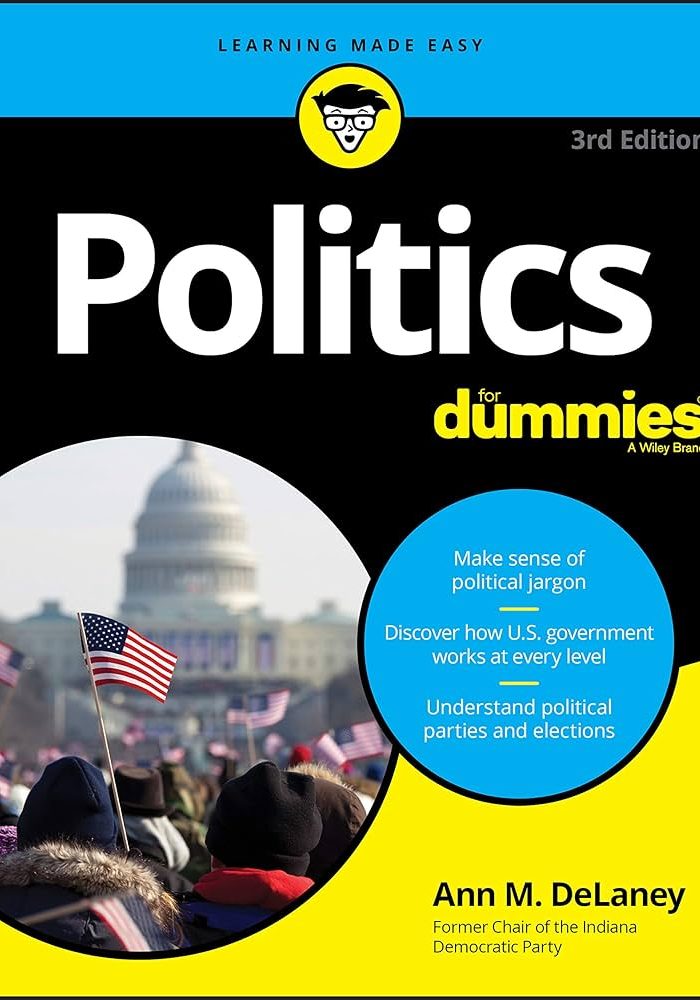
Politics For Dummies
Ann DeLaney
 GENRE: Miscellaneous
 PAGES: 384
 COMPLETED: November 1, 2025
 RATING:
Short Summary
The world of politics can be complex. In Politics For Dummies, Ann DeLaney sets it all straight with clear explanations and real-world examples on how government works, how campaigns unfold, and how Congress operates.
Key Takeaways
1️⃣ Branches of Government and How Congress Works
Both the federal and state government are comprised of three main branches: Judicial, Legislative, and Executive. Here’s how they break down:
- Judicial Branch — This branch consists of all federal courts, ranging from trial courts all the way to the U.S. Supreme Court. The federal judges that make up the judicial branch are appointed by the president and confirmed by the Senate. We don’t have an ability to vote for judges, although we have indirect influence by electing the president. The main job of these judges is to interpret and rule on federal laws when lawsuits are filed in federal courts.
- Legislative Branch — The legislative branch is Congress. They are one and the same. The main role of Congress is to draft bills, which, if passed and signed by the president, become laws. Unlike the federal judges of the judicial branch, we are able to elect members of Congress, which is made up of the House of Representatives and the Senate.
- Executive Branch — The executive branch is the president and the vice president. The executive branch plays a major role in shaping laws through the president’s veto powers. The president can block legislation proposed by Congress by vetoing it. He can also threaten to veto a bill in order to get Congress to make changes to legislation that they’ve proposed. The other members of the executive branch are the Cabinet secretaries. The president chooses the Cabinet secretaries, and these officials run the various departments of the executive branch, including the Treasury, Justice, State, Labor, and Homeland Security departments.
Congress — the legislative branch — is made up of two houses: The House of Representatives and the Senate. Again, these two houses are responsible for drafting bills and creating laws. It takes 218 votes for any legislation to pass the House of Representatives, and it takes another 51 votes for anything to pass the Senate. For a bill to become a law, it must pass both houses of Congress, then be approved by the president. Once a bill passes both houses, it goes to the president, who can either pass it or veto it. If he vetoes, the bill must get a 2/3 vote in both the House and the Senate to override the veto and allow the legislation to become law. This is why it’s valuable when one political party controls the majority in these two houses of Congress, in addition to the presidency. When these stars align, drafting and passing bills becomes much easier because the two houses of Congress and the president are on the same page with their views and goals.
We know how the president is chosen, but how are members of Congress selected? When it comes to the House of Representatives, each state elects politicians to represent them in the House. The House is limited to 435 seats, and the census determines how many of those 435 representatives each state receives. Some states have more representatives than others — it’s all based on population. Members of the House are elected every two years. As for the Senate, every state — regardless of population — elects two senators to serve 6-year terms. That’s 100 senators in total.
Just like the federal government, each state government is divided into the same three branches of government: judicial, legislative, and executive. The functions of these three branches are largely the same as they are within the three branches of the federal government.
- Judicial Branch — Judges in state courts interpret state laws. Some states elect their judges, some don’t.
- Legislative Branch — State legislatures create laws for their state. Most state legislatures include two chambers: an upper house (usually called the Senate) and a lower house (usually called the House of Representatives).
- Executive Branch — A state’s executive branch administers the laws. Just like the president, governors have the power to pass or veto a bill drafted by the state legislature. The governor is basically the president of their state, and voters of each state vote to elect their governor. The length of term that a governor serves is dependent on state law.
Counties, cities, and towns also have elections to choose officials for their own legislative and executive branches. But local government is not nearly as influential as the federal and state governments.
2️⃣ How Money Influences Politics: Special Interest Groups
One thing to understand about politics is that it’s impossible to make everybody happy. Resources are scarce, and government must choose among competing interests. Every decision government makes benefits some groups and takes away from others. This is why politics can be so divisive.
For example, if a government decides to cut taxes on middle-income people, it will likely have to raise taxes on the rich to make up for the lost revenue. There will never be enough money to do everything everyone wants to do, so tradeoffs have to be made. Those choices about how to allocate resources and about who benefits and who doesn’t are decisions that are political in nature. Another example: programs like Medicare and Medicaid provide support for low-income individuals, but they require funding that often comes from higher-income taxpayers.
These decisions about what to take on and what to avoid are largely driven by two things: votes and money. This is key to remember with politics. When elected officials and potential candidates analyze an issue, they look at what’s at stake for them in terms of votes and money. This drives their behavior and decisions. They will ultimately take a stance that gains them more votes and money in the next election.
Money is a critical influencer because campaigns are expensive. Certain groups of people with high-stakes interests will pool money together and donate it to government officials in an effort to get certain laws passed, protected, or repealed. Why is this important to know? Because, ultimately, many decisions made by government officials are driven by big-money contributors who have their own self-interests in mind.
One of the biggest examples of this is Special Interest Groups. These are organized groups that lobby, pool money, and exert political pressure to get what they want from elected officials. Lobbyists are people who are paid to represent Special Interest Groups and influence politicians in the legislative branch (Congress). Many corporations pay lobbyists out of their operating budgets to help protect favorable laws or block harmful ones. Lobbyists closely monitor bills and amendments that could affect their clients, sound the alarm if threats emerge, and build relationships with lawmakers — usually by doing favors or offering political support in hopes of reciprocity. Their reputation and success literally depend on how the legislation they monitor ends up.
A real-world example: pharmaceutical companies. Presidential candidates for the 2020 election raised the issue of the high cost of drugs in the U.S. compared to other countries. In an attempt to prevent any federal action that might affect the prices pharmaceutical companies receive for their products, pharmaceutical Special Interest Groups spent a record $280 million for lobbying efforts in 2018. Companies and Special Interest Groups like these are able to contribute huge sums of money like this to parties and candidates by forming what are called Political Action Committees (PACs) and Super PACs. These political support vehicles allow companies to contribute to candidates indirectly.
The point here? While many politicians genuinely want to serve and improve lives, the reality is that resources are limited and not everyone can get what they want. Truth is, resources are scarce and not everybody can be happy, and certain people and groups will do anything they can to make sure they are getting their way. In the background, there is a lot of money and favors being thrown around by Special Interest Groups and the lobbyists who represent them. This ultimately has a major impact on politicians and legislation.
3️⃣ Republicans vs. Democrats
In large part due to the “winner take all” nature of the electoral college, the U.S. is primarily a two-party political system dominated by the Republican Party and the Democratic Party. The U.S. has had a two-party system since the country’s early years, though the names of the dominant parties have changed over time. Every single U.S. president has been a member of one of the two major parties. What primarily distinguishes the two parties is how they view the role of government.
The Republican Party generally favors a limited role for the federal government, believing that state and local governments should handle most issues and programs. Republicans favor smaller government and want the federal government to “get off the backs” of the states, businesses, and individuals. In general, they believe less government and regulation is better. They see little role for the federal government aside from foreign policy and national defense. Historically, the Republican Party’s base has included higher-income individuals, business owners, and more college-educated white voters.
The Democratic Party believes that the federal government should play a large role in assisting citizens whom they consider to be disadvantaged: the poor, the elderly, and the disabled. Democrats are more willing to see the federal government intervene and propose solutions to problems. They lack the same inherent faith in state government that the Republicans have. They favor things like increased taxes on the rich to fund programs that support lower-income people. Historically, the Democratic base has included working-class voters, racial and ethnic minorities, women, and younger Americans.
Many people don’t align with either of these parties and consider themselves Independents. These voters often agree with some positions from both sides and make decisions based on current candidates and issues rather than party loyalty. There have been plenty of politicians who have run for president as independents, but our political system simply does not provide a lot of opportunity for success for any candidate who does not belong to one of these two major parties. That doesn’t mean independents haven’t been influential. Several presidential elections have seen independent or third-party candidates draw votes away from the Republican or Democratic nominee, ultimately influencing which candidate secured a state’s electoral votes.