

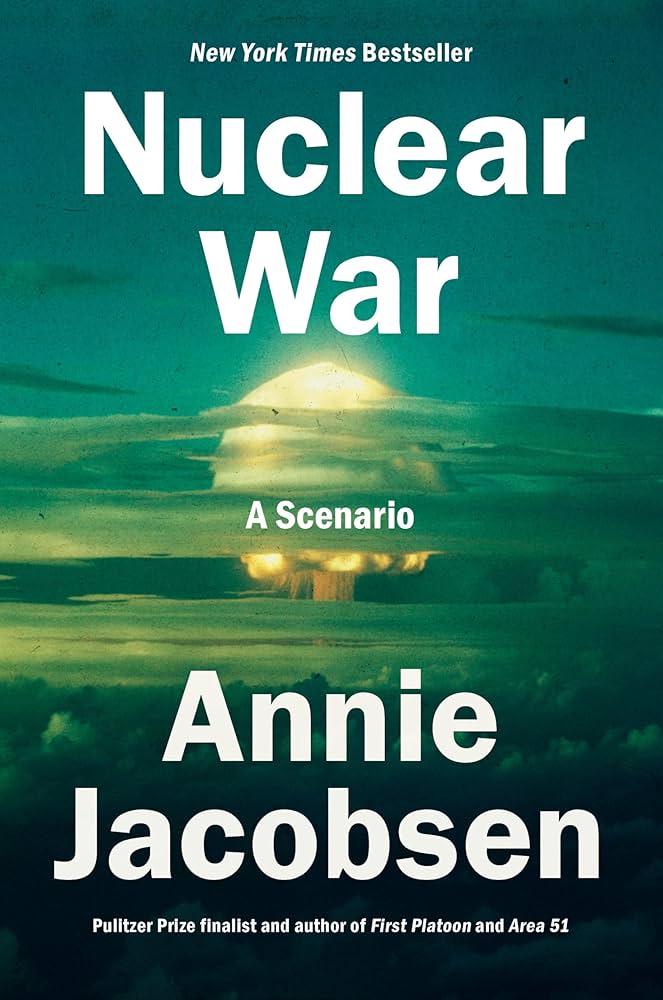
Nuclear War: A Scenario
Annie Jacobsen
 GENRE: Miscellaneous
 PAGES: 301
 COMPLETED: October 20, 2025
 RATING:
Short Summary
Since 1945, the race for nuclear supremacy has left the world just one misstep away from total annihilation. In Nuclear War: A Scenario, Annie Jacobsen delivers a chilling, meticulously researched account of what could unfold if a nuclear attack were ever launched against the United States.
Key Takeaways
1️⃣ The Race for Nuclear Supremacy
Other than an asteroid strike, there is really only one thing that could end the world in a matter of a few hours: nuclear warfare.
And, unfortunately, the world’s most powerful nations have a long history of developing, refining, and stockpiling nuclear weapons. When people think of nuclear war, most can’t help but recall 1945 — the year the U.S. ended World War II by dropping atomic bombs on Japan in Hiroshima (the bomb used was called “Little Boy”) and Nagasaki (the bomb used was called “Fat Man”). This was the first time nuclear weapons had ever been used in combat, and the bomb dropped on Hiroshima killed 80,000 people instantly on its own. Sadly, those bombs were only the beginning.
Since 1945, major countries like the U.S., Russia, China, and North Korea have been developing nuclear weapons much, much stronger than the atomic bombs dropped on Japan. Their militaries have also run simulations for how to use these weapons, including where to strike, how many casualties certain attacks would cause, and more. With the race for nuclear supremacy underway, these nations engaged in a mad rush to build massive arsenals. By 1946, the U.S. had developed nine atomic bombs. In 1949, Russia successfully developed its first bomb. By 1952, the U.S. had developed more than 800 atomic bombs!
The year 1952 also saw the invention of the most terrifying weapon yet: the thermonuclear bomb, also called the hydrogen bomb. Richard Garwin and the other scientists who designed it called it “The Super.” A thermonuclear bomb is a nuclear bomb inside a nuclear bomb. It’s a weapon that uses an atomic bomb inside as its triggering mechanism. As the author writes: The weapon’s explosive power comes as the result of an uncontrolled, self-sustaining chain reaction in which hydrogen isotopes fuse under extremely high temperatures in a process called nuclear fusion. An atomic bomb will kill tens of thousands of people, as did the ones dropped on Hiroshima and Nagasaki. A thermonuclear bomb, if detonated on a city like New York or Seoul, will kill millions of people in a superheated flash. The weapon Richard Garwin designed in 1952 had an explosive power of 10.4 megatons. The near equivalent of 1,000 Hiroshima bombs exploding at once.
By 1967, the U.S. had built a jaw-dropping 31,255 nuclear bombs. To reign everything in, the Secretary of Defense ordered all of them into one single plan, called the Single Integrated Operational Plan (SIOP). Today it is called the Operational Plan, or OPLAN. This is the U.S. plan for general nuclear war against Russia, China, and North Korea — if any of those adversarial nations were to ever attack us with a nuclear weapon.
Thankfully, the entire world has cut back a bit on their stockpile of nuclear weapons since the Cold War. The U.S. now has around 1,700 — many of which are on “Ready for Launch” status. Russia has around 1,600, and many of theirs are on “Ready for Launch” status as well. China and North Korea have smaller but growing arsenals, while nations like Iran are watched closely for signs of nuclear activity. It’s unsettling to know that the world is one miscommunication or accident away from a nuclear war that would basically end mankind.
2️⃣ The Nuclear Triad: ICBMs, Submarines, and Bombers
The U.S. stockpile of nuclear weapons sits at around 1,700. This is a significant reduction from the 31,000 in the 1960s, but it’s still more than enough to destroy a country. These weapons are spread across America’s “nuclear triad” — land, air, and sea:
- On Land — We have about 400 ICBMs locked and loaded in several states. Each one holds one warhead capable of carrying a nuclear weapon.
- In the Air — We have 66 nuclear-capable bombers (B-52 bombers and B-2 stealth bombers), each carrying multiple nuclear warheads
- At Sea — We have 14 nuclear-armed submarines, each carrying multiple submarine-launched ballistic missiles (SLBMs) outfitted with multiple nuclear warheads
On land, the ICBMs primarily lie underneath blast doors in hidden private ranches and farms across states like Wyoming, Montana, North Dakota, Nebraska, and Colorado. The missiles are called Minutemen III — huge missiles sitting at 60 feet tall, 80,000 pounds, and with a 300-kiloton thermonuclear weapon loaded into their nose cone. The missile’s name reflects its speed — Minutemen can be armed, targeted, and launched inside of 60 seconds.
The B-2 bomber is a beast. It’s a $2B, 172-foot-long flying wing that can carry up to 16 nuclear bombs. It flies at 630 mph and can go 6,000 miles without a refuel. The B-2 uses stealth technology to penetrate enemy air defenses without being seen by radar. One of the weapons it can carry is the B61 Mod 12 thermonuclear gravity bomb — also known as a nuclear “bunker buster” because of its ability to penetrate deep below the earth’s surface. This particular bomb is great at destroying deeply buried targets. The B-2 bomber is the most expensive aircraft in history, and the most effective.
Just as devastating are our nuclear-armed submarines. In fact, these are the real nightmares of nuclear warfare. Hidden from satellite radar, these submarines move around the ocean as they wish, and the nuclear firepower they carry can destroy an entire nation. Because they are undetectable in the ocean, they can sneak up close to a country’s coastline and launch a first-strike attack — reducing the launch-to-impact time from about 30 minutes (ICBM) to a fraction of that. These submarines can rise close to the surface, unload their full arsenal of weapons really fast, then disappear.
Nuclear weapons have not been launched by the U.S. since World War II, but the president has all of these options at his disposal if he wants, or needs, to use them. Part of the process of launching a nuclear strike involves the president moving the status of U.S. forces to Defense Readiness Condition 1 (DEFCON 1), which basically means that the military needs to prepare for nuclear war. The military has never been raised to DEFCON 1, although U.S. forces were placed at DEFCON 2 — nuclear is presumed to happen — during the Cuban Missile Crisis in 1962.
It wasn’t always the case, but the president is the only person who has the authority to launch a nuclear weapon. He does this using The Football, which contains authentication codes and strike options. Nobody else. If the president is killed or presumed dead, the next in line has to be sworn in as president before he can authorize a nuclear strike.
3️⃣ 30 Minutes Away From Catastrophe
One of the most unsettling facts about nuclear war is how fast it can arrive. From time of launch to impact, it would take about 30 minutes for a nation like Russia to strike the United States with a nuclear weapon. Even faster if it’s launched by a nuclear submarine. And once an attack is launched, there’s no recalling it.
We detect ICBM launches through our Space-Based Infrared System (SBIRS), a constellation of satellites designed to sense the heat signature of a missile at liftoff. Often called the modern-day Paul Revere, SBIRS can spot a launch and warn command centers within seconds. Some nations, like Russia and the U.S., share advance notice of test launches under treaty agreements. Others — most notably North Korea — do not. In 2022 and 2023, North Korea conducted more than 100 missile tests, many without prior announcement.
Once a launch is detected, ground-based radar systems confirm the trajectory. From there, teams of nuclear specialists in the North American Aerospace Defense Command (NORAD), the U.S. Northern Command (NORTHCOM), and the U.S. Strategic Command (STRATCOM), communicate with the president to determine what to do next. Action must be taken almost immediately — the president has about 6 minutes to open his Nuclear Football and make a decision about where to launch counterattack missiles. This is not an option — it’s policy. The U.S. will not wait to absorb a nuclear blow before firing back. Thanks to our “Launch on Warning” guidelines, the president can launch as soon as we’re warned of an inbound attack.
What’s there to worry about? We’ll simply shoot down an incoming missile. Unfortunately, this is a myth among Americans. Turns out, the systems we have in place for shooting down ICBMs are shaky at best. The U.S. Missile Defense Agency is in charge of shooting down incoming missiles, and its Ground-Based Midcourse Defense System is its weapon of choice. We have just 44 missiles that can be launched from these interceptor vehicles in California and Alaska. In the span of a few minutes, one of these interceptor missiles would have to hit the inbound ICBM traveling in space at 14,000 miles per hour. As a Missile Defense Agency spokesperson once said, “it’s akin to shooting a bullet with a bullet.” In controlled tests, the system’s success rate has been a little over 50%. In real-world conditions, the odds would likely be lower.
More so than shooting down missiles, what we really rely on to prevent nuclear war is something called deterrence. This is the concept of stockpiling enough nuclear weapons that other nations are deterred from even thinking about launching a nuclear attack. The idea is this: if you strike us, you won’t survive the response.
But what if deterrence fails? The fact that shooting down an inbound nuclear weapon is not a sure bet is frightening. All it really takes is one mad king with a nuclear arsenal to start a nuclear war that ends the world. One crazy leader who wants to make a statement. North Korea has 80 nuclear submarines lurking in the ocean and conducted a successful test launch from an underwater platform in 2019. Or we could simply have a miscommunication. The satellite system Russia built to rival SBIRS and detect a nuclear launch is considered “deeply flawed” and inaccurate by defense analysts. What if Russia thinks it’s being attacked when it really isn’t? They keep hundreds of nuclear weapons on “Ready to Launch” status at all times.
The bottom line is this: We live in a world that is far closer to nuclear disaster than many people realize. As United Nations Secretary-General Antonio Guterres said in 2022: “Humanity is just one misunderstanding, one miscalculation away from nuclear annihilation.” And it can all happen in less than 30 minutes.
4️⃣ Fallout: Nuclear Winter
Of potential nuclear war, former Soviet Union leader Nikita Khrushchev is quoted as saying: “the living will envy the dead.” He was referring to what many scientists call Nuclear Winter, an ominous term to describe what would happen after the bombs stop falling and the dust settles.
If you happened to survive the initial blasts and the complete incineration of everything near ground zero, you would face a world that is dark, cold, and dying. The barrage of bombs and explosions would hurl billions of pounds of soot and dust into the upper troposphere and stratosphere, where it would linger for years. The black, powdery soot high in the atmosphere would block the sun, causing the temperature to drop 10-30 degrees in many places.
But the weather would be the least of our concerns. All life depends on the sun. Sun equals life. Its energy drives Earth’s ecosystem. Plants require sunlight to grow via photosynthesis. Animals, including humans, need plants for food. With the sun’s rays blocked, agriculture would collapse and food supply would become a big issue.
Then there’s the radiation poisoning. Along with the billions of pounds of soot, all kinds of radioactive material would get swept up into the atmosphere after impact. These materials would slowly drift down and become dispersed across the planet. Whatever food and water is left would become contaminated, further shrinking our available resources. People would starve.
Something similar to what a Nuclear Winter might look like happened about 66 million years ago, when an asteroid hit Earth. Dust and soot from the asteroid’s impact blocked the sun’s rays, causing about 70% of the world’s species at the time to become extinct. This included all the dinosaurs — they either starved or froze to death.
This is what could lie on the other side of a nuclear war. As long as the threat of nuclear warfare is alive, so too is the possibility that human life as we know it could be over. It took us 12,000 years to build civilization to where it is today, and it could all be reduced to rubble in a matter of minutes and hours.