
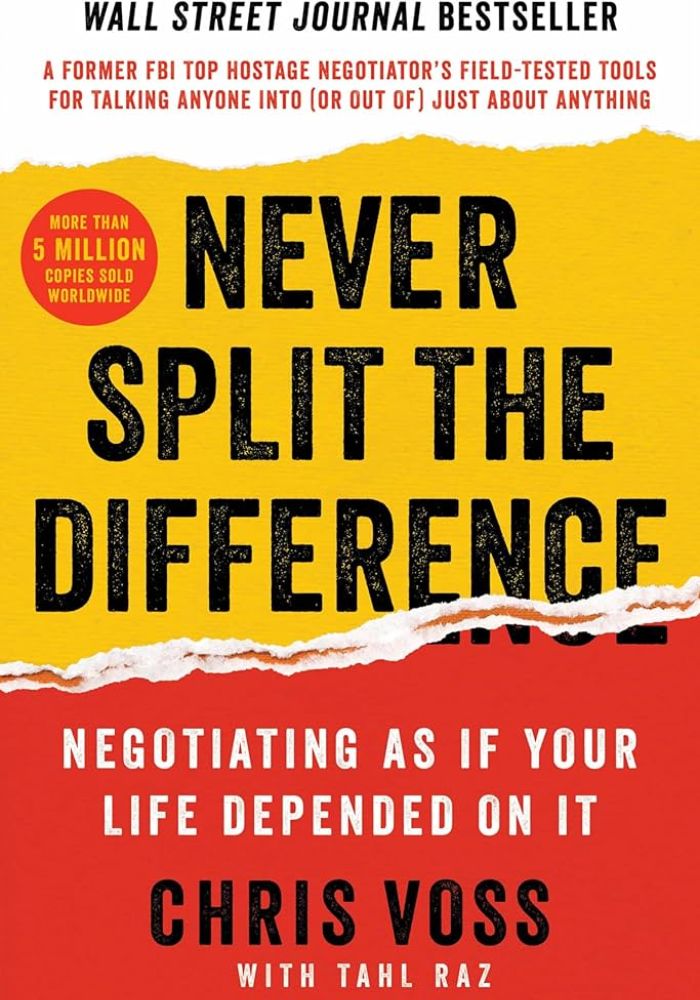
Never Split
the Difference
by Chris Voss
- 288 pages
- June 7, 2026
- ⭐️ ⭐️ ⭐️
- 288 pages
- Completed on June 7, 2026
- 288 pages
- June 7, 2026
- ⭐️ ⭐️ ⭐️
Short Summary
Negotiating can be one of life’s most uncomfortable and emotionally charged experiences. In Never Split the Difference, former FBI lead hostage negotiator Chris Voss draws on decades of high-stakes negotiation experience to reveal a practical framework for reaching the outcomes you want in both business and everyday life.
My Takeaways
1️⃣ Use Calibrated Questions to Say “No” Without Actually Saying “No”
One of the best techniques you can use in a negotiation setting is to continually ask what the author calls Calibrated Questions.
Before getting into some of the benefits, what exactly is a Calibrated Question? It’s an open-ended question that usually starts with “How” or “What.” Below are some examples:
- How am I supposed to do that?
- What is going to happen if we take that approach?
- How am I supposed to accept those terms when my budget is strictly capped at $$5,000?
- What are we really trying to accomplish here?
- How would you like me to proceed?
Calibrated Questions serve a number of purposes and can be useful both inside and outside of a negotiation.
First, the primary purpose of a Calibrated Question is to say “no” without actually saying “no.” Everyone understands that a direct “no” can completely derail a negotiation or even end it entirely. If you’re actually trying to solve a problem and work toward a reasonable outcome, that’s not what you want. Calibrated Questions allows you to say “no” without using the word itself. When asked repeatedly throughout a negotiation, they almost force your counterpart to keep thinking of solutions until they arrive at YOUR solution.
Second, Calibrated Questions take the hostility and emotion out of your statements. Most people think of negotiation as an emotional process where both sides are out to get each other. While there might be some truth to that in certain situations, the real enemy is the issue itself — not your counterpart. By turning your emotional statements into Calibrated Questions, you eliminate any accusatory and/or confrontational energy in your words while still getting your point across. They also have the added benefit of educating your counterpart on what the problem is rather than creating conflict by telling them what the issue is. For example, instead of blurting out “You’re screwing me out of money and it has to stop,” you can ask a Calibrated Question such as “How am I supposed to do that?” As the author writes: “If you were able to take an armed kidnapper who’d been surrounded by police and hook him up to a cardiac monitor, you’d find that every calibrated question and apology would lower his heart rate just a little bit. And that’s how you get to a dynamic where solutions can be found.”
Third, Calibrated Questions guide your counterpart toward arriving at YOUR solution because they come across as requests for help. They extend the negotiation by forcing your counterpart to consider your problems when making their demands. In other words, the more you ask these questions, the more your counterpart is encouraged to consider your perspective and help you overcome your roadblocks. The idea is that they will continue thinking through possible solutions until they arrive at the outcome you want.
Your tone is absolutely critical when asking Calibrated Questions. You MUST use a warm, respectful, and deferential tone of voice where you are genuinely asking the other side for their help. Avoid sounding accusatory or confrontational at all costs! When delivered and framed correctly, these questions invite your counterpart to participate in your dilemma and help solve it with a better offer.
Bottom line: rather than saying “no,” keep hitting the other side with Calibrated Questions until you get an offer that’s closer to what you’re looking for.
2️⃣ Incorporate Reciprocity, Anchoring, and Loss Aversion Into Your Negotiating Framework
There’s no perfect model for negotiating. Most people come into a negotiation with a gameplan, only to be quickly thrown off course.
That said, there comes a point in every negotiation where both sides have to get down to business and start discussing numbers. This stage of the process makes many people uncomfortable. The framework below can help you approach the bargaining portion of a negotiation, whether you’re pushing for a raise at work, trying to get a better rental agreement, or anything else.
- Step 1: Determine Your Target Price — Do tons of research and pick a price point that you’re ideally looking for. Come into the negotiation with this number in mind.
- Step 2: Set an Extreme Anchor — Set your first offer at 65% of your target price. This initial offer anchors the other side on an extreme number and allows you to establish a starting point. From there, you can work your way up, or down, to your actual price.
- Step 3: Adjust Your Offer — Before the negotiation, calculate three price raises of decreasing increments (to 85%, 95%, and 100% of your target price). You will use these numbers throughout the negotiation to gradually work your way toward your target. Each time you adjust your offer, you’re tapping into the principle of reciprocity. Your counterpart will usually feel compelled to make a concession in return for your compromise. These secondary offers also make the other side feel like they are winning and gaining control. As you negotiate, emphasize what the other side will lose if an agreement isn’t reached. Psychologists have found that the emotional pain of losing something is about twice as powerful as the pleasure of an equal gain. As the author writes: “In a tough negotiation, it’s not enough to show the other party that you can deliver the thing they want. To get real leverage, you have to persuade them that they have something concrete to lose if the deal falls through.” Additionally, use lots of empathy and different ways of saying “no” (calibrated questions) to get your opponent to counter before increasing your own offer.
- Step 4: Give a Final Number — When delivering your final offer, use precise, nonround numbers like $37,417 instead of $38,000. Using a nonround number gives the offer more credibility and weight; it gives the impression that you spent a lot of time calculating it. If you want, also throw in a nonmonetary item (that the other side probably doesn’t want) to show you’re at your limit. This will encourage your counterpart to empathize with your situation; he’ll feel like he’s squeezing every dime out of you and you truly can’t go any further.
- Step 5: Be Prepared to Walk Away — Not every negotiation is going to have a happy ending. You have to be willing to walk away if you and your counterpart can’t come to an agreement that works for you. Always remember that if you kill the deal, it disappears for the other side as well — and the fear of completely losing out on an agreement can spark loss aversion in your counterpart. As mentioned, loss aversion can work in your favor: for us humans, the pain of loss is about twice as powerful as the pleasure of an equal gain. It’s possible that the mere thought of you walking away will prompt a better offer from your counterpart.
Overall, this framework can be effective because it taps into several psychological principles that are hardwired into humans, including reciprocity, anchoring, and loss aversion.