
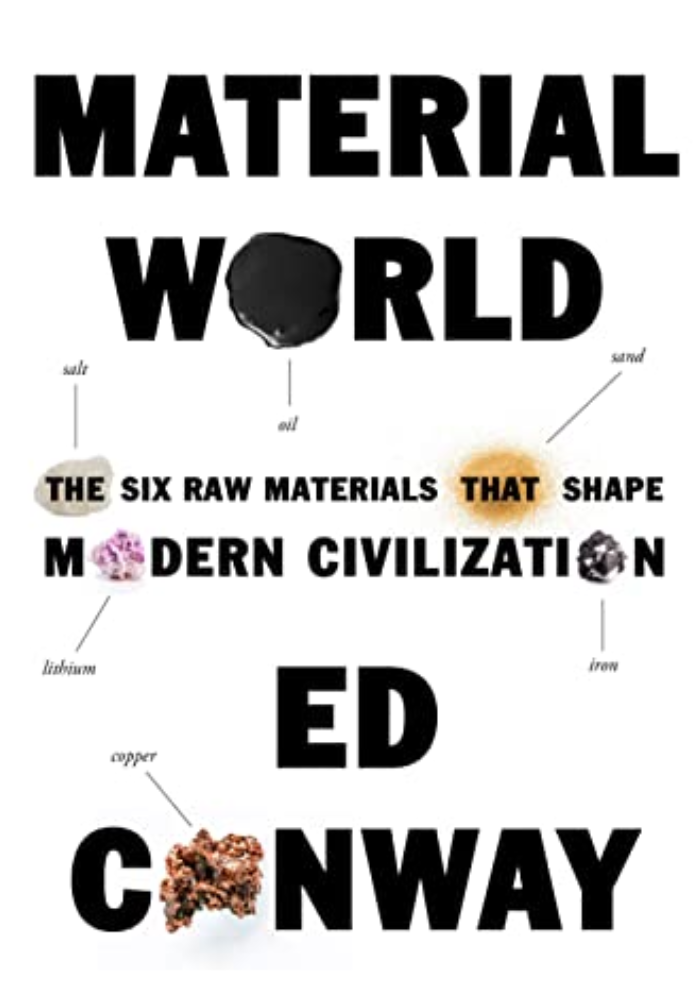
Material World
by Ed Conway
- 443 pages
- September 5, 2026
- ⭐️ ⭐️ ⭐️ ⭐️ ⭐️
- 443 pages
- Completed on September 5, 2026
- 443 pages
- September 5, 2026
- ⭐️ ⭐️ ⭐️ ⭐️ ⭐️
Short Summary
From the sand in our smartphones to the lithium in electric-car batteries, six very ordinary raw materials form the foundation of modern civilization. In Material World, Ed Conway explores each of the six materials and how they have transformed our world.
My Takeaways
1️⃣ Sand, Salt, Iron, Copper, Oil, and Lithium Are the Building Blocks of Life, and We Destroy the Planet to Get Them
The six raw materials covered in this book — sand, salt, iron, copper, oil, and lithium — are the building blocks of life. Look around and you’ll see them everywhere in your environment. They are the main ingredients in many of the products, devices, and infrastructure that we use on a daily basis. Without them, our smartphones wouldn’t turn on, our electric cars would have no batteries, and our homes would have no electricity.
Although there are many other materials we rely on, these six are the most widely-used and hardest to replace — which is why we go to great lengths to dig, mine, and blast them from the ground. To get these materials, we dig holes the size of canyons. We scrape the ocean floor. If we are to reach our climate goals, we require tons of these materials to build the renewable energy infrastructure we need, but in our quest to acquire them, we do a lot of damage to our planet.
That’s the great irony here. In order to enjoy the standard of living we’re accustomed to and also accomplish our environmental goals, we need to extract enormous quantities of these materials from the Earth to build the technology and infrastructure we depend on. This is already happening. In 2019, for example, we mined, dug, and blasted more materials from Earth’s surface than the sum of everything we extracted from the dawn of humanity through 1950. In other words, in a single year, we extracted more resources than our species has in its vast history. This trend of aggressive digging and blasting for resources will only continue in the years ahead, driven by industrialization, urbanization, and rising standards of living.
Fossil fuels — coal, oil, and natural gas — are at the heart of any discussion about the environment. But they are required to maintain our current standard of living. The process of making cement to produce concrete, for example, is responsible for roughly 7-8% of global CO2 emissions, but cement and concrete are essential to the buildings, roads, bridges, and other infrastructure that surround us. Turning lumps of quartz into the silicon wafers needed to make the chips that power our electronic devices requires an enormous amount of fossil fuels as well. The red-hot furnaces that turn iron into steel burn tons of fossil fuels. The power stations outside of our cities that pump electricity into our homes require fossil fuels, too.
Fossil fuels ultimately allowed us to grow and expand our population. Without them, we wouldn’t be able to feed and serve the billions of people on this planet. Yet the CO2 that fossil fuels emit are threatening our planet’s health. As the author writes: “There is a paradox here. Without fossil fuels, roughly half of us would not be alive. Yet now, the carbon emissions from those fossil fuels are causing problems that threaten us all.”
In yet another ironic twist, a big reason we began using fossil fuels in the first place was to protect the planet. For centuries, we created energy by burning wood, but wood emits more CO2 than any of the fossil fuels and cutting down forests wasn’t going to be sustainable as the population grew. So, we transitioned to coal, which fueled the Industrial Revolution. Oil and natural gas later became major energy sources as well. Natural gas emits the least amount of CO2 of all the fossil fuels, and we’re actively trying to use more of it for our energy needs. China is the world’s leading CO2 emitter because it primarily burns coal for energy. If China would shift from coal to natural gas, we would be well on our way to meeting our near-term climate goals.
The point here is this: we began using fossil fuels because they were a better alternative to wood and gave us the energy we needed to build the modern world. But, in doing so, we opened up a different set of climate issues. Despite all the talk about environmental protection, the same thing might be happening right now as we dig and blast the planet to satisfy our ever-growing demand for the six raw materials needed to maintain our lifestyle and build the tools required for a world driven by renewable energy. These six materials are everywhere, and we’ll need much more of them in the years ahead.
2️⃣ Sand Is Used to Make Concrete, Glass, and Semiconductor Chips
Sand is so useful to us that we dig and blast more of it out of the earth than any other material. Given that sand is a main ingredient in so many of the products we use on a daily basis, it makes sense that we go to such extreme efforts to acquire it.
When most people think of sand, they think of the beach. But there are many different varieties of sand found around the world, some more pure than others. The main ingredient in most sands is silicon dioxide, or silica. You can think of sand as grains of silica. The purest sands are those that contain at least 95% silica, and these are the grains that we actually use to make products. The sand found on beaches usually doesn’t contain enough silica to be useful in manufacturing.
There are several products found in our everyday environment that use sand as a main ingredient:
- Glass — Glass is essentially melted sand, as silica is the primary ingredient in glass. The glass we drink from and the glass that fills our window panes typically contain about 70% silica. The more pure the sand — in other words, the more silica in the sand — the clearer the glass. Interestingly, glass played a major role in World War I. Glass was essential for rifle scopes, binoculars, telescopes, scientific lenses, rangefinders and other tools critical for war. Germany had access to some of the world’s best optical-glass manufacturing capabilities, and Britain had been heavily dependent on German optical glass before the war. After war was declared, that supply was cut off, creating a serious shortage for the British. Britain eventually became so desperate for glass that it asked Germany to replenish its supply. Despite the fact that British and German troops were trying to kill each other, Germany agreed to trade glass for rubber — which the Germans needed badly. To sum this up, Germany willfully handed over glass that was inserted into the sights of British rifles, and these rifles were used to kill German troops.
- The Internet — Sand and glass play a major role in how the Internet works and how we send information around the world. In some ways, the Internet is made of glass. In the 1930s, chemists figured out a way to synthesize ultra-pure glass by spraying silicon tetrachloride — a liquid formed by dissolving silica sand in chlorine — into the flame of a welder’s torch. In the 1960s, this ultra-pure synthesized glass was used to transform long-distance communication by giving birth to the modern fiber-optic era, which is the era we are still in today. Video calls, Internet searches, emails, streaming — most online data is sent as beams of light through strands of glass. A fiber optic is a long, thin wire made of glass. The online data and information travels as light inside the fiber optic made of glass. This light can be sent very long distances, very quickly, through these glass fibers. We hardly think about this, but beneath the ground, out of sight, traversing oceans and ringing around the world, there is a huge collection of hair-thin strands of glass transmitting our information and data. Today’s high-speed Internet would not be possible without them. Prior to the fiber optic era, most information was transmitted down copper wires. But copper wire can only carry limited amount of information at limited speed.
- Semiconductor Chips — The chips in our phones, computers, weapons, and cars are made from silicon wafers. Silicon happens to be a semiconductor, which is a unique material that doesn’t conduct much electricity on its own but can allow an electric current to flow when transistors and an electric field are added. Tiny transistors are etched into silicon wafers, and chips are cut out of the wafer and inserted into our devices. These days, a chip can have billions of tiny transistors etched into it, and these transistors are what allow our devices to perform calculations and function. Sand plays a critical role in creating the actual silicon wafers that transistors are engraved into, but ordinary grains of sand are not ideal — you want fist-sized lumps of quartz made of silica. Sand would work, but quartz lumps are more efficient in the smelting furnaces that convert raw silicon into the silicon metal needed for chips. Eventually this silicon metal becomes a silicon wafer, ready to engraved with transistors. We’ve basically turned sand into chips, and chips are now driving the AI era.
- Concrete — Concrete is a mix of four ingredients: sand, cement, water, and aggregate (gravel). Although the words concrete and cement are used interchangeably, cement is an ingredient needed to make concrete. And so is sand! And here’s the thing about concrete: it’s everywhere. Concrete is used as the foundation for homes, buildings, and skyscrapers; it’s used as structural walls and beams inside buildings; it’s used to pave our roads and streets; it’s a structural component for bridges and tunnels; it’s used to make parking garages and parking lots, as well as dams, sidewalks, driveways; and much more. A few centuries ago, we used dirt roads and nearly all buildings were made of brick. Today, because of its role in making concrete, it’s fair to say that we build on sand, we build with sand, and we make homes from blocks made in large part from sand. The built world as we know it is mostly made of sand. Interestingly, Thomas Edison helped scale concrete by building the world’s longest kiln at the time. Using Edison’s large kiln, thousands of barrels of concrete could be made every day. Edison is mostly known for his role in scaling electricity, but his contributions in mass producing concrete were equally important.
Look around and you’ll find sand everywhere in your environment. Without this critical material, we wouldn’t have high-speed Internet that transmits our data across the world, we wouldn’t have the solid buildings and homes that give us shelter, and we wouldn’t have the tiny chips that power the devices we use every day.
3️⃣ Salt Is Used on Food, But It’s Also a Main Ingredient In Cleaning Products and Many Pharmaceutical Drugs
When most of us hear the word salt, we immediately think of table salt. This is sodium chloride, and it is used in many of our food products. Contrary to popular belief, our body needs a good amount of salt — it provides sodium and chloride, two essential electrolytes that help our nerves and muscles function properly and allow nerve cells to transmit electrical signals. But salt is a lot more than a substance we put on our food and in our body — it’s also a main ingredient in cleaning products and pharmaceutical drugs. Think of the stuff you have underneath your kitchen sink: salt is an important starting material for many of the chemicals used to make cleaning products.
Just like most of the materials covered in this book, salt is used in a lot of products we use every day, and we need a lot of it. There are three main ways we get it:
- Evaporate It — Through a long, tedious process, salt can be evaporated from seawater or other salty water. In places with the right climate, seawater is collected in shallow ponds and left to evaporate in the sun, leaving behind salt crystals.
- Mine It — We can dig rock salt out of the ground. This happens at the oldest operational salt mine in the world: the Khewra salt mine in Pakistan. Khewra salt is better known today as Pink Himalayan Salt.
- Extract It From Brine — Another major way we acquire salt is by extracting brine from the ground and removing its salt contents. Brine is a salty, watery solution made up of 30% salt. By comparison, seawater contains about 3% salt. Much of the salt in the U.S. comes from brine found underground in Kansas, Louisiana, Texas, and New York. Once pumped up from the ground, brine can be sent to a nearby plant, where the water and other minerals in the solution are removed and evaporated, leaving just wet salt that feels like sand. It’s then put into an oven and comes out as glistening pure grains of salt ready to be used as table salt, added to snack and food products, consolidated into pellets for water softeners, and more.
- Evaporate It — Through a long, tedious process, salt can be evaporated from seawater or other salty water. In places with the right climate, seawater is collected in shallow ponds and left to evaporate in the sun, leaving behind salt crystals.
Surprisingly, only a fraction of produced salt is used for food purposes. That’s because salt is also a critical material for the chemicals and pharmaceuticals industry, and much of the salt we extract is used to make products that keep us healthy and our surroundings clean. The chemicals industry uses a process called Chloralkali to convert brine into three important products: chlorine, hydrogen, and sodium hydroxide, also known as caustic soda. These chemicals can then be used to manufacture a huge number of other products.
- Caustic Soda (Sodium Hydroxide) — Used to make soaps and detergents, as well as paper and aluminum. For example, there is sodium hydroxide in my laundry detergent.
- Chlorine — Chlorine is used to purify the water we drink. It’s also an ingredient in a whole suite of medicines, including sedatives like Librium, anti-anxiety medication like Valium, some antibiotics, and some anti-malaria drugs.
- Sodium Bicarbonate — Used in baking powder and many other products
- Bleach — Chlorine and caustic soda can be reacted together to produce sodium hypochlorite, the active ingredient in household bleach
- Caustic Soda (Sodium Hydroxide) — Used to make soaps and detergents, as well as paper and aluminum. For example, there is sodium hydroxide in my laundry detergent.
These products start with salt and are why we can expect clean drinking water and clean living conditions. The availability of cheap soaps, disinfectants, and sanitary items helped increase life expectancy significantly in the 20th century. And at the heart of these improvements was salt.
Salt’s story doesn’t end there, however. Technically, in chemistry, a salt is a compound that is formed by mixing an acid and a base. Something called Saltpeter qualifies as a salt, although its chemical composition is potassium nitrate. Saltpeter has historically been used to preserve meat. It also acts as a chemical helper that provides oxygen to make things burn fast, making it a key ingredient in fireworks and gunpowder.
Another random fact about salt: It’s used on icy roads because it lowers the freezing point of water, allowing ice to melt at temperatures below the normal freezing point. Salt has a de-icing effect.
4️⃣ Iron Is Used to Make Steel, and Steel Is Everywhere
That’s because the vast majority of iron ore we mine is turned into steel. This separates iron from many of the other materials covered in this book — it’s primarily used to make one product: steel. What is steel? It’s an alloy of iron — when you combine iron and carbon, you get steel. And that fusing of iron and carbon is exactly what’s going on in the giant steel-making blast furnaces located around the globe.
Steel is everywhere in our lives. We use steel as a skeleton for buildings and skyscrapers; most of the machines and tools in our factories are made of steel; steel helps hold up those tall power lines that bring electricity to our homes; and we use steel to build cars, parts of planes, and weapons (steel guns, steel bombs, steel armor). At the center of it all is iron, which is the main element in Earth’s core and the second most abundant metal in Earth’s crust behind aluminum. As the author writes: “Iron is the bones of our society. We build bridges and buildings from it, we use it to reinforce concrete, we turn it into cars and build data centers. We used it to fashion tools and equipment thousands of years ago, and we use it to fashion tools and equipment today.”
For thousands of years, steel tools and machines have helped us make huge leaps as a species. The invention of the steel plow by John Deere in 1837 made farmers much more efficient at working tough soils. Today, the steel machines and tools in our factories help us get much more done, much faster, across nearly all industries. Henry Ford was obsessed with steel and was the first to make steel cars affordable to the masses. He used steel in the machines for his factories, in the tools along the assembly line, and in the cars themselves. He famously used vanadium steel in the Ford Model T.
Steel is made in giant blast furnaces, and you need a lot of iron and coal to do it. Recall that steel is the result of combining iron with carbon and some other minor elements. These blast furnaces melt iron and add in the carbon by burning coal, which is the top carbon dioxide emitter of all the fossil fuels (coal, oil, and natural gas). The coal not only helps heat the furnace, but it provides the needed carbon to turn iron into steel. Certain ingredients can be added into the steel production process to create different types of steel. For example, adding chromium produces stainless steel. There are many varieties of steel that can do slightly different things, depending on what it is needed for.
Given that China emits more carbon dioxide into the atmosphere than any other country by far, it’s probably not surprising that it is also the world’s top producer of steel. Making steel emits a ton of carbon dioxide into the atmosphere, and China produces a lot of steel. Because making steel releases so much carbon dioxide into the air, many countries are now trying to use recycled steel rather than making it from scratch.
5️⃣ Copper Helps Bring Electricity Into Our Homes and Devices
There has never been a greater revolution in our living standards than the one brought on by electricity in homes. It improved nearly every aspect of our lives, and the material that made it practical to generate and carry electricity into homes and buildings was copper.
It turns out that copper was the perfect material to bring light and energy into our homes. That’s because copper is a unique metal that is capable of conducting heat and electricity while also being pliable enough to be rolled, pulled, and twisted into wires without snapping. Electrical currents are able to start and travel along these copper wires to provide electricity. Today, our devices and homes are lined with copper. When we flip a switch — whether it’s a light switch in our home, the ON switch on a blow dryer, the touchscreen on a phone, or the START button in an electric car — electricity flows through copper wires and provides power. Without copper, we’d literally be left in the dark.
But how does electricity actually make its way into our homes in the first place? Huge transformers, generators, and power stations located outside of our cities contain coil after coil of copper wire. Using fossil fuels like coal and natural gas, these power stations generate electricity that is then sent through the copper coils in the generator and out onto the tall power lines stationed along our streets and highways. The current runs along these power lines and other underground cables until it reaches your home, which is lined with copper wiring to distribute it throughout the building. This network of power stations, power lines, underground cables, and copper wiring inside of buildings is called the Electric Power Grid. The same thing is happening when you see wind turbines — the difference is that the wind is helping to create the electric current rather than fossil fuels. When you lose power in your house, it’s usually because a weather event or equipment malfunction knocked out a nearby power line or disrupted this process somehow, interrupting the flow of electricity into your home.
All the devices plugged into outlets in your home are using the power of electricity. The cables and wires leading from your device to the wall outlet have copper inside them and are carrying the electric current from the copper wiring in the wall to your device. For example, a hairdryer. You’re plugging it into a wall outlet that has copper feeding electricity into it, and that electricity is being sent to your home via power stations outside the city. As the author writes: “Any switch you flick on any device in your home is summoning up the power of copper.”
This also applies to devices that aren’t plugged into anything. Our phones are lined with copper wiring, and electrical currents run along them to help power the phone. The average car contains a mile of copper wiring that connects the sensors and electrical components that help it function. In electric cars, you need 3-4 times more copper than a normal car, with about half going to power the motor and the rest going into the wiring harness and battery.
Quick sidebar here — the reason many rural homes — like Papa Bill’s cabin — use natural gas or propane is because these fuel sources are significantly more efficient when it comes to heating the house, and many rural homes are located in places with cold winter climates. Although the Electric Power Grid reaches most rural homes, it’s much more expensive to use electricity to heat the home. Instead, many of these homes have a tank of natural gas or propane located on-site and draw on it for heating purposes. Many of these homes also have backup generators, which work by connecting to the propane or natural gas tank. If a power line goes down and electricity can’t be used to heat the home, the backup generator kicks in and begins burning gas to provide electricity and heat. Normally, natural gas is pumped throughout a city using underground lines, but rural areas are often so spread out that it makes more sense to just have a tank on-site at the home.
Now for a history lesson to finish. In the early days of electricity, in the late 1880s, Thomas Edison helped string a web of electrical copper wires around American cities. Edison wasn’t the first to create a lightbulb, but he built the electrical infrastructure that helped bring electricity to homes and buildings. He buried copper wires underneath the streets of New York, he helped incorporate copper wires into homes and workplaces, and he helped string copper inside of generators. The only problem with Edison’s electrical infrastructure was that it relied on Direct Current, or DC, which was difficult to transmit over long distances and only went one direction, like water going down a stream. The voltage also couldn’t easily be increased and decreased, which meant that people had to live close to power stations to get electricity.
Nikola Tesla helped pioneer Alternating Current, or AC, electrical systems. Unlike Direct Current, Alternating Current can go two directions. More importantly, AC systems could use transformers to increase voltage for long-distance transmission and then decrease it again near the point of use. This made it possible to send electricity much farther from power stations. We still use AC power grids today: enormous power stations send Alternating-Current electricity into cities, towns, and rural settlements around the world. Tesla was named after Nikola Tesla to honor his contributions to the development of the AC induction motor, which became an important technology in the company’s electric vehicles.
6️⃣ Oil and Natural Gas Provide the Energy We Need to Do Stuff
Energy is everything. We need energy to move our vehicles and planes. We need energy to fuel the power stations that deliver electricity into homes and buildings. We need energy to make concrete and glass. The list goes on and on.
Most of the energy we use is delivered to us either directly, or indirectly, by fossil fuels (coal, oil, and natural gas). In fact, 80% of the world’s energy comes from burning fossil fuels, and we use these fuels to do stuff. Coal is the least energy-dense of the group, meaning you need much more of it to get the same amount of energy as a fuel like natural gas, which is the most energy-dense of the fossil fuels. The problem with fossil fuels is that as we burn them to do stuff, we emit carbon dioxide into the atmosphere. Transportation is one of the leading sources of CO2 emissions — our cars burn gasoline to move around.
That gasoline is a product of crude oil, also known as petroleum. Crude oil is acquired in two main ways: by drawing it up from the ground in oil fields or through a system called fracking. The Ghawar oil field in Saudi Arabia is the biggest in the world and has provided a consistent stream of oil for decades. Fracking involves drilling into shales of rock and injecting a high-pressure mixture of water, sand, and chemicals into the shale to break open the pores and allow trapped oil and gas out. This has become a common practice in Texas, where oil and gas are trapped in shale formations across the state. As its oil reserves were dwindling, fracking helped the U.S. double its oil production in the 2010s and reclaim its position as the top oil producer in the world, a position we still hold. Although fracking has been successful in the U.S., it tends to be much more expensive than drawing oil up from the ground in oil fields.
Once crude oil is acquired, it’s sent to refineries. If the U.S. is the top producer of oil in the world, why are we so dependent on oil from other countries? The reason is that there are many different types of oil: light and heavy, and sweet and sour (sour oil has more sulfur in it than sweet oil). Many U.S. refineries are built to refine heavy, sour crude oil, but a lot of our domestic oil comes from fracking in Texas, which is a light oil. As a result, our refineries are not well suited to deal with this kind of oil, so we ship our shale oil off to other countries in Europe and Asia to be refined, and we import heavy crude oil from other countries like Canada, Mexico, and Venezuela to be refined domestically.
Oil refineries around the world have one job: to turn oil into hydrocarbons, which we can then use to make fuels, chemicals, and plastics. The products that come out of an oil refinery can be generally divided into six categories:
- Gasoline — Fuels cars and other gas-powered vehicles
- Diesel — Fuels big trucks, trains, and heavy transport vehicles
- Kerosene — Fuels planes and jets. Because it’s more energy-dense, planes can pack more of it on board to go longer distances.
- Petrochemicals — Used to make things like plastic products, fertilizers, packaging, preservatives, paints, dyes, and more
- Waxes and Lubricating Oils — Used in everything from machinery and industrial equipment to cosmetics, skin products, and other products we use to clean ourselves
- Asphalt — Used to cover our roads
Natural Gas, or methane gas, is the sister fuel to crude oil. They are both fossil fuels, but they aren’t the same — and Natural Gas emits far less carbon than oil products. Natural Gas flows into some gas-powered homes through underground pipes. Furnaces or boilers in these gas-powered homes use it to create heat for the house. Gasoline for your car is a liquid, not a gas, that is made in refineries from crude oil. Propane is somewhere in the middle and is put into big tanks near rural homes and used for heating. (Think about the time the cabin ran out of propane). A way to think of oil and gas: most hydrocarbons made in oil refineries end up in the tanks of vehicles, while most natural gas is used to generate power, heat, and electricity.
However, a very small percentage of crude oil is converted into Petrochemicals (think “petroleum chemicals”). These products go into plastics, packaging, pharmaceuticals, preservatives, paints, dyes, and many more everyday products we use and enjoy. Polyethylene — the world’s most widely-used plastic — is one of these Petrochemical products, and it became mass produced after World War II. Polyethylene is used in plastic toys, beads, plastic bags, water bottles, and almost anything else you can imagine that’s plastic. Although plastic products have provided a lot of convenience, they are bad for your health and disrupt your endocrine system. Many of these plastics find their way into your body as microplastics and impact your health. As weird as it seems, the plastics we encounter on a daily basis are the product of the oil industry.
A sidebar on gasoline: Lead used to be used to gasoline to improve octane levels and reduce engine knocking. Lead is a neurotoxin that is extremely bad for you and the environment. Only in the 1980s did the U.S. ban lead from gasoline, which is why you see the word “unleaded” at the pump.
7️⃣ Lithium Is the Lead Ingredient in Batteries
Lithium is an interesting element. Not only was it one of the first three elements created in the Big Bang — alongside hydrogen and helium — but it has unique properties that make it ideal for storing energy. This ability to store energy is why lithium is one of the lead ingredients in batteries.
How does a battery actually work? Imagine that a battery contains two skyscrapers — one is an office skyscraper and the other is an apartment skyscraper. These skyscrapers represent the Anode and Cathode – the negative and positive electrodes inside the battery. When a rechargeable smartphone or electric car battery is low or dead, what that means in electrochemical terms is that there are a lot of lithium ions sitting in the Cathode — in the apartment skyscraper — where they are no longer providing energy to the device. But when the battery gets charged, those ions shuttle across to the other skyscraper — the Anode or, in this analogy, the office skyscraper. They go from the lazy apartment to the productive office. And a fully charged battery is one where the Anode structure is full of these charged lithium ions that are ready to move again. When that battery is being used, the ions are shuttling back home from the office to the apartment skyscraper, generating an electric current that powers the device.
So, that is roughly how lithium-ion batteries work — lithium ions shuttle from one side of the battery to the other. These lithium-ion batteries are in all of our major devices: smartphones, electric cars, laptops — and there is growing demand for batteries as we try to improve the climate by reducing our dependence on fossil fuels. There’s a lot of focus on electric vehicles right now because transportation is a major source of CO2 emissions. When we drive, our cars burn gasoline and emit lots of CO2 into the atmosphere. Electric cars powered by batteries can help reduce the amount of CO2 we emit from transportation.
Tesla is driving this move toward electric vehicles in the U.S. The company has developed several Gigafactories worldwide that are strictly focused on building batteries for its fleet of cars. But even with Tesla’s Gigafactories, China controls 80% of the world’s battery production. Many of America’s electric cars — outside of Teslas — use Chinese batteries. When it comes to batteries, we are highly dependent on China.
Now, lithium is not the only ingredient needed to make a battery, but it is one of the most important. Making a high-performing, functional battery wouldn’t be possible without it. As the container of a battery is built in a plant like one of Tesla’s Gigafactories, lithium electrolyte solution is poured into it, and the shuttling between skyscrapers commences. This lithium electrolyte solution is developed from lithium that is extracted from various rocks, as well as brine — the same watery solution that we use to extract salt.
Another interesting thing about pure lithium — it can be a bit explosive. Therefore, batteries can be explosive. Batteries can undergo a process called Thermal Runaway, in which a rapid, uncontrolled increase in temperature can lead to fire or, in extreme cases, an explosion. This is extremely rare in properly manufactured and protected batteries, but it explains some of the viral videos of people’s phones or other devices catching fire. Damage, overheating, and overcharging can trigger a Thermal Runaway. This is also the reason airlines have strict rules about lithium batteries. Spare lithium batteries and power banks aren’t allowed in checked bags because a Thermal Runaway event in the cargo area would be very hard to stop. This explains why airline employees ask you if you have any batteries in your bag as you’re checking it in.