

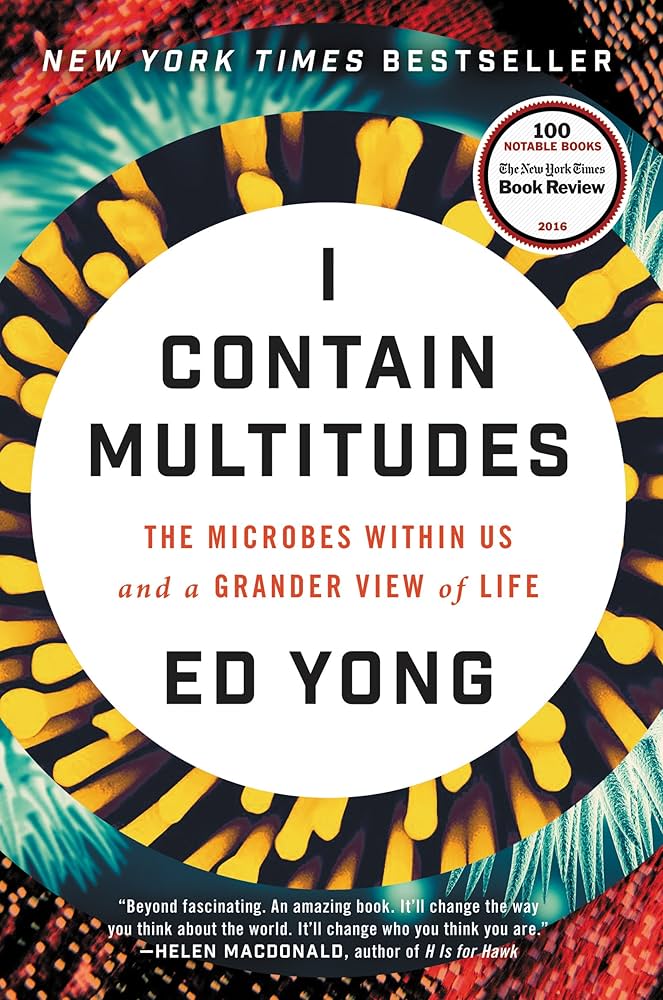
I Contain Multitudes
Ed Yong
 GENRE: Health & Wellness
 PAGES: 368
 COMPLETED: August 5, 2025
 RATING:
Short Summary
Ed Yong believes bacteria get a bad rap. In I Contain Multitudes, he dives into the hidden world of microbes and shares how these microscopic organisms impact our health.
Key Takeaways
1️⃣ It's a Bacterial World
We humans like to believe that we are the center of the universe, but that couldn’t be further from the truth. Earth is 4.54 billion years old. If we zoom out and create an imaginary 12-month calendar covering Earth’s entire existence, the first humans didn’t arrive until December 31st at 11:30 p.m. In other words, humans have existed for about 30 minutes — modern humans less than one minute. We are incredibly new. Here is a quick breakdown of this imaginary timeline of events:
- January 1 — Earth forms from dust and gas around the Sun
- March — Life on Earth begins with single-celled microbes (e.g. bacteria and archaea)
- October — Multicellular organisms emerge
- December 31 (11:30 p.m.) — The first humans appear
- December 31 (11:59:46 p.m.) — Modern humans (Homo Sapiens) appear
What quickly becomes apparent in looking at this timeline is that this is a bacterial world, and we’re just living in it. From the start of life on Earth in March (about 3.7 billion years) to the arrival of multicellular organisms in October (2.1 billion years ago), the only living things on the planet were single-celled microbes like bacteria and archaea. Bacteria have existed for far, far longer than we have. We’re living in THEIR world.
During this time, bacteria completely changed the planet. They were the first organisms to make their own food by harnessing the Sun’s energy in a process called Photosynthesis. During this process, they released oxygen as a waste product, pumping out so much of it that they permanently changed the atmosphere of our planet. It is because of bacteria that we live in an oxygenated world.
It wasn’t until October of our imaginary timeline (2.1 billion years ago) that multicellular organisms arrived on Earth. How did that come to be? The tiny single-celled microbes living on Earth at the time could be divided into two camps: Bacteria and Archaea. One day, a bacteria somehow merged with an archaea and became trapped inside, creating what is called a Eukaryote. More of these Eukaryote cells began to appear, and some started to cluster together. This process gave rise to all kinds of multicellular beings like animals and plants. As far as humans go, we eventually evolved from an animal.
Today, every living thing that you can physically see with the naked eye (e.g. humans, animals, plants) is a Eukaryote, and all of us evolved from that single ancestor 2.1 billion years ago.
2️⃣ Bacteria Are Everywhere
Microbes like bacteria are absolutely everywhere. They are in the deep ocean. They are on doorknobs. They are on food. They are in the jungle. They are on and inside your body. They are literally everywhere, and the sheer number of different bacterial species is astonishing. Again, this was their planet long before we arrived.
Because multicellular beings like humans and animals are so big, we are able to host microbes like bacteria on and inside of us. In fact, the number of bacteria living on and inside our body is about the same as the number of our own human cells. Scientists estimate that the average person has around 40 trillion human cells and roughly 40 trillion bacteria! About 90-95% live in the gut and make up what is called your Gut Microbiome. Most bacteria on and inside us are either harmless or helpful and carry out important functions. Don’t get it twisted, we need bacteria to survive — we’d be dead without them. We should learn to appreciate them. Here are just a few things they do for us:
- Digestion — The thousands of species of bacteria living in our gut help us digest food
- Vitamins — Bacteria produce important vitamins that are missing from our diet
- Toxins — Bacteria help us break down toxins and hazardous chemicals
- Taking Space — Good bacteria take up so much space in our gut, mouth, and on our skin that they help crowd out harmful bacteria
Not all bacteria we come across are good, however. Harmful, disease-causing microbes are called Pathogens. The word ‘Pathogens’ is pretty wide-sweeping and includes bacteria, viruses, parasites, and anything else that can cause disease. These bad guys are out to kill your cells, and therefore you, and your immune system is responsible for detecting them and taking them down when they enter your body. Thankfully, there are only about 100 species of bacteria that cause infectious disease in humans.
Each of us has a very unique Microbiome, which refers to all of the different species of microbes (including bacteria) living on and inside us. My Microbiome is different than anyone else’s. The factors that influence your Microbiome include genes, places you’ve lived, drugs you’ve taken, food you’ve eaten, years you’ve lived, hands you’ve shaken, and so much more. Just as interestingly, species of bacteria found in one area of the world and on some animals or humans are often not found in other places and other animals or humans. There are certain places and climates where specific microbes thrive. This goes for regions of the body as well — the species of bacteria found in our mouth are far different than the ones found in our gut or on our skin.
In the end, we are vessels full of bacteria. And when we die, the bacteria living on and inside of us will eat our corpse and go on with their lives.
3️⃣ Diet and Microbiome Are Linked
As mentioned, most of the 40 trillion bacteria we live with exist in the gut, specifically the large intestine. What’s interesting is that our Gut Microbiome is constantly changing. As author Ed Yong puts it: “The microbiome is not a constant entity. It is a teeming collection of thousands of species, all constantly competing with one another, negotiating with their host, evolving, changing. It wavers and pulses over a 24-hour cycle, so that some species are more common in the day while others rise at night. Your genome is almost certainly the same as it was last year, but your microbiome has shifted since your last meal or sunrise.”
Because it changes constantly, what we eat has a big influence on the composition of our Gut Microbiome. Different microbes fare better on certain diets than others. This means that when you choose your meals, you are choosing which bacteria in your gut get fed — and this influences which bacteria will emerge stronger and more plentiful. This has implications when you change your diet — doing so means your Gut Microbiome will change a bit as well. For example, an obese person often has a different community of microbes in their gut than a healthy person. In other words, a poor diet changes the microbes within.
The fact that the composition and performance of your Gut Microbiome is influenced by what you eat is why we have things like Probiotics, which are live bacteria that are already present in your gut. Taking Probiotics simply adds to your existing collection of friendly bacteria, thereby helping to crowd out harmful ones. This supports your immune system in fighting off pathogens and helps you maintain a healthy balance of gut bacteria. Probiotics are found in things like yogurt and are commonly taken as supplements.
Dietary Fiber is another interesting point here. Fiber is a catch-all term for complex plant carbohydrates that your body cannot digest but the bacteria in your gut can. By eating Fiber, you are actually feeding your Gut Microbiome and making it much more diverse as a whole. A more diverse Gut Microbiome is what we want. How does this work? Fiber is so complex to digest that it “creates openings” for a wide range of bacteria that possess the right digestive enzymes. In effect, by not eating Fiber you allow opportunities for less optimal bacteria to fill those spots in your Gut Microbiome. Depriving your Gut Microbiome of Fiber also means your bacteria will eat away at the mucus layer covering your Epithelial Cells/gut lining (see next takeaway). Fiber has two bonus benefits:
- Anti-Inflammatory — When our bacteria break down Fiber, they release anti-inflammatory molecules that help prevent our immune system from generally overreacting to things. A less jumpy immune system means less inflammation in our body, which is a great thing.
- Poo — Fiber has the benefit of helping you “get things moving” and poo more easily. Constipated? Try eating some Fiber.
Overall, by eating the right foods with a wide array of nutrients, we feed a wide range of friendly bacteria in our gut while excluding the ones that pose danger. It’s all about eating the right foods to create a gut bacteria ecosystem where the right bacteria can survive and thrive.
4️⃣ Defending the Gut Wall
It’s a little unsettling to think that we have trillions of bacteria living in our gut, and they are only separated from the rest of our body by one single layer of Epithelial Cells. These cells form a very thin wall that lines our intestines and prevents bacteria from slipping through and reaching the blood vessels just below. If gut bacteria make it past this Epithelial Cell wall and into our blood, they will spread to other parts of the body and create big problems.
While many of the bacteria in our gut help us digest food and are usually friendly partners, they can become dangerous if they cross that boundary. Thankfully, our body has a sophisticated three-pronged defense system designed to protect this important Epithelial Cell wall and keep gut bacteria where they belong:
- Mucus — Places like the gut, lungs, mouth, and nose are some of the most vulnerable and exposed areas of our body. That’s why these areas are lined with layers of gooey mucus that act as a protective barrier and prevent harmful bacteria and viruses from penetrating deeper into our body. In the gut, we have a layer of mucus that sits directly on top of the Epithelial Cell wall, trapping microbes and making it harder for them to cross.
- Bacteriophages — These are specialized viruses that specifically go out and infect and destroy bacteria. Many types of Bacteriophages attach to our mucus and patrol it like security guards, helping to keep bacteria in check by attacking harmful invaders.
- Antimicrobial Peptides (AMPs) — As a final line of defense, the Epithelial Cells themselves spray chemical weapons called AMPs. These molecules can kill bacteria that get too close to the wall, adding another layer of protection.
If any rogue bacteria manage to get past all three of these barriers, our immune system is waiting on the other side of the wall. Specialized immune cells monitor the area just beneath the Epithelial Cell wall and are ready to detect and destroy any bacteria that break through.
Overall, the gut is one of the most exposed and sensitive parts of the body, and it depends on this layered defense system to keep us safe. When it’s working properly, it allows us to live in harmony with trillions of bacteria. When it breaks down, things can go wrong fast.
5️⃣ Mother's Milk = Baby Superfood
Breast milk is much more than a bag of chemicals. Not only is it food for the baby, it passes from mother to child crucial bacteria, immune cells, and Antibodies that help the child develop a strong Gut Microbiome and immune system from the very beginning of life.
Every mammal mother has the ability to feed her baby by literally dissolving her own body to make a white fluid that is passed on to her offspring. The ingredients of that fluid have been adjusted and perfected through 200 million years of evolution to provide all the nutrition an infant needs. Among those ingredients are complex sugars called Oligosaccharides. There are more than 200 Human Milk Oligosaccharides (HMOs) in breast milk — this is five times as many varieties of HMOs as are found in cow’s milk. HMOs are the third most abundant solid ingredient in breast milk, after lactose and fats.
But here’s the twist: babies can’t digest HMOs. Scientists believe these sugars are instead meant to feed a certain microbe in the baby’s gut called B. infantis. As it digests HMOs, this microbe releases fatty acids that feed an infant’s intestinal cells and help maintain a healthy gut environment. So, while mothers nourish this microbe with HMOs, the microbe in turn nourishes and protects the baby.
HMOs are important because they’ve been shown to increase a baby’s ability to fight off pathogens— research has shown that breast-fed babies have fewer gut infections than bottle-fed ones.
What about the immune cells and Antibodies that get passed from mother to child through breast milk? Breast milk is packed with Antibodies that coat the baby’s gut and protect against harmful bacteria and viruses. These Antibodies are tailored to the mother’s environment — meaning she passes on to the baby Antibodies that can fight pathogens that the mother has already encountered and overcome in her lifetime.
In addition to Antibodies, breast milk contains immune cells such as Macrophages, Neutrophils, and Lymphocytes. These cells help the baby fight infections during the early months of life, when their own immune system is still developing. It’s as if the mother is lending part of her immune army to her child.
Together, these immune factors help breastfed babies fend off illness and build a stronger, more resilient immune system over time.
6️⃣ Bacteria Can Swap DNA
One amazing feature of bacteria — and one that has allowed them to succeed for billions and billions of years — is their ability to literally swap genes with each other. This unique skill, combined with their ability to reproduce rapidly, allows bacteria to quickly adapt to different environmental conditions, evade our immune system at times, protect themselves against antibiotics, and even create new ways of infecting hosts.
This ability is unlike anything humans or animals are capable of. When we need to adapt physically to changing conditions, it takes generations of evolution and natural selection for the right genetic mutations to become dominant. On the other hand, when bacteria face challenging conditions, they don’t have to wait — they can just borrow adaptations on the fly by exchanging genes with neighboring bacteria around them. In evolutionary terms, bacteria sprint while we crawl.
Looking specifically at how this applies to the medical field, a bacterium’s ability to swap genes at any moment is one of the leading reasons antibiotics are slowly becoming less effective. Bacteria are evolving at breakneck speed to resist our current inventory of antibiotics, and we are not creating enough new ones to replace the non-effective ones. The spread of these antibiotic-resistant bacteria, and their ability to reproduce rapidly, is one of the greatest public health threats of the 21st century.
7️⃣ Bacteria Are Our Partners
Our relationship with bacteria is truly a partnership: we need them, and they need us. It’s helpful to think of your Microbiome as a living ecosystem, or a community. As long as the trillions of bacteria that make up our Microbiome are balanced and doing their jobs, everything runs smoothly.
Like any ecosystem or community, your Microbiome is constantly changing based on factors like your environment and climate (the bacteria in Arizona are very different from those in New Zealand), what you’re eating, and more. What’s exciting is that we can actually intentionally manipulate our Microbiome through our choices — especially through things like our diet. We can replace faltering communities of microbes with new ones that can lead to better health and help us fight disease.
But when you mess with your personal community of bacteria, unexpected things can happen. Add a supposedly beneficial microbe, and it might displace competitors that we also rely on. Blow up a supposedly harmful microbe with antibiotics, and an even worse one might rise to take its place.
The point here is that our Microbiome plays a significant role in our health, and our relationship with it is like a partnership that is constantly evolving. It’s worth paying attention to this dynamic ecosystem and doing what we can to support the balance that keeps it working for us.
8️⃣ Antibiotics, Probiotics, Previotics, and FMT
You can’t talk about bacteria and the Microbiome without mentioning Antibiotics, Probiotics, Prebiotics, and Facal Microbiota Transplants (FMT). In one way or another, each of these is a method for changing or influencing the microbial ecosystem in your gut.
Antibiotics are probably the most well-known of the four. They’re prescribed when you have an infection and need to kill harmful bacteria quickly. The problem is, Antibiotics act as a grenade — they wipe out bad bacteria, but they also kill helpful bacteria and some of your cells in the process. It’s like nuking a city just to wipe out a rat. When you wipe out a big chunk of your Gut Microbiome, harmful bacteria have the opportunity to move in and replace the good bacteria. This is one of the main ways the bacteria C-diff takes hold — the likelihood of getting it increases sharply after taking Antibiotics.
The world’s first Antibiotic was Penicillin, which was discovered on accident by Alexander Fleming in 1928. Since then, we’ve developed many others that have saved millions of lives. But because they can exchange genes and reproduce quickly — and because Antibiotics are generally overprescribed — many species of bacteria have evolved to resist these medications. On top of that, we’re exposed to low doses of Antibiotics through the food supply, since many livestock animals are routinely given Antibiotics to grow faster. Unfortunately, while bacteria continue to evolve, modern medicine has failed to develop new Antibiotics to replace the ones that are becoming less effective. The result? We are heading into a terrifying post-Antibiotic era where we may not have the drugs we need to fight serious bacterial infections.
On the plus side, we have things like Probiotics. The opposite of Antibiotics, Probiotics are live bacteria that are already present in your gut. Taking Probiotics simply adds to your existing population of friendly bacteria, thereby helping to crowd out harmful ones. Probiotics are found in things like yogurt and are commonly taken as supplements. One downside, though, is that the bacteria in these products only represent a tiny slice of the massive microbial ecosystem inside you, and they’re often not the most important members of the adult gut. This means that Probiotics may not make a big impact on your overall gut health, although there is ongoing research being done to investigate.
Prebiotics, on the other hand, are substances that feed beneficial bacteria already in your gut. By feeding beneficial bacteria, you help those species take up space in your gut and crowd out potentially harmful bacteria. Prebiotics are usually plant carbohydrates like fiber and inulin that can’t be digested by the body — only the helpful bacteria that you’re trying to feed can break them down. HMOs in breastmilk are another example of a Prebiotic.
Now for the most disgusting way of changing your Gut Microbiome: Facal Microbiota Transplants (FMT). This is the process of taking somebody else’s poo, blending it up, and sticking it (and all of its microbes) in another person. The goal? To completely repopulate the recipient’s gut with a healthy, functioning community of microbes. Think of it like returfing a damaged lawn. Why would anyone do this? FMTs are usually used as a last resort to help somebody who has a species of bacteria that is really causing problems in their gut. By completely replacing your Gut Microbiome using somebody else’s microbes, the goal is to drive out the bad bacteria. FMTs have proven to be especially useful against C-diff, since that condition is usually treated with a ton of Antibiotics. Giving a C-diff patient an FMT not long after taking Antibiotics has shown to have a 70-90% success rate. That said, FMT success rate with other conditions isn’t super high — in the end, it’s very difficult to reset a microbial ecosystem.
9️⃣ Don't Run From Bacteria
Today’s society is one that has a zero-tolerance attitude toward bacteria, and understandably so. Pathogens — any bacteria, virus, or parasite that causes disease — are legitimate threats to your immune system and body and should be taken very seriously. But a case can be made that we’ve gone a little too far in our efforts to avoid microbes.
Anti-bacterial soaps, sanitizers, wipes, and other products are now part of daily life. While they’re great at killing harmful bacteria, they can also reduce our exposure to harmless or helpful ones that can help us create a more diverse Microbiome. In fact, by removing harmless bacteria that would otherwise impede the growth of pathogens, we are perhaps inadvertently creating a more dangerous environment.
Your body — especially your skin, lungs, and gut — is home to diverse microbial communities. Many of these bacteria are either neutral or beneficial, and treating them all like threats may do more harm than good. Let kids play in the dirt. Get sweaty at the gym. There are times when being exposed to the microbial world helps build a stronger, more resilient Microbiome. As author Ed Young argues: Rather than designing public spaces to exclude all microbes, maybe it’s time to lay out the welcome mat.
One area where this is especially true is the hospital. These are buildings full of people who are sick and spreading pathogens. Despite strong sanitation protocols, your chances of getting some kind of infection increase when you enter the hospital. In these situations, as Florence Nightingale discovered, opening a window can make a world of difference. By doing so, you invite in harmless bacteria from the outside that can help exclude pathogens lurking in the hospital.
Overall, it’s smart to practice good hygiene, but it’s not always helpful to avoid bacteria at all costs. There are far more helpful and harmless bacteria in the world than there are harmful ones — and many of them are on our side.