

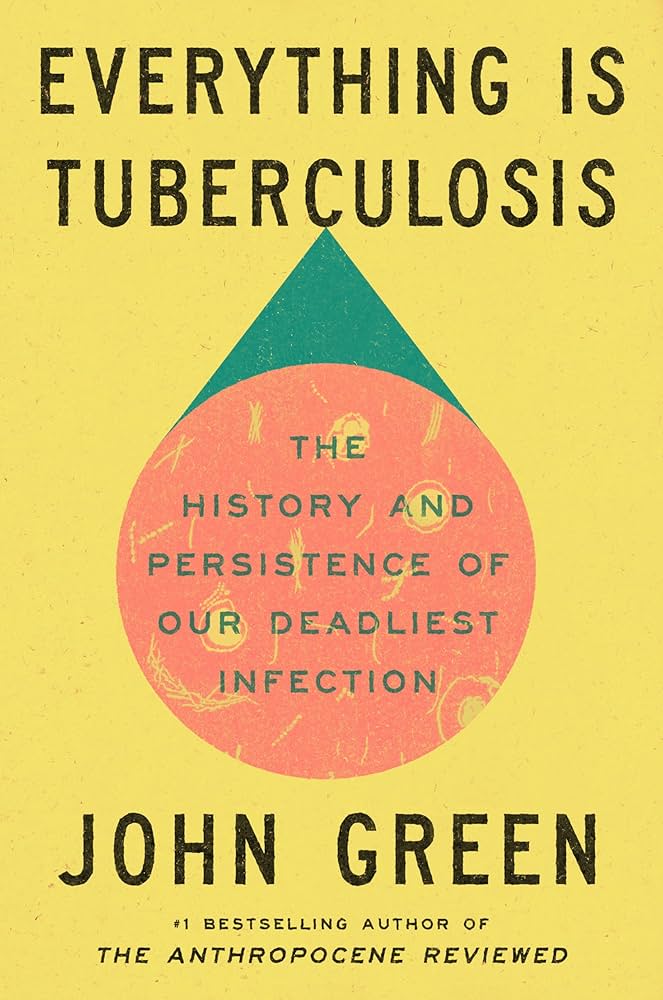
Everything Is Tuberculosis
John Green
 GENRE: Health & Wellness
 PAGES: 208
 COMPLETED: September 11, 2025
 RATING:
Short Summary
Until fairly recently, Tuberculosis was the leading cause of death globally. In Everything Is Tuberculosis, John Green explores the unique history of this bacterial disease and why, in some areas of the world, it’s just as ferocious as ever.
Key Takeaways
1️⃣ Tuberculosis: World's Deadliest Infectious Disease
Up until the early-to-mid 1900s — when sanitation and water quality improved, living conditions were enhanced, and antibiotics and vaccines were developed — infectious diseases were by far the leading cause of death worldwide. The worst of them was Tuberculosis, widely considered the deadliest infectious disease in human history. Over the centuries, this infectious disease has ravaged humans, killing around one in seven people who have ever lived. Looking at the past two centuries alone, Tuberculosis has killed more than one billion people. Cures for Tuberculosis were finally developed in the 1940s and 1950s, but it still managed to kill more than a million people in 2023 — mostly in poor, malnourished developing nations where medicine is either scarce or unaffordable.
So, what is this deadly disease? Tuberculosis is an airborne bacterial infection caused by the bacterium Mycobacterium Tuberculosis. It spreads through small particles in coughs, sneezes, and exhalations, and it is incredibly common. In fact, between one-quarter and one-third of the world’s population carry Tuberculosis. In most people, the infection will lie dormant for a lifetime, never causing problems. But up to 10% of infected people will become sick — when this happens, it’s called Active Tuberculosis.
Once active, how does Tuberculosis do its killing? It essentially “chokes” patients by attacking and growing in the lungs, causing inflammation in the area so severe that patients feel like they’re breathing through a straw or drowning. It also causes severe coughing, a lack of appetite, and stomach pain — all of which result in patients losing significant weight and sort of “wasting away” until they die. These horrible symptoms are why the disease was called “Consumption” until the 20th century — it literally consumes the body from within. As the author writes: “The afflicted often drown as blood and pus fills their lungs. They die starved of oxygen, desperate for air.”
Slowness is the signature of Tuberculosis. Compared to other infectious diseases — like E. Coli — it has an uncommonly slow growth rate. This is because the Mycobacterium Tuberculosis bacterium needs a lot of time to build its unusually fatty, thick cell wall. The white blood cells of our immune system struggle to penetrate this thick wall and kill the bacteria inside. Instead, they choose to surround the bacterium, creating what is called a Tubercle.
The Tuberculosis bacterium can survive inside of these Tubercles for a very long time, which is why it often lies dormant inside somebody for a lifetime. The Tubercles basically prevent the bacterium inside from becoming active. But in 5-10% of cases, the immune system can’t create enough white blood cells to surround the bacteria and create Tubercles, allowing the Mycobacterium Tuberculosis bacterium grow in the lungs and cause inflammation in the area. The body is then slowly overwhelmed until the lungs collapse or fill with fluid, leading to death.
What causes Tuberculosis to become active? In short, a weak immune system. The cures developed in the 1940s and 1950s basically put an end to Tuberculosis in rich countries, but poor nations still struggle mightily with it since the disease is more likely to become active in people living in places where there is widespread malnutrition and other factors that cause the immune system to be compromised. A weak immune system allows Tuberculosis to break free from the Tubercles and spread through the lungs, causing severe inflammation in the area. Treatment is vital to survival — without it, about half of active Tuberculosis patients die within five years.
2️⃣ Tuberculosis Finds a Cure
Throughout most of the 19th century, people believed Tuberculosis was an inherited disease. This all changed in 1882, when Robert Koch proved that the disease was caused not by genetics but by a bacterium: Mycobacterium Tuberculosis.
This discovery opened the floodgates for cures and preventative treatments. Worried others would beat him to it, Koch rushed to develop a remedy called Tuberculin, but this solution actually made patients more sick and even caused deaths. Koch suffered a hit to his stellar reputation, although he ultimately remained a well-respected figure in medicine.
In 1918, Dr. Alan Hart helped pioneer the use of chest X-rays to diagnose Tuberculosis, and this tool continues to be an essential diagnostic tool today. But even with better ways to spot the disease, effective treatments were not yet available. In 1921, the BCG vaccine was introduced. It remains the world’s only Tuberculosis vaccine, but its protection is limited — especially in adults — and it was never enough to stop the disease on its own.
The real turning point came in the 1940s and 1950s, when several anti-Tuberculosis drugs were developed to treat the disease. The big four were:
- Para-Aminosalicylic Acid (PAS)
- Streptomycin
- Isoniazid
- Pyrazinamide
By the mid-1950s, doctors were using these drugs in combination to treat patients, and an immediate decline in Tuberculosis deaths followed. Even today, Isoniazid and Pyrazinamide remain essential treatments against Tuberculosis. By the late 1950s, Tuberculosis was broadly curable. The discovery of two more antibiotics — Ethambutol in 1961 and Rifampin in 1966 — led to the creation of the RIPE protocol. This is the go-to protocol used today to treat Tuberculosis.
- R — Rifampin
- I — Isoniazid
- P — Pyrazinamide
- E — Ethambutol
With the RIPE protocol in hand, Tuberculosis was almost completely eliminated in rich countries like the United States and throughout most of Europe where the medications were easily accessible and affordable. Today, we have fewer than 9,000 cases of Tuberculosis in the U.S. Unfortunately, for low and middle-income nations where poverty, malnutrition, and limited access to healthcare persist, the disease rages on.
3️⃣ Challenges of Drug-Resistant Tuberculosis
Although 90% of patients will respond well to the RIPE protocol, there’s still a possibility of developing a form of Tuberculosis that is resistant to these drugs. Like many infectious diseases, the Tuberculosis bacterium can adapt and develop resistance to first-line antibiotics in the RIPE protocol. These drug-resistant forms of Tuberculosis are much harder to treat. Multidrug-resistant Tuberculosis (MDR-TB) and extensively drug-resistant Tuberculosis (XDR-TB) require newer, second-line drugs such as Bedaquiline, Linezolid, or Delamanid. These must be taken daily for many months, and they tend to have inconsistent success rates.
Part of what makes Tuberculosis so difficult to treat is its slow growth rate, as mentioned in the first takeaway. Unlike faster-spreading bacteria, Tuberculosis replicates slowly and can lie dormant in the body. This means it takes a long time to kill, which gives it more time to adapt to the medications we’re using. Treatment typically takes at least 6-9 months of daily medication — and sometimes much longer when resistance is involved.
This long treatment window causes issues. Drug-resistant Tuberculosis primarily develops when drugs are administered inconsistently and patients miss days of treatment. This happens a lot in developing nations because Active Tuberculosis takes 6-9 months to fully treat, and many patients either aren’t able to afford all of the medicine or run into other challenges that prevent them from taking their regimens as prescribed. This is a major reason why drug-resistant Tuberculosis is so common in developing nations. It’s also one of the main reasons the DOTS strategy (see next takeaway) was introduced to ensure that patients are taking their medications on schedule and as prescribed.
4️⃣ A Disease of Injustice
The fact that Tuberculosis is now rare in rich countries but remains a very serious problem in low and middle-income areas like Sub-Saharan Africa has led many to call the illness a disease of injustice or a disease of poverty.
Before cures and treatments were developed in the mid-1900s, Tuberculosis killed anybody. It didn’t care who you were; some of its notable victims include King Henry VII of England, Eleanor Roosevelt, King Louis XIII of France, and many more. But since effective treatments became available, Tuberculosis is now a disease that primarily impacts people in poor and malnourished countries. Why is that? There are two main reasons:
- Lack of Access to Medication — These countries have a very difficult time accessing and affording the drugs they need to prevent and treat Tuberculosis. This is not the case in places like the U.S. and Europe, where the healthcare systems are far stronger and medications are readily available.
- Living Conditions — Tuberculosis thrives in conditions of poverty and malnourishment. Again, a lot of people around the world carry Tuberculosis, but it usually only becomes activated in those with weak immune systems. Many people in developing nations live in very difficult conditions where food, clean water, and decent housing are scarce. This makes them more likely to develop and spread Active Tuberculosis. It’s a nightmarish cycle.
To help make Tuberculosis care more accessible in these developing, impoverished countries, something called the DOTS strategy was introduced by the World Health Organization (WHO) in 1994. This method basically involves:
- Diagnosis — Doctors use smear microscopy to diagnose Tuberculosis. This is far less effective than chest x-ray technology and molecular tests used in rich countries and misses or misdiagnosis 50% of Tuberculosis cases. But it’s better than nothing.
- Treatment — Those who test positive for Tuberculosis are put on the RIPE regimen. If it’s a case of drug-resistant Tuberculosis, other combinations of medications are used.
- Observation — Patients have to come to the clinic every day to take their medicine. Health workers must “directly observe” the medication being taken to ensure compliance.
DOTS was primarily created because inconsistent or incomplete treatment is the main driver of drug-resistant Tuberculosis, which is much more difficult to treat than regular Tuberculosis. DOTS helps ensure that people in impoverished nations are being diagnosed and treated in a consistent manner to hopefully prevent the disease from becoming resistant.
Put simply — there’s really no reason anybody living today should die of Tuberculosis. We have the cures; the problem is that they’re not always accessible in the places that need them the most. Work by various activist organizations like Partners in Health has helped make Tuberculosis treatments more affordable and accessible in developing nations. It used to cost $15,000 on average to treat a Tuberculosis patient; now it’s down to about $300. Still, there is a lot of work to be done. In places like the U.S., we hardly ever think about Tuberculosis, which is wild considering it was one of the leading causes of death not long ago. The truth is we’re fortunate, because this disease continues to be a death sentence in places where poverty and malnourishment are present. We owe it to the people living in these places to find a way to make the cures more accessible.