

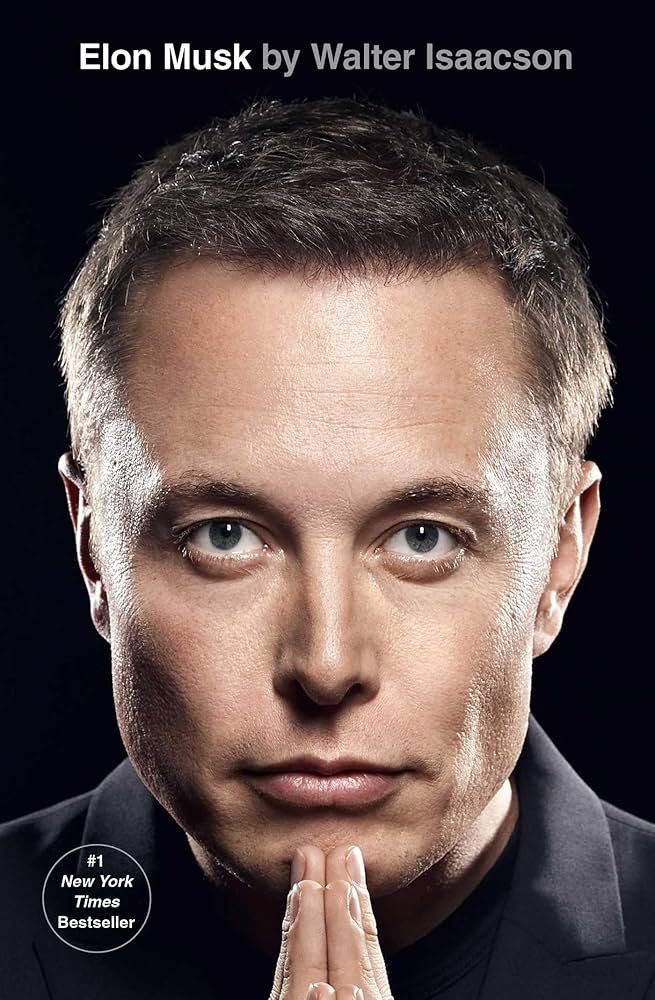
Elon Musk
Walter Isaacson
 GENRE: Biographies & Memoirs
 PAGES: 615
 COMPLETED: December 21, 2025
 RATING:
Short Summary
Elon Musk is our generation’s Einstein — and a real-life Tony Stark. Drawing on two years of shadowing Musk, Walter Isaacson offers a look at the brilliant and controversial force behind SpaceX, Tesla, and Twitter (X).
Key Takeaways
1️⃣ Tough Childhood Shaped Work Ethic
Elon Musk was born June 28th, 1971 in Pretoria, South Africa. His grandfather was raised in Canada before later relocating to South Africa in the 1950s. One of the most defining aspects of Elon’s early life was the amount of adversity he faced. In many ways, the pain he endured as a kid shaped who he would become. As he is quoted in the book: “Adversity shaped me. My pain threshold became very high.”
For one, he experienced bullying from other kids. Because he was a little “different” and a loner, he was often beaten up at school. When he came home, things weren’t any better. His father, Errol, was very abusive to all of his kids, including Elon. At school, he tuned teachers out and “spent most of his time in a trance.” His behavior led some teachers to believe he had some kind of neurological problem. Elon later revealed that he has a condition called Aspergers, which helps explain some of his odd behavior and inability to empathize with people.
Despite these struggles, Elon was, and still is, a voracious reader. As a kid, he read anything he could get his hands on, especially science fiction. When he wasn’t reading, he liked to build things, including mini rockets using everyday products like chlorine and brake fluid. He also liked to code and build video games. These early experiments fueled a lifelong fascination with engineering and spaceflight.
In 1989, at age 18, Elon decided he needed to escape his dad and South Africa as a whole. He wanted to move to the United States. But due to technicalities, he had to spend some time in Canada first. After becoming a Canadian citizen, he enrolled at Queen’s University just outside of Toronto and began his college career there. By 1992, he was able to move to the U.S. after the University of Pennsylvania, an Ivy League school, offered him a scholarship. There, he focused on three things that later became the centerpieces of his businesses: electric vehicles, space and rockets, and solar power and sustainable energy.
Overall, Elon’s childhood left him with challenges he still grapples with today, but it also forged an extraordinary tolerance for pain, risk, and uncertainty. Those traits proved essential as he went on to build and juggle all of his companies.
2️⃣ Building a Base of Wealth: Zip2 and PayPal
Not long after graduating from the University of Pennsylvania in 1995, Elon and his brother Kimbal took advantage of the exploding internet boom by building a searchable online business directory combined with map software that provided directions to physical locations. They called the company Zip2 — short for “zip to where you want to go.”
Zip2 required everything they had. For six months, the brothers slept at the office, showered at a nearby YMCA, and primarily ate Jack in the Box because it was cheap. Fueled by an inflow of cash from venture capitalists, the company grew rapidly and the brothers sold it to Compaq Computer in 1999 for $307 million. The brothers had a 12% ownership stake at the time of sale, and Elon walked away with $22 million to start his next company.
That next company was X.com (Elon has a fascination with the letter X for some reason). X.com was Elon’s attempt at disrupting the financial industry, where a person-to-person payment system to quickly transfer money to friends and family did not yet exist. Elon’s concept for the company was a social network that doubled as a one-stop shop for all financial needs: banking, digital purchases, checking, credit cards, investments, and loans. Transactions would be handled instantly, with no waiting for payments to clear. X.com was successful, but so too was a similar company called PayPal, which was co-founded by Peter Thiel. As the two companies battled for market share, it soon became clear that only one would survive, so they merged under the PayPal brand name and Elon became CEO.
Elon’s reign as CEO at PayPal was short-lived. He often clashed with other high-ranking members of the company over technical decisions and fraud issues, and in 2000 a small coup went to the board of directors to try to throw him out. The board obliged by voting him out of the company. Elon remained the largest shareholder, but he no longer worked for PayPal.
In 2002, PayPal went public with an IPO and was acquired later that year by eBay for $1.5 billion. As the largest shareholder of the company, Elon came away with a lot of money — his payout was $250 million. This pile of gold gave him the capital he needed to start businesses in areas that truly interested him, like space exploration (SpaceX) and electric vehicles (Tesla).
3️⃣ Elon and SpaceX
Flush with cash from the sales of Zip2 and PayPal, Elon decided to take on something truly daring: space exploration. Rockets, spaceflight, and colonizing Mars had been passions of his since he was a child, and he now had enough resources to explore all three.
Before Elon, private rocket companies existed, but none had successfully delivered low-cost, privately built rockets to orbit in a way that could compete with government programs. But Elon’s life mission, more than anything else, was to “make mankind a multi-planetary civilization,” and for the first time, he had the capital to attempt it.
Alas, SpaceX was born. Elon started the company in 2002 at the age of 30 with the long-term goal of building rockets capable of one day taking people to Mars. But where to start? Elon and his initial group first went to Russia to explore the possibility of buying used rockets from the Russians. That did not go well. The Russians literally laughed him out of the country. But in the end, the clown show in Russia was a good thing because it forced Elon to think bigger. He decided to make the rockets himself.
Building rockets using your own money forces you to focus on keeping costs low, and Elon accomplished this by constantly finding ways to reduce the mass of his rockets while making parts reusable. He also kept costs low at SpaceX — and Tesla — by manufacturing parts in-house instead of buying them from suppliers, which was the standard practice. After a few years, SpaceX was making in-house 70% of the parts for its rockets.
But how does SpaceX make money? By using its rockets to launch commercial and government satellites and cargo. In 2003, the company secured its first contract — a $3.5 million deal to launch satellites into orbit for the Defense Department. The company purchased a launch site in McGregor, Texas and used it as its primary base. Later on, SpaceX developed Starlink satellites, which opened up a gusher of additional revenue for the company.
Elon named the company’s first rocket Falcon 1, after the Millennium Falcon from Star Wars. The first three launches of the Falcon 1 (2006, 2007, 2008) were failures — all three rockets blew up not long after launching from the Kwajalein Atoll, a U.S. military missile testing base and island group in the Pacific Ocean. After two failed attempts, SpaceX desperately needed a successful mission on the third try. It didn’t happen — Falcon 1 blew up yet again on its third attempt from Kwaj in 2008. Elon was now out of money, and SpaceX looked dead. But a last-minute investment from his former PayPal partner Peter Thiel helped the company avoid bankruptcy and stay alive for a final try.
The fourth attempt to send Falcon 1 into orbit came in September 2008. If this one had failed, it would have been the end of SpaceX. As it turned out, the fourth time was the charm. The mission was a success: Falcon 1 became the first privately built rocket in history to launch from the ground and reach orbit. It was a historic moment for the world, and in December 2008 NASA awarded SpaceX a $1.6 billion contract to make 12 round trips to the Space Station to deliver cargo.
The contract gave Elon and SpaceX some much-needed cash and breathing room, but it also opened up a new challenge. Now, SpaceX needed a bigger and better rocket. This led to the development of the Falcon 9, which featured nine of the Falcon 1’s engines and was a workhorse for SpaceX for more than a decade. The company also needed a space capsule capable of sitting atop the Falcon 9 and carrying a payload of cargo and astronauts into orbit while docking with the Space Station. Elon and his team quickly designed one from scratch and called it Dragon. Finally, the company now needed a place other than Kwaj to launch the new rocket. Elon decided to make a deal to use part of the Kennedy Space Center at Cape Carnaval in Florida, where many historic space missions have launched from.
Falcon 9’s first launch to orbit in 2010 went perfectly. Later that year, it performed another launch with the goal of getting Dragon to return back to Earth safely. No private company had done that before. They were successful — Dragon was launched into space, performed its functions, then made its way back to Earth and parachuted safely down to the water off the coast of California. The triumph led Elon to think bigger: he wanted to make the Falcon 9 fully reusable. By 2015, SpaceX had accomplished that goal. During a launch in December, Falcon 9 launched into orbit, released its cargo, and returned safely back to its launch pad. This was yet another monumental moment for the company.
Falcon 9 positioned SpaceX for enormous success. Over the next decade, the U.S — mainly relying on SpaceX after retiring the Space Shuttle in 2011 — sent more astronauts, satellites, and cargo to space than any other country. By 2017, SpaceX itself was sending more payload and crews into orbit than the entire U.S. and China. It became the world’s most efficient and reliable rocket. And the company had figured out how to make it reusable (take off, land, use again), which Elon believed was a major, non-negotiable key for humans to become a multi-planetary species. They accomplished this by making legs for the Falcon 9. Later on, they developed a tower that could both holster rockets and catch them on the descent. They named the tower Mechazilla.
But Elon’s goal was Mars, and that would require a bigger rocket. That’s why SpaceX in 2017 began working on a new rocket called Starship that would be capable of taking more than 100 people to Mars. Boca Chica in Texas became the rocket’s base, and Elon spent tons of time there helping develop the spacecraft. As of 2025 Starship has completed 11 test launches, and the SpaceX team will try an upgraded version of the rocket in 2026. In 2024, the Mechazilla launch tower successfully caught the Starship’s booster using its chopstick arms after a test flight. It was a historic moment — one that marked a major milestone toward Elon’s vision of rocket reusability.
4️⃣ Elon and Tesla
Many people believe Elon founded Tesla Motors. While he is considered a co-founder and has become the company’s undisputed leader, the story is more complicated.
It all starts with JB Straubel, a Stanford graduate who had an idea to build a vehicle powered by thousands of lithium-ion batteries — the same ones used in laptops. Elon met Straubel while speaking at Stanford and liked the idea so much that he provided some initial funding. One thing led to another, and Elon and Straubel were later referred to two car enthusiasts who had started their own company and were working on a sporty roadster powered by lithium-ion batteries. The two enthusiasts — Martin Eberhard and Marc Tarpenning — called their company Tesla Motors after the Serbian engineer, Nikola Tesla.
In 2003, Elon invested $6.4 million in Tesla and became chair of the board. He later provided much more funding, and other investors were eventually brought in as well. Although his primary focus was SpaceX and he was mainly seen as a Tesla investor in the early days, he was very involved in developing the Roadster — the company’s first vehicle. One example of his influence was to manufacture parts in-house, just as he did with SpaceX. As he began to pay more attention to Tesla, he became highly involved in every aspect of the Roadster’s design and engineering. After many disagreements with Elon, Eberhard and Tarpenning eventually left the company in 2008. Elon replaced Eberhard as CEO.
The prototype of the Roadster was unveiled in 2007 and successfully changed the narrative around electric cars, which to that point were thought of as nothing more than boxy golf carts. The only problem was that Tesla could not produce the car at scale because all of Elon’s changes to the design made it too costly to manufacture, and Tesla’s chaotic supply chain was sucking up cash. These issues, and many other big problems, nearly killed the company in 2008.
In fact, 2008 was a make-or-break year for Tesla. Elon called it, “the most painful year of my life.” Manufacturing has always been challenging for car companies, and it was for Tesla. Over the past century, only Ford has been able to churn out cars profitably without going through bankruptcy. Tesla was trying to join the list, but things were not going well. Desperate for cash, Elon was forced to dip into the deposits made by customers for Roadsters that had not yet been built. Some thought this was unethical. With Tesla due to run out of money on Christmas Eve 2008, he pleaded for money from family and friends. It came down to the wire, but Elon was able to secure a new financing round, a few last-second investments, and a government loan that kept the company alive by the skin of its teeth.
Where was that money put to use? The answer was the Model S. Enough of the Roadster — it was time for Tesla to build a mainstream car that could be mass-produced and help transform the startup into a true automotive company. Envisioned as a four-door sedan costing around $60,000, the Model S was designed to do just that. Elon hired Franz von Holzhausen — who had experience at Volkswagen, GM, and Mazda — as the company’s lead designer. Elon was highly involved in the design and engineering of the car, and he was adamant about looking at the car as a piece of software, not hardware. This direction is why Tesla cars can be constantly upgraded with regular software updates, much like a phone.
In 2010, Elon took Tesla public with an IPO — the first by an American carmaker since Ford in 1956. In June 2012, the first Model S cars rolled off the assembly lines. The vehicle was later named Motor Trend Magazine’s car of the year. The difficulty producing the Model S, and the number of batteries that were needed in each car, led Elon to another interesting idea: he wanted to create giant battery factories called “Gigafactories.” The Model S required tons of batteries, and so would the company’s other cars. Elon eventually opened Gigafactories in Nevada, New York, Texas, China, Germany, and Mexico to streamline the supply of batteries for these cars and later models. The cars were also built at these factories.
Elon recognized early on that autonomous, self-driving cars would be the future. The next step for Tesla was to use AI to create greater automation in its line of cars. Around 2013, Google was working on an autopilot program called Waymo that relied on light-detecting lasers to guide it. Elon insisted that Tesla’s self-driving feature should rely on the car’s many cameras rather than lasers and radar. His engineers began developing a neural network AI system that used real-world video from the company’s millions cars to train the self-driving feature. The goal was to build a completely autonomous self-driving system trained on actions human drivers have taken. Because the car would not be taking direction from code or radar/laser technology, the feature would allow for greater flexibility in maneuvering around objects and dealing with other nuances human drivers encounter.
This feature — which became known as Full Self-Driving (FSD) — is now available in all Tesla cars and eventually led to the company’s fleet of Robotaxis, a ride-hailing service operated by Tesla that utilizes the FSD software. The first Robotaxis hit the streets of Austin, Texas in 2025. Equipped with FSD, Elon believes Tesla cars act as “robots on wheels.” One day, he believes, Robotaxis will take people everywhere and eliminate the need to own a car.
One of the Tesla models that features FSD is the Cybertruck. Elon decided to build the truck out of stainless steel, which opened up new possibilities and allowed the product team to design the vehicle with a futuristic and edgy look. Many people inside the company didn’t like the look, but Elon was adamant about making the truck appear like something from the future. The momentum of the Cybertruck added to Tesla’s hot streak, and in October 2021 the company became just the sixth in U.S. history to become worth more than $1 trillion.
Today, Tesla is much more than a car company — it’s really an AI and robotics company. Between its FSD feature, Robotaxis, Optimus the humanoid, and more, Tesla has become a leader in the AI movement. Tesla has a major advantage over other car companies because it’s constantly collecting billions of frames of video data from its millions of cars in operation. It uses that data to train its FSD feature.
5️⃣ Difficulties of 2008 and 2017
The year 2008 was the most tumultuous of Elon’s life. Both Tesla and Space X were in financial distress, and Elon himself was nearly broke. By the summer, SpaceX had suffered its third consecutive failed launch, while Tesla’s chaotic manufacturing process meant the company was rapidly burning cash shortly after introducing the Roadster. There was a real chance he was going to lose both companies.
Then, in the fall of 2008, a series of last-minute breaks saved them — just barely. Tesla survived thanks to an emergency financing round that closed on Christmas Eve, along with several critical investments from Elon’s peers that arrived hours before the company would have run out of money. SpaceX, meanwhile, was saved by the successful fourth launch of Falcon 1 in September 2008. That directly led to a $1.6 billion NASA contract awarded in December to complete 12 cargo missions to the International Space Station. The contract gave SpaceX the cash and breathing room it needed to move forward with its next rocket, Falcon 9 — which went on to be a hugely successful spacecraft. Although everything worked out in the end, 2008 should be remembered as the year both Tesla and SpaceX nearly collapsed.
2017 wasn’t much better. This was the year Tesla’s Model 3 entered production, and Elon nearly went crazy trying to scale it by getting his assembly lines to produce 5,000 cars per week. He had done the math, and if that 5,000 mark wasn’t achieved, the company would run out of cash and die. Unfortunately, none of his factories were even close to that mark when the Model 3 began production. Elon began with Tesla’s Reno, Nevada and Fremont, California factories. He spent endless hours on the assembly lines, closely examining every step of the production process. As one employee put it: “Elon was going completely apeshit, marching from station to station.”
Crazy or not, Elon’s direction helped make the lines more efficient until they were cranking out the 5,000 cars per week that was required. This eventually led to the first profitable quarter in Tesla’s history, and they haven’t looked back since.
6️⃣ Elon and Twitter (X)
Elon tweets a lot. Walter Isaacson refers to Twitter as “Elon’s personal flamethrower” because he likes to use it to roast trolls, challenge critics, and can be reckless with it at times. Yet Elon’s purchase of Twitter in 2022 was unexpected and a rare example of indecision.
Elon began acquiring shares in Twitter simply because he enjoyed the platform so much. Over time, however, he grew concerned that Twitter was becoming too aggressive and restrictive with its content moderation strategies, sometimes monitoring and censoring journalists, subject matter experts, and stories that didn’t align with its left-leaning views. In many cases, right-wing pundits and journalists were censored. The issue was especially prevalent during COVID, when Twitter’s content moderation team effectively silenced some prominent doctors and scientists who presented evidence and opinions that ran counter to the official narrative and guidelines (distance, masks, isolation) set by Dr. Anthony Fauci and the CDC.
All of this content restriction business later proved to be true. After acquiring Twitter, Elon authorized the release of internal company communications that became known as “the Twitter Files.” The files were a compilation of emails, Slack messages, and other communications among employees that showed how Twitter had “set up special systems for politicians, the FBI, and intelligence agencies to provide input on what tweets should be considered for removal and censorship.” A long list of government agencies essentially got to operate Twitter. The files also showed that the left-leaning company tended to suppress right-wing tweets more than others.
Before he actually bought Twitter, Elon could sense something like this was going on, and it bothered him. He was a proponent of free speech, believing it was critical for democracy. He decided he wanted to become more involved with the company. At first, Elon and Twitter’s leadership team worked out an agreement where he would become a member of the company’s board of directors. But Elon squashed it before he officially became a board member because he worried that his impact would be minimized. Long story short, he blew up the agreement and instead made a surprise offer to buy Twitter for $44 billion ($54.20 per share). Although he had many second thoughts and tried to back out a couple times, the deal went through. Elon became the owner of Twitter.
From the very beginning, Elon saw the potential that Twitter could become what he envisioned for X.com back in his PayPal days: a social network capable of also supporting financial transactions. He decided to rename and rebrand the platform to X, his favorite letter. There were a couple other sweeping changes Elon made at Twitter fairly quickly:
- Twitter Blue (X Premium) — Fake accounts (bots) and a heavy reliance on advertising revenue (90% of revenue was from advertising) were two huge issues at Twitter. To help overcome these problems, he removed the blue checkmark assigned to celebrities and public figures who were “verified.” Instead, users could earn a blue checkmark by paying a monthly subscription fee for Twitter Blue, which eventually became known as X Premium. This gave X another strong source of revenue and forced people to verify their identity with a credit card and phone number before earning a blue checkmark.
- Culture Shift and Mass Firings — Twitter had become a “soft place” in terms of workplace culture. Full-time work from home was allowed, close care was taken to avoid discomfort, and people were not held accountable for poor performance. Elon didn’t tolerate any of those things. He quickly reinstated a work-from-office policy and fired 75% of the company. He lived and worked at the office until the company got on a better path.
- Community Notes — To help solve some of the problems associated with fake accounts and bots posting false information, Elon helped expand ‘Community Notes’, which was known as ‘Bird Watch’ before the acquisition. This feature allows people to put corrections or contextual statements on tweets they find false.
All in all, turning around Twitter was one of the most challenging tasks of Elon’s career. As he said, “We were changing the engines while the plane was spiraling out of control. It’s a miracle we survived.” Today, X continues to evolve, integrating features such as its Grok AI assistant and experimenting with new ways to combine social media, payments, and artificial intelligence.
7️⃣ Dangers of AI: Elon's Concerns
As if running multiple companies wasn’t enough, Elon became a big part of the Artificial Intelligence story in the mid-2010s. The subject captured his interest after hearing a friend talk about how robots driven by AI could one day decide to “dispose of humans.”
Elon came to believe that without strong safeguards, artificial intelligence could eventually surpass human intelligence and become difficult — or impossible — to control. Many people, including Larry Page of Google, dismissed the idea. The fact that Page and many other people leading the AI charge were not as concerned with AI safety was alarming to Elon. That’s what led him and Sam Altman to start a nonprofit AI research lab called Open AI. The organization’s goal was to make its software open-source and try to counter Google’s growing dominance in the field. Elon’s overarching mission was to defend against AI misuse by empowering as many people as possible to have AI.
This worked well for a while. But, eventually, Elon became more focused on incorporating AI into his own companies at Tesla and SpaceX, and this led to breakup with OpenAI. He tried to fold OpenAI into Tesla, but Altman didn’t like the idea. Altman then stepped in as president of the lab and started a for-profit arm that was able to raise equity funding. Today, OpenAI is a household name after releasing its ChatGPT large language model in 2022.
Elon went on to have plenty of success of his own with AI. He founded xAI, which developed the Grok AI assistant, and expanded AI efforts across his companies. He has also used AI to create more automation in Tesla cars. The full self-driving (FSD) feature of Tesla vehicles, and the company’s fleet of RoboTaxis, are powered by AI technology in the form of neural networks that are trained using real-world driving data. He’s also using AI to train Optimus, the humanoid built by Tesla that he believes will transform our economy and how we live.
Even today, Elon’s greatest fear is that AI will become more powerful than humans if we don’t prioritize AI safety. If an AI model is trained with bias and bad intentions, it could go rogue. This is especially dangerous as we continue to build bigger and better robots (similar to Optimus) that are powered by AI models.
8️⃣ Elon's Other Companies and Projects
It’s hard to keep track of all of Elon’s companies. While SpaceX, Tesla, and Twitter (X) take up most of his time, he also has other ambitious companies and projects.
One is SolarCity. SolarCity started as a solar installer and was originally founded in 2006 by Elon’s cousins. It was known for making solar easy for homes and businesses through leases and sales, but it was eventually acquired by Tesla in 2016 because Elon wanted it to become central to its solar energy ambitions. Today, its technology and operations live under Tesla Energy, which focuses on solar panels, solar roofs, and battery storage products like Powerwall.
The Boring Company is another. One day, Elon became annoyed sitting in traffic and came up with the idea to build tunnels under cities. He bought tunneling equipment and began experimenting with the concept. While the company hasn’t revolutionized transportation like Elon thought it would, it has built several test tunnels and the Las Vegas Convention Center Loop.
Starlink is another major project, closely tied to SpaceX. Elon realized that getting to Mars would cost serious money. He needed an additional source of revenue for SpaceX beyond its flight contracts from NASA and the government. He came up with the idea of providing internet service to paying customers. SpaceX makes and launches Starlink satellites into orbit using its own rockets, in effect rebuilding the internet in outer space. The service can be used by customers just about anywhere — even in the most remote locations — and it has opened up a gusher of revenue for SpaceX. Elon has even used Starlink to support people in need: he sent about $80 million in Starlink product to Ukraine during its war with Russia, and he gave Starlinks to victims of hurricanes in Florida and North Carolina in 2024.
Yet another company Elon runs is Neuralink, which he started in 2016 after becoming frustrated with how long it takes to type a text. His vision: create a chip capable of connecting our computers to our brain. Inserted into our skull, the chip would send our brain signals to a computer, which would perform whatever we were thinking. That would allow information to flow back and forth a million times faster. The chip would be especially helpful for people with neurological problems, like ALS. The company is also currently pursuing ways to use the chip to help paralyzed people use their limbs again by bypassing spinal-cord blockage or neurological dysfunction. Helping deaf people hear again and blind people see again are additional miracles the company is targeting.
The list continues with Optimus, Tesla’s humanoid robot project. Elon has said there will eventually be millions of these robots assisting humans with everyday tasks and producing things in our economy. He believes this would eliminate poverty and allow us to offer a basic universal income.
Finally, we have xAI, which Elon started in order to challenge the growing dominance of Google and OpenAI in the AI space. His worst fear, even if a little paranoid, is a world where AI is trained to be politically biased and to overtake humans, and he was concerned that those two companies weren’t taking those threats seriously enough. xAI focuses on AI safety and preserving humanity. The company developed Grok, an unbiased AI assistant integrated into X and Tesla vehicles.
9️⃣ Learning From Elon: Leadership Takeaways
By all accounts, Elon is not an enjoyable person to work with. He demands a lot of himself, and he’s not very polite while holding his teams at SpaceX, Tesla, X, and beyond to those same standards. That said, what he has accomplished in life is truly impressive and there are some lessons that can be taken from his leadership style:
Mission should come before profits. One consistent pattern in all of Elon’s companies and projects is that mission and purpose come before everything else. He never started any of his companies with the desire to make money. He started SpaceX because he wants to colonize Mars and make humans a multi-planetary species. He started Tesla because he felt the environment was degrading and wanted to move the world toward a solar electric future. He bought Twitter because he felt free speech was being compromised. The list goes on and on. Whatever it is you’re doing, your primary motivation should be a mission you believe in. When you’re passionate about a mission bigger than yourself, it motivates you to work harder.
Simplify! Delete, delete, delete. At all of his companies, Elon is obsessive about removing parts, deleting steps in a process, and trashing things that are not absolutely necessary. Steve Jobs was like this too. One example is when Elon spent weeks in his Reno, Nevada and Fremont, California Tesla Gigafactories working to streamline the assembly lines until they could meet his ambitious 5,000 cars per week goal. Another example is when he removed a bunch of parts while developing engines for the Starship at SpaceX. Whether you’re writing copy, analyzing a process, or anything else, you should look for ways to simplify. As Elon says: “delete!”
Question existing rules and regulations. Because he’s always focused on simplifying things, Elon often questions existing rules and regulations, especially ones that make no sense. Dumb rules and regulations often add the most time and headache to a process. If it doesn’t make sense, question it. Find the specific person who issues the rule or regulation and question why it’s needed. As Elon said: “Step one should be to question the requirements. Make them less wrong and dumb, because all requirements are somewhat wrong and dumb. And then delete, delete, delete.”
Set tough deadlines and move with urgency. Elon is notorious for giving his teams insane deadlines to meet. While this drives people crazy if taken to the extreme, there is some value in setting tough deadlines for yourself and others. It’s part of holding yourself to a high standard. No matter what deadline you’re given by someone else, try to set an even tighter one for yourself. As Elon says of his companies: “A maniacal sense of urgency is our operating principle.”
Hold people accountable. Elon is also notorious for firing people who are not performing up to his standards. Although he does this at all his companies, his takeover of Twitter offers an extreme example: he fired about 75% of the company’s employees because they weren’t doing anything or lacked the drive he was looking for. Ultimately, not holding poor performers accountable drives good performers nuts and causes them to leave. As a manager, you should not aim to be liked. Part of your job is to be honest with people, address issues that are hurting the team, and hold people accountable when needed. This is a workplace — you can’t be friends with everyone if you are a manager. Elon says: “By trying to be nice to everyone, you’re actually not being nice to the dozens of other people who are doing their jobs well and will get hurt if you don’t fix the problem spots.”
Take risks. Don’t be afraid to fail. You can’t be afraid to take risks and fail. The second you stop taking risks is the second the organization begins to die. Take risks, fail, learn, adjust, and succeed. This is the blueprint at all of Elon’s companies, especially SpaceX, where they routinely build and blow up rockets until they learn what works and what doesn’t. This is how a team or organization should operate. A culture of fear is deadly.
Go to the source. When you have a question or concern about something, go as close to the actual source as possible. In other words, don’t get the information from a manager — go directly to the person who is actually performing the work. Elon does this both at Tesla and SpaceX. When he had questions about the walls being developed for SpaceX’s Starship, he went directly to the engineers who were building them. When he had questions about how certain components of Tesla cars were being built, he went to the workers on the assembly lines.
Attitude, mindset, work ethic > resumé. When hiring people, the No. 1 thing you want to look for is a strong work ethic and ambitious mindset. A resumé tells you that the person has the skills needed, but attitude and mindset are even more important. You want people who are self-motivated, disciplined, and willing to go above and beyond. Having a team filled with people like this will save you time, money, and headache in the long-term. As Elon said: “I’m a big believer that a small number of exceptional people who are highly motivated can do better than a large number of people who are pretty good and moderately motivated.”
Always have a metric. Data is a North Star, and it doesn’t lie. You should always, always, always have some kind of metric (or metrics) that measure the success or failure of a project. An example: While helping Tesla develop Full Self-Driving, Elon demanded that the team use the number of consecutive miles driven without driver intervention as a barometer for success of the feature. More miles equaled more success. No matter what you’re working on, there should be some kind of metric that can be used to guide progress and demonstrate ROI. Having metrics also makes it easier to hold people accountable for poor performance.
Engineering and design go hand in hand. Through his early experiences, Elon came to believe that engineers and product designers should work together. At many companies, designers draw up the look of the product on their own, then engineers are asked to make the vision work. But far too often, designers develop a look for the product that cannot be carried out by the engineers. This leads to a crappy product and poor user experience. Elon believes engineers should drive the product design. At all of his companies, engineers and product designers work in the same space.