
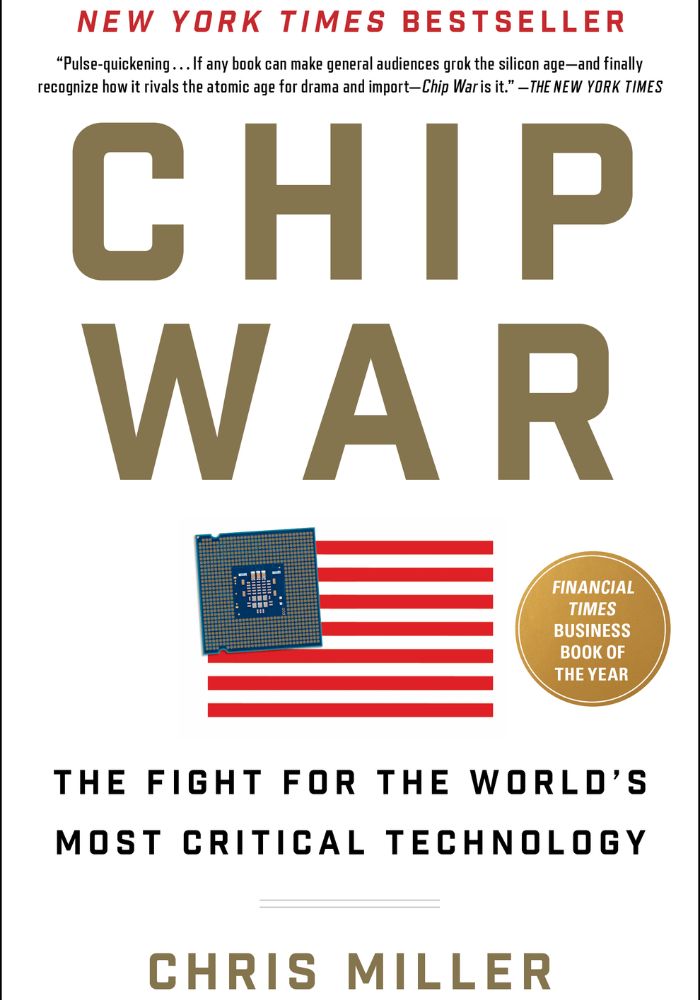
Chip War
by Chris Miller
- 385 pages
- August 5, 2026
- ⭐️ ⭐️ ⭐️ ⭐
- 385 pages
- Completed on August 5, 2026
- 385 pages
- August 5, 2026
- ⭐️ ⭐️ ⭐️ ⭐
Short Summary
In the age of AI, the battle for chips has never been more intense. In Chip War, Chris Miller explains what chips (semiconductors) are, why they are critical to the global economy and U.S. military, and how the race to develop and control these tiny pieces of silicon might determine the balance of power for decades to come.
My Takeaways
1️⃣ Chips Power Our Devices, Our Military . . . and Our World
In our modern digital world, almost everything has a chip in it. Cell phones, cars, refrigerators, laptops, iPads, smartwatches, and an endless number of other everyday electronics are packed with, and powered by, tiny chips that are often barely bigger than a fingernail.
What is a chip? A chip is essentially a piece of silicon etched with millions or billions of transistors, which are tiny electrical switches that turn on and off and allow our devices to perform calculations, process information, and store memory. The device’s battery provides the electricity that powers the chips. Chips are also commonly called semiconductors, which are a unique class of material. Most materials in our natural world either let electric current flow freely (e.g. copper wires) or block current (e.g. glass). Semiconductors — like silicon — are different because they hardly conduct any electricity on their own, but when certain materials are added and an electric field is applied, electric current can begin to flow.
In the case of chips, transistors (i.e. electric switches) carved into a semiconductor like silicon are what allow electric current to flow through and supply power to our devices. In this way, you can think of transistors as computing power — the more of them that are carved into a chip, the more potential computing power the chip contains. At the time they were first introduced, in the 1950s, chips were revolutionary because they provided much more power, in a much smaller package, than anything that was in existence at the time. Today, there are many different kinds of chips that serve a wide variety of roles in our devices, but there are a few worth singling out:
- Logic Chips — These chips perform calculations and process information. The CPU (central processing unit) inside a PC is an example of a logic chip. Logic chips power our smartphones, computers, iPads, and cloud data servers. Logic chips are usually customized and specifically designed to match the needs and purpose of the device it powers.
- Memory Chips — Memory chips store information, and the DRAM memory chip is found in most of our devices. Memory chips don’t usually need to be specially designed because they simply store memory — they can be made one way and stuffed into a bunch of different electronic devices. This ability to be used in a wide variety of devices means they can be mass produced by chip companies like Intel. In fact, Intel initially built its empire on DRAM chips. NAND chips — which are used in flash drives — are another type of memory chip.
- GPUs — GPUs are graphics processing units, and they are a specialized type of logic chip. GPUs were originally designed to render complex graphics and images, particularly 3D graphics. But GPUs are also really good at performing large numbers of calculations, making them highly effective for training and running AI models in data centers. GPUs weren’t nearly as important in the early days of the chip industry because the computing needs of the time were fairly basic compared to today. The rise of AI in the 2020s has turned GPUs into a massive deal. Today, they are in extremely high demand as companies develop AI systems and train AI models in their data centers. This is why Nvidia — the world’s leading designer of GPUs — has become the most valuable company in the world.
- Logic Chips — These chips perform calculations and process information. The CPU (central processing unit) inside a PC is an example of a logic chip. Logic chips power our smartphones, computers, iPads, and cloud data servers. Logic chips are usually customized and specifically designed to match the needs and purpose of the device it powers.
Chips don’t just power our phones and mocha machines; they have also completely revolutionized our arsenal of military weapons. Tons of chips are loaded into our most advanced military planes, missiles, bombs, satellites, and radar technology. In the 1960s and 1970s, during the middle of the Cold War, the Soviets possessed a military that was nearly as formidable as ours. But the U.S. was well ahead of the Soviets in computing and chips, and we leveraged that lead to transform our weapons systems and add to our position as the top military in the world. Today, chips are packed into most of our weapons and allow us to strike targets with remarkable precision. To retain our advantage as the top military in the world, it’s important that we maintain our lead in chips and computing — especially in the age of AI.
Although the military was one of the chip industry’s first big customers, consumer products are where chip companies make most of their money today. Smartphones alone account for around 25% of the chip industry’s revenue. When you pay for a new phone, most of the money is being used to pay for the chips inside it. The wide variety of chips loaded into a smartphone — there can be a dozen or more in a single phone — are what make it work. There are chips that manage the battery, Bluetooth, and Wi-Fi. There are chips that operate the phone’s audio, camera, and memory storage. There’s even a sensor chip that monitors where your phone is located in space; this chip is what tells your screen to rotate when you tilt your phone horizontally. An example: the iPhone 12 was powered by an A14 processor, a logic chip with 11.8 billion tiny transistors carved into its silicon.
While consumer products and the military continue to be focal points for the chip industry, AI has changed things drastically. AI systems and data centers require a gargantuan volume of chips, particularly GPUs. Understanding the vital link between chips and AI, big tech firms – Google, Amazon, Microsoft, Apple, Facebook, and others – are now pouring billions of dollars into designing their own chips. By 2023, Google, Meta, and Microsoft were spending $5-$10 billion per quarter on data centers, most of which went toward purchasing high-end chips that data centers require. As these companies compete with each other to win the AI race, they are buying an incredible amount of GPU chips. Nvidia, as the dominant supplier of high-end AI GPUs, has been one of the biggest beneficiaries of this spending. Here in 2026, it is the most valuable company in the world.
The takeaway here is that chips — and the billions of microscopic transistors built into them — power so many of the devices we use on a daily basis. And with the rapid rise of AI, they will continue to be an important part of our lives. Without them, we would not have many of the devices we rely on, and work with, every day.
2️⃣ Advances in Lithography Have Helped Shrink the Size of Transistors, Creating Massive Leaps In Computing Power
In the 1960s, as the chip industry was starting to hit its stride, Gordon Moore predicted that the computing power of chips would grow exponentially for at least the next decade. Moore, who co-founded both Fairchild Semiconductors and Intel, believed that chip firms would find ways to carve more and more transistors into their silicon wafers, which would lead to significant increases in computing power.
This prediction became known as Moore’s Law, and it is considered one of the most accurate forecasts ever made. For decades, chip companies continued to find ways to shrink transistors and pack more of them onto their chips, leading to huge increases in computing power. While the pace of this progress has slowed in recent years, the basic principle behind Moore’s Law has driven the chip industry for more than five decades. We seem to experience this progress every year as companies roll out new smartphones and laptops powered by even more powerful chips than the previous generation.
The growth and advancement of technology in the past two or three decades alone has been breathtaking. Whether it’s the iPhone’s release in 2007, the introduction of cloud services like Google Drive, or the birth of ChatGPT in 2022, we continue to develop new and better technology — and none of it would be possible without rapid advances in chips. Chips equal computing power. Advances in chips have allowed companies like Apple, for example, to develop faster, more powerful iPhones every year. Advances in chips are allowing companies like Tesla to develop the technology needed to execute autonomous driving. In fact, some cars today have as many as 1,000 chips in them!
These advances in technology require more computing power. We have found ways to create more computing power by shrinking the size of transistors and packing more of them onto chips. How? Lithography is the process of carving transistors into chips. It involves projecting a light source through a “mask” to create a specific pattern of light that is transferred onto a layer of photoresist chemicals covering the silicon wafer. The light reacts with the photoresist chemicals and creates the desired pattern on the silicon. From there, certain tools are used to etch the microscopic transistors into the chip. Fueled by the battery, electrons zip around on these transistors to power the chip.
In the early days of the chip industry, lithography was a fairly simple process that used very basic materials. The first light source ever used in lithography was a simple light bulb, for example. But as the years went on, there was a relentless desire to pack more transistors onto chips to create more computing power. Doing this required shorter wavelengths of light to carve into silicon wafers, and chip makers transitioned to ultraviolet light to make this happen. As the appetite for more computing power continued to grow, chip makers eventually began developing extreme ultraviolet (EUV) light, which creates even shorter wavelengths than ultraviolet light. These shorter wavelengths provide the ability to carve even tinier transistors into chips.
Today, EUV is the standard light source for the most advanced lithography machines. The process of using EUV to carve transistors into silicon is mind-boggling complex and expensive — not because the fundamentals of lithography have changed but because the process for actually creating and controlling the EUV light source is very difficult and costly. It took more than three decades to develop EUV, and today’s EUV lithography machines cost around $350 million each. Making these machines is so challenging and costly that there’s really only one company that can do it: a firm called ASML located in the Netherlands. ASML supplies advanced lithography machines to both the Taiwan Semiconductor Manufacturing Company (TSMC) and Samsung — the world’s two leading chip building companies.
By the late 2010s, EUV lithography allowed chip makers to pack billions of microscopic transistors onto chips. As the demand for better technology grows, the challenge will be finding ways to further shrink transistors and create more computing power.
3️⃣ Taiwan Is the Heart of the Chip Industry’s Supply Chain
One of the interesting things about the chip industry is that a tiny number of companies control the production of chips, and the industry’s supply chain primarily runs through Taiwan.
The reason for this is that designing and manufacturing advanced chips is incredibly expensive and complex. Other than Intel, and Samsung in Korea, there really are no companies that have the equipment, experience, and capital to do both at scale while maintaining solid profit margins. In the chip industry’s early days, many companies tried to design and build their own chips in-house. But it didn’t take long for leading firms at the time like Fairchild Semiconductor and Texas Instruments to realize that it was much cheaper to design chips internally, then outsource the actual assembly and manufacturing of chips.
Today, Taiwan is at the center of the chip universe. East Asia in general — including Taiwan and South Korea — builds 90% of the world’s DRAM memory chips and 75% of logic chips. While Samsung builds most of the DRAM memory chips in South Korea, the majority of logic chips are built by the Taiwan Semiconductor Manufacturing Company (TSMC), which also specializes in manufacturing GPU chips. Nvidia uses TSMC to build nearly all of its GPUs. Almost all of today’s advanced chips are designed by companies in the U.S. and other countries, then built by TSMC in Taiwan. In fact, Apple is TSMC’s No. 1 customer and outsources the assembly of nearly all of its chips to the firm. In many ways, the chip industry runs through Taiwan.
How did the little island of Taiwan become such a huge player in one of the world’s most important industries? In the 1980s, Taiwan Minister K.T. Li put Morris Chang — a former Texas Instruments engineer — in charge of developing a chip presence in Taiwan and essentially gave him a blank check to do so. Li felt that having a strong chip industry in Taiwan would strengthen its ties with the U.S. and offer protection against a potential attack from China.
Chang responded by founding TSMC. Unlike other firms around the world, TSMC from the start decided that it would not compete with its customers by designing chips — it would only build them for clients. Chang understood how expensive and challenging it was for companies to build chips in-house, so he envisioned TSMC being a partner that companies around the world could lean on to manufacture the chips they designed. This enabled chip firms to stop worrying about establishing factories of their own to build their chips and instead outsource assembly to TSMC instead. Over time, TSMC’s experience, scale, and equipment allowed it to become the go-to company for manufacturing chips.
Ultimately, the rise of TSMC was a great thing for the chip industry. Being able to ditch their factories and outsource the manufacturing of chips to TSMC allowed chip firms to improve their profit margins and use the extra cash to design better chips for a whole host of new devices, including smartphones. It also lowered some of the industry’s massive barriers to entry, opening the door for new companies with innovative ideas. A startup like Nvidia is a good example — if Nvidia had to both design and build its own chips, it may not have survived its first few years. Now, Nvidia designs cutting-edge GPUs and is the world’s most valuable company.
The point here is this: the chip industry’s supply chain is heavily dependent on a small handful of firms, most notably TSMC in Taiwan. TSMC has a monopoly on the manufacturing part of the supply chain because building advanced chips is enormously challenging and expensive. Many companies around the world have chosen to simply outsource that part of the process to TSMC and instead focus on designing cutting-edge chips. Things are unlikely to change — it would take decades for a new company to develop the experience and funding needed to compete with TSMC. The main threats to TSMC are an earthquake or an attack from China. Because the chip industry is vital to America’s economic and military strength, these threats are closely monitored by the U.S. government.
4️⃣ China Is Trying to Become a Chip Leader, But the U.S. Is Making It Hard
Up until fairly recently, China has been heavily dependent on foreign nations for its most advanced chips. Most of its chips were designed by companies in the U.S. and built by TSMC in Taiwan. This was all well and good for several decades, but things have changed.
In the 2010s, the leader of China, Xi Jinping, decided that this arrangement was a security and economic risk. From a security and military perspective, Jinping realized that relying on the U.S. and its allies for chips could compromise China. Why load your weapons, satellites, and radar systems with chips made by your rival? From an economic perspective, Jinping understood that there would be an even greater demand for chips in the years ahead as tech firms at home and across the globe began developing advanced AI platforms, cloud computing, autonomous vehicles, and more. For China’s economy to grow, its tech firms would need to be a leader in these areas. Becoming a leader in these areas would require tons of cutting-edge chips.
In the 2010s, Jinping decided to take action. At the time, China was the world’s leading chip customer — it spent more money importing chips than it spent importing oil. Jinping launched a series of initiatives and mandates designed to reduce China’s dependency on foreign nations for chips. The idea was to enhance China’s ability to produce chips at home while reducing its reliance on the U.S. and other foreign nations.
So far, the results have been mixed. Today, China is much less reliant on foreigners to design and build chips, but it is still well behind the U.S., Taiwan, and South Korea in many critical areas. But this doesn’t mean the U.S. isn’t watching China’s progress very closely. The two countries have become rivals in many areas, and the rapid rise of AI has only intensified things. Both nations are battling to become the leader in AI because the implications are massive. China is a communist nation that routinely censors people. The U.S. does not want China to have a major role in the direction and future of AI, and controlling the chip war is the key to preventing this from happening.
This is why the U.S. has actively tried to slow China’s chip ambitions in recent years. By 2019, it became clear that a Chinese company called Huawei could be a threat to the U.S. The company had become a world leader in developing telecom and networking equipment, and its R&D spend rivaled American tech giants like Microsoft, Google, and Intel. It produced hardware for cell towers, and it was becoming increasingly successful at designing cutting-edge smartphone chips. Huawei eventually became TSMC’s second biggest customer, behind Apple. The U.S. decided it needed to muzzle Huawei, and it did so by prohibiting the sale of U.S. chips to the company. The restrictions were later expanded to prevent foreign chip manufacturers that relied on certain U.S. technology and equipment — such as TSMC — from producing advanced chips for Huawei. Although Huawei is still one of China’s leading tech firms, these restrictions have been devastating.
The U.S. took things a step further in 2022 by banning the sale and export of chipmaking tools — including lithography equipment — to the entire nation of China. Nvidia’s most advanced chips were also banned from being sold and exported to China, although the company can still sell lower-end chips to China. Restrictions like these are designed to ensure China remains behind the U.S. and key partners like TSMC in chipmaking ability. We simply cannot allow China to gain an edge in chips or AI.
5️⃣ A Brief History of the Chip Industry: Chips Have Powered Every Major Technology Era
For a technology that was invented just 75 years ago or so, the impact that chips have had on our daily lives is incredible.
The first working semiconductor was demonstrated by Jack Kilby of Texas Instruments in 1958. A year later, Bob Noyce at Fairchild Semiconductor developed a more advanced silicon-based version. Together, these two companies essentially established the chip industry, and the eight engineers who founded Fairchild Semiconductor in Palo Alto, CA are widely recognized as key figures who helped launch Silicon Valley. The name makes sense: chips are made of silicon, and many of today’s top tech companies — which rely heavily on chips — are based in Silicon Valley.
Early on, the chip industry’s first major customers were military and space programs. One of the first customers for chips was NASA, which was trying to send astronauts to the moon in the 1960s and needed a guidance system for its rockets. NASA bought a truckload of chips from Fairchild and Texas Instruments for its Apollo program. Later, the Air Force purchased chips from Texas Instruments for its Minutemen II missiles. Supplying the U.S. military with chips to advance its arsenal of weapons was how the chip industry got off the ground. The military stuffed chips into missiles, satellites, radars, planes, torpedoes, submarines, and much more. During the Vietnam War, the U.S. dropped a record number of bombs, but most of them missed their target. Texas Instruments helped the military develop electronically guided weapons using advanced chips, and they were deployed in Vietnam with great success toward the end of the war.
Soon, consumer electronics became the primary target for chip companies. Chips powered the computer and PC revolution in the 1960s and 70s. In Japan, Sony was founded in 1946 and later became a world leader in building innovative consumer electronics. Sony used cutting-edge chips to power its devices, including the iconic Walkman (1979), which became one of the most successful consumer products ever. The U.S. intentionally helped Japan rebuild its economy and become a leader in electronics after World War II. It was a crucial part of the U.S. Cold War strategy — helping Japan rebuild and thrive through electronics made the Japanese more reliant on the U.S. and prevented communist nations like Russia and China from overtaking them.
In 1968, Bob Noyce and Gordon Moore broke away from Fairchild Semiconductor to start Intel. Two years later, Intel produced its first product: a Dynamic Random Access Memory chip, or DRAM. The DRAM chip was vital to Intel’s early success and is still the main memory chip used in computers today. But Intel’s real breakthrough came later on when it designed a cutting-edge logic chip for computers. They called it a “microprocessor.” As PCs became increasingly popular in the 1980s and 90s, Intel ballooned into a massive company because it provided huge PC companies like IBM with the logic chips they needed. With the exception of Apple’s Macintosh computers, basically every PC used Intel chips. This gave Intel a near-monopoly on chip sales for PCs. This mastery of the PC ecosystem is what allowed Intel to become such a massive company.
Even as computers and consumer electronics became the focus for many chip companies, the military never went away. American defense firms continued to pack their newest planes, tanks, satellites, radars, missiles, and rockets with as many chips as possible, enabling better guidance, communication, and command and control. The U.S. used its lead in the chip industry to bolster its position as the world’s leading military power. Using advanced chips, the U.S. has built weapons systems that no other country can match.
By the mid-2000s cloud computing began to emerge, giving chips a new use case. The data centers and servers responsible for storing and processing massive amounts of information in the cloud require an enormous amount of chips. Cloud services like Google Drive and Microsoft OneDrive helped drive huge demand for CPU logic chips, and Intel was particularly well positioned to benefit because its CPU logic chips dominated the server market. As big tech firms built massive data centers to support cloud computing, Intel became even more successful.
Today, the chip industry is hyper-focused on AI. No company was better positioned to take advantage of the AI boom in the early 2020s than Nvidia, which was founded in 1993 by three individuals, including Jensen Huang, who serves as the company’s CEO today. From the beginning, Nvidia specialized in GPU chips — which help render complex, 3D images — and its first customers were video and computer game companies. Today, Nvidia’s GPU chips are the preferred choice for AI companies. The company’s GPUs play a vital role in rendering the images and graphics produced by AI and are essential for training and running AI models. Training AI models requires a huge number of GPUs. The massive AI demand for Nvidia’s GPUs has helped the company’s valuation explode. Since 2022, Nvidia’s share price has increased about 1,800%, and it is currently the world’s most valuable company.
Overall, the evolution of the chip industry is remarkable. Chips first found their way into military weapons and spacecraft, then transformed consumer electronics, powered the PC revolution, became the backbone of cloud computing, and are now at the center of the AI revolution. Each technological era has demanded more computing power — and each time, advances in chips have helped make the next era possible.