


CFP Book No. 3
College of Financial Planning
 GENRE: Business & Finance
 PAGES: 330
 COMPLETED: June 30, 2025
 RATING:
Short Summary
The third installment in the College for Financial Planning’s CFP® certification series dives into the fundamentals and strategies of investment planning. The book provides a look at how to build and manage a diversified portfolio using a variety of asset classes, including stocks, bonds, mutual funds, ETFs, and cash equivalents.
Key Takeaways
1️⃣ IPOs and Margin Accounts
Most companies don’t start as public companies. They start as private companies and create a product or service that shows some signs of success, which can often lead to a debate among management about potentially “going public” to raise more money to expand and grow. When companies want to “go public” and raise capital by selling stock, they consult investment banks to underwrite and issue their securities to the public through an Initial Public Offering (IPO). In this case, underwriting involves the investment bank buying the company’s shares at a pre-established price and then reselling them to the public (presumably at a significant profit). The bank makes its money from the spread and underwriting fees.
This whole process usually takes place in one of two ways. There is a Firm Commitment, which means the investment bank guarantees the company that it will purchase any shares that remain unsold after they are offered to the public in the IPO. Then there is the Best Efforts option, where the bank will make every effort to sell all of the shares to the public in the IPO, but the company will not receive any money for the shares that go unsold. During an IPO, the majority of the money flowing in from the public goes to the company, but the bank also takes a nice cut for underwriting and selling the shares.
The “market” can be broken down into two parts, and the series of events just described is known as the Primary Market. The two segments of the market are:
- Primary Market — This is the part of the market that facilitates the initial sale of securities issued to the public through IPOs. Funds from a new issue flow from investors to the issuing company (less underwriting costs).
- Secondary Market — After an IPO, investors are free to trade the issued shares among themselves. This is called the Secondary Market. The actual company does not receive any money through these transactions; it is simply investors buying and selling shares with each other. When you buy and sell shares in your portfolio, you are trading on the Secondary Market.
While it’s not recommended, you as an investor have the ability, if you so choose, to open what is called a Margin Account. A Margin Account allows you to borrow money from your brokerage firm to buy more shares than you normally would have been able to, and, hopefully, make more money. Using Margin is generally risky — just as you can potentially make more money with Margin, you can also lose more money. Short selling is only possible with a Margin Account.
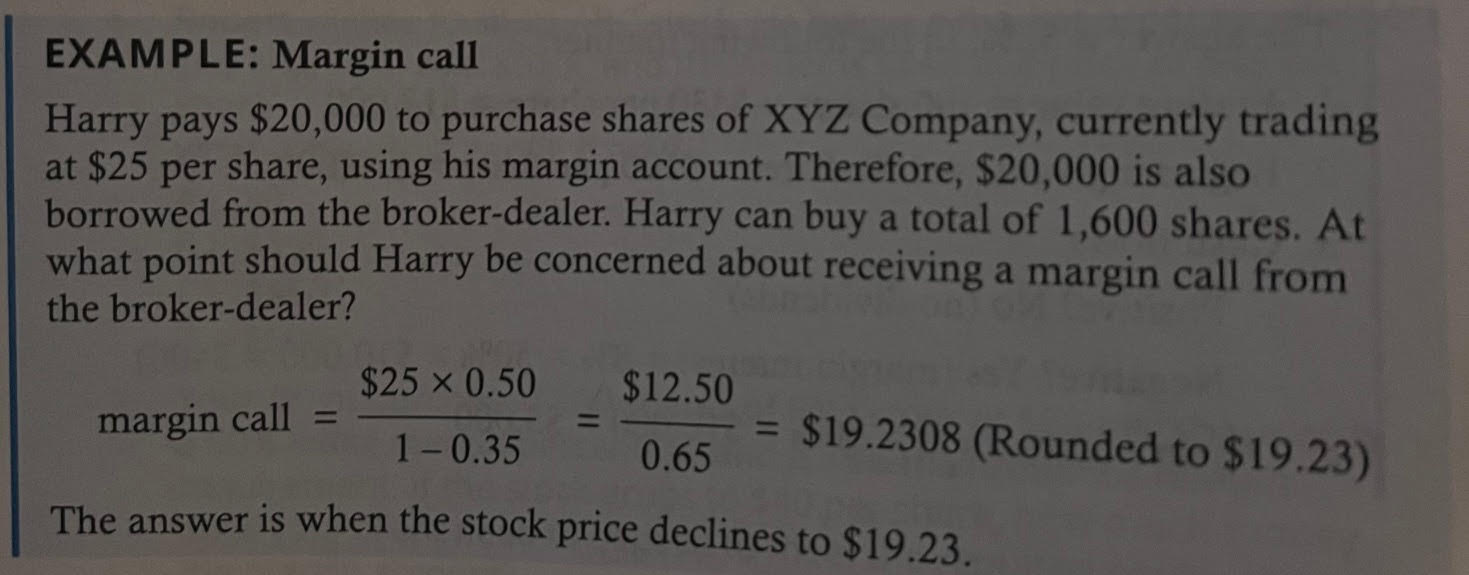
When you buy a stock using Margin, 50% of the funds comes from the investor, and another 50% can be borrowed from the brokerage firm. For example, if you buy $30,000 of Apple stock using Margin (your 50%), you can generally buy up to another $30,000 of the stock using borrowed funds (their 50%). Once a Margin position has been established, you have to maintain a Maintenance Margin, which is established by the brokerage firm and is usually set at 35%. If the equity in your position drops below the Maintenance Margin percentage, then you receive a Margin Call, which is a demand by the brokerage firm to add cash to the account. If cash is not added quickly, a portion of your stock will be sold to provide the needed money. The example below provides a good example of how this works. Things get a little more interesting when the investor has to pay interest to the brokerage firm on the borrowed money.
2️⃣ Straight Cash, Homie
As the great Minnesota Vikings wide receiver Randy Moss once said, “Straight cash, homie.” There are many different investment vehicles that you as an investor have at your disposal. Cash and Cash Equivalents are among your options.
Generally, you only want to have a small amount of your wealth in Cash. Having just enough of it in a savings account or money market fund to pay your monthly bills and establish an emergency fund is good practice. If you’re saving up for a big purchase, like a home and need to protect your money, it’s also OK to have a good amount in Cash. Cash is very safe and highly liquid. Otherwise, you want the bulk of your money invested in Stocks, Bonds, and other investment vehicles. These vehicles allow your money to grow and compound, while Cash in a savings account makes only a small return and erodes over time, thanks to inflation. Indeed, having a bunch of your wealth in Cash actually hurts you in the long run.
In addition to Cash, there are other very short-term investment vehicles where you can park money that you think you’ll need soon. A Certificate of Deposit (CD) is a savings account that holds your money for a set time and pays you interest, but you usually have to lock your money up for a certain period of time (e.g. 6 months, 1 year). Money Market Mutual Funds are another option. These funds are very safe and invest in high-quality, short-term investments like U.S. Treasury Bills, Commercial Paper, and CDs. Your money can be taken out or invested at any time, and the return usually hovers around the going market interest rate, so you generally don’t lose money to inflation. You make the same amount of money that you’d make in a high-yield savings account. The Fidelity SPAXX fund that I use to hold cash is an example.
U.S. Treasury Bills (TBills) are another option. The U.S. Treasury is the No. 1 issuer of debt in the world, and it offers quite a few different securities. The TBill is one of these securities, and it is bought by the investor at a discount to the bill’s par value and matures in some time interval of one year or less — 4, 13, 26, and 52-week TBills are available. Because these securities are bought at a discount, there are no interest payments to the investor, unlike most bonds. Instead, the investor’s profit is the difference between the bond’s par value and the discounted price that it was purchased at, and the profit is only taxable at the federal level, not the state or local levels.
Because TBills are guaranteed by the federal government and are therefore extremely safe, people use whatever yield that these securities produce as the “risk-free” rate of return that all other investments must exceed in order to be valuable. In other words, if I can park my money in an ultra-safe TBill yielding 5%, any other investment I’m considering better return something much more than 5% to compensate me for the risk I’m taking.
There are other short-term, highly liquid investments, but they generally aren’t purchased by everyday investors and aren’t very important. These include things like Commercial Paper, Repurchase Agreements, Banker’s Acceptance Notes, and more.
The point here is to only use Cash and other short-term investment vehicles if you need access to your money now or in the near future and want to keep it protected from a huge crash in the equity markets.
3️⃣ Fixed Income Securities
When you buy a Bond, you are loaning money to the entity who is issuing it. This means you will be paid a fixed rate of interest on your loan at regular intervals to compensate you for the risk you’re taking, and the money you loaned will be returned to you at a later date. This is why Bonds are often called “fixed-income” securities. Below are some common features of bonds:
- Par Value — This is the amount of money that you loaned to the entity. It’s what the entity will return to you once the bond reaches its maturity date. Let’s say a bond has a Par Value of $1,000.
- Coupon Rate — This is the interest rate that will be paid to you each period while you hold the bond. Usually, this is twice per year. For example, a $1,000 Par Value bond with a Coupon of 4% will return an interest payment of $40, or $20 semiannually.
- Maturity Date — The Bond’s Maturity Date is when the money you loaned to the entity will be repaid. A Term Bond has a single Maturity Date, while a Serial Bond has a staggered series of Maturity Dates. Generally, Bonds with longer Maturity Dates pay higher Coupons than Bonds with shorter ones. This is done to compensate the investor for taking on more risk with a long-term Bond.
- Premium / Discount — Most Bonds trade in the secondary market. This means a Bond’s price could trade higher (Premium) or lower (Discount) than the Par Value. The Bond’s time to maturity and the Federal Reserve’s market interest rate play major roles here.
- Call Provision — Some Bonds come with a Call Provision, which allows the entity to call it back in before the Maturity Date. This usually happens when market interest rates fall below whatever interest rate that the Bond is paying — the issuing entity would rather call it in and issue new Bonds with reduced Coupons that mirror the lower market interest rate.
Bond prices and the market interest rate (which is primarily determined by the FED) have an inverse relationship. When the market interest rate goes up, the price that bonds trade at goes down. And vice versa. For example, when the market interest rate declines to 2%, Bonds paying a 5% Coupon are suddenly very attractive, so the price to acquire one goes up. On the flip side, when the market interest rate increases to 7%, Bonds paying a 5% Coupon are suddenly not as attractive because investors can easily get newly issued bonds with 7% Coupons. The 5% Coupon Bonds therefore go down in price. In general, long-term Bonds tend to be more price volatile than short-term Bonds. This is because, when market interest rates change, nobody cares about short-term Bonds — they will be maturing soon anyway. Long-term bonds have a longer period of time to potentially drop in price.
The fixed-income Bond market is massive — much, much larger than the stock market. There are a few different entities that issue Bonds. The big ones include:
- Federal Government
- Federal Government Agencies
- Municipalities
- Corporations
The Federal Government issues bonds primarily via the U.S. Treasury. They do this to collect money to finance national government programs and operations, like the military and Social Security. The other way they collect money is through the taxes we pay every April. You can buy Treasury Bills (TBills), Treasury Notes (TNotes), and Treasury Bonds (TBonds). TNotes and TBonds are identical except for their terms of maturity — TNotes are issued with maturity dates of 2, 3, 5, 7, and 10 years, while TBonds have a maturity of 30 years. TBills have a maturity date of less than a year and don’t pay any interest; instead they trade at a discount, and the investor profits off of the spread between the Par Value and whatever discounted price they paid.
In addition to these standard Treasury securities, investors can also purchase Treasury STRIPS and TIPS, as well as Series I-Bonds (“Inflation Bonds”), which combine a fixed interest rate with a variable rate that is tied to inflation. I’ve used I-Bonds before. Interestingly, Japan is the No. 1 holder of U.S. Treasuries, meaning we owe them more money than anybody. When you hear about the “government deficit,” it refers to the massive amount of debt we continue to build by issuing these securities. Treasury securities are subject to federal income tax but are exempt from state and local taxes.
Federal Government Agencies also offer Bonds and Mortgage-Backed Securities that are backed — either directly or indirectly — by the guarantee of the U.S. government, making them very safe investments. The agencies include:
- “Ginnie Mae” (GNMA) — The Government National Mortgage Association
- “Freddie Mac” (FHLMC) — The Federal Home Loan Mortgage Corporation
- “Fannie Mae” (FNMA) — The Federal National Mortgage Association
- “Sallie Mae” (SLMA) — The Student Loan Marketing Association
All of these entities, with the exception of Sallie Mae, offer what are called Mortgage-Backed Securities. In other words, these entities buy a pool of home mortgages, collect the principal and interest from these monthly mortgage payments (the “cash flow”), then distribute a cut of that money to investors who hold the Mortgage-Backed Securities. One of the only major differences is in which underlying mortgages these entities buy. Ginnie Mae buys FHA and Veterans Affairs mortgages and packages them up into Mortgage-Backed Securities for investors, while Freddie Mac and Fannie Mae compete to buy conventional mortgages from banks and package those up. Probably the biggest risk to these Mortgage-Backed Securities is prepayment risk — homeowners have the option to refinance or pay down their loan faster than their contract states. Unlike U.S. Treasuries, which are only taxed at the federal level, all of these are taxed at the federal AND state levels.
What about Municipal Bonds? Like the federal government, Municipalities like states, cities, and towns can offer Bonds to the public to raise money for various local projects. If the individual lives in the state where the Bond is issued, the interest payments on these securities are exempt from both federal and state taxes — which is why investors who make a lot of money and land in really high tax brackets often consider them. There are two main types of Municipal Bonds:
- General Obligation Bonds (GOs) — Issued to finance capital improvements benefiting the community. These improvements usually do not produce revenue, so the principal and interest payments on the Bonds are dependent on the revenue of the issuing organization.
- Revenue Bonds — Issued to raise money for facilities (e.g. a community airport) that generate enough revenue and profit to pay the principal and interest payments on the Bonds.
Now, let’s touch on Corporate Bonds. These are Bonds issued by companies to raise money for their initiatives. Many companies prefer to raise money via Bonds versus selling more Stock, which would dilute the ownership interest of existing shareholders. But this comes with risk. For a company, Bonds represent debt that must be paid to the bondholders. This is not the case with Stock, where shareholders are owners of the company and are not owed interest payments and initial principal. This is why raising money via debt is riskier than raising money via equity. If a company can’t pay their bondholders, they risk bankruptcy. For this reason, you’d prefer to see as little debt as possible on a company’s balance sheet. For an investor, interest income from Corporate Bonds is taxed at the federal and state levels.
Companies like Moody’s rate all Bonds, including Corporate issues. Highly-rated Bonds (called “investment grade”) tend to be safer, but they come with a lower Coupon. Lower-rated Bonds (called “non-investment grade”) are riskier and offer higher Coupons to compensate you for taking a chance on them. Really poorly-rated Corporate Bonds are called Junk Bonds. These are very risky because they are offered by companies that have shaky financials. Because they are so risky, the Coupons tend to be high on these.
In addition to all of the Bonds discussed in this section, there are a few others worth mentioning briefly:
- Zero-Coupon Bonds — These are like TBills; they are sold at deep discounts to their Par Value. Investors receive the difference in value at the Bond’s Maturity Date, rather than in the form of periodic interest payments. Although you don’t receive the money from these investments until the Maturity Date, you still have to pay taxes on Phantom Income every tax season.
- Convertible Bonds — These are Bonds offered by Corporations where the investor has the ability to convert their Bonds into a fixed number of shares of the company’s stock. The ability to convert is nice, which allows companies to get away with paying a smaller Coupon.
Overall, Bonds are a great way to diversify your portfolio. Because they tend to be safer than Stocks, they’re best for older people who have a short time horizon and want to protect their money while making a little interest on it.
Bonds can also be strategically timed to align with major life events, such as funding a child’s college education. But overall, young people should primarily be in Stocks.
4️⃣ Reading Bond Yield Curves
In normal economic circumstances, long-term Bonds will always pay the investor higher interest rates (Coupons) than short-term Bonds. Why? The further out the Maturity Date, the more risk that inflation can eat into the Bond and/or the price of the Bond could fall significantly. As mentioned before, when market interest rates (which are highly influenced by the FED) go up, Bond prices go down. And vice versa. Therefore, Bonds that won’t reach maturity for many years will pay a higher interest rate to compensate the investor for taking on that risk. Of course, none of this matters if you hold until the Maturity Date because you will receive back the Par Value that you loaned out. It only matters if you sell early.
What’s the point here? There is something called a Bond Yield Curve that shows the current interest rates (yields) of all kinds of Bonds that are of the same quality but have different Maturity Dates. The one tracking U.S. Treasury Bonds is the best to look at. This curve gives us some insight on the economy. The curves to look for include:
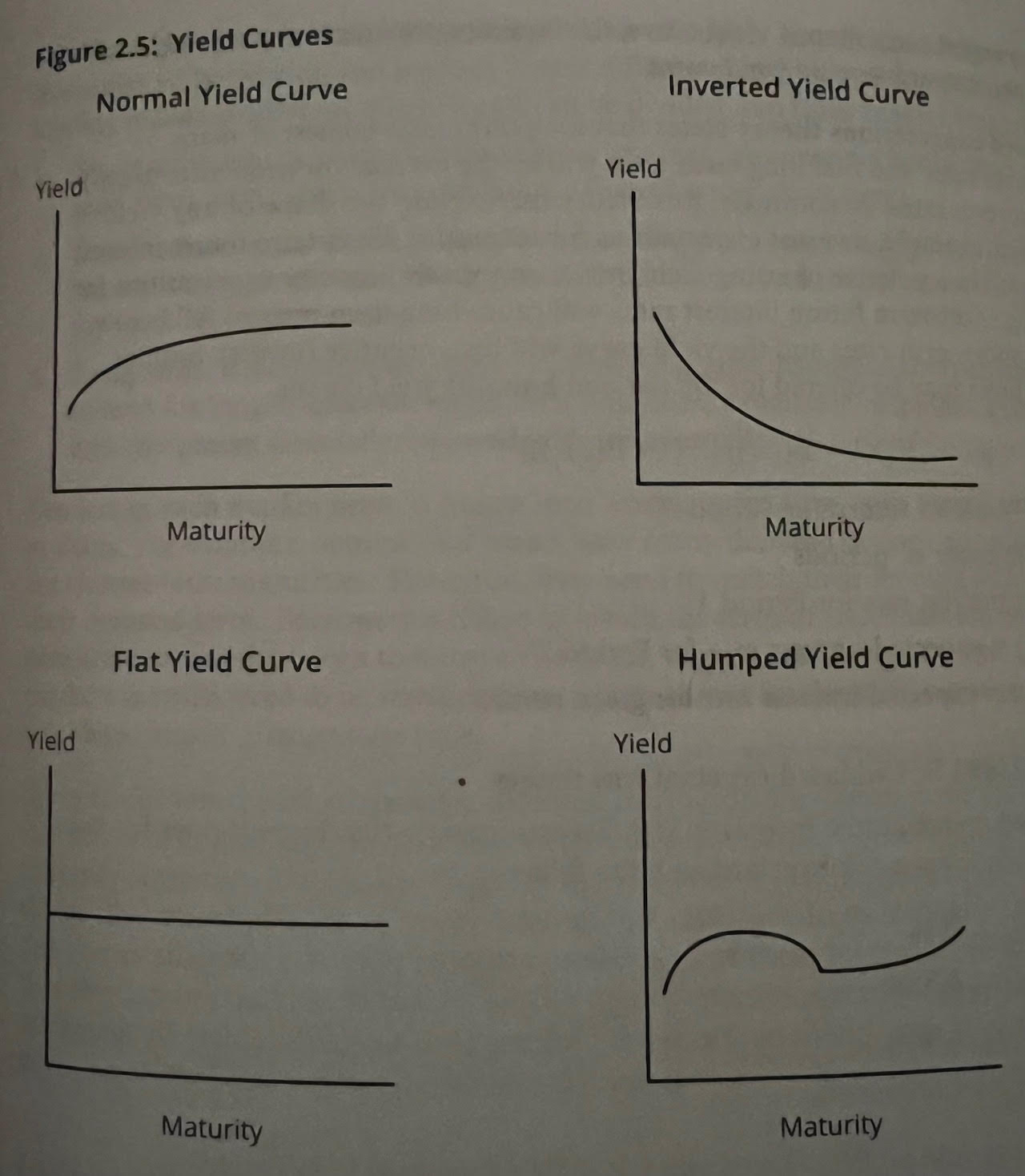
- Normal Yield Curve — A normal yield curve is one where the Bonds with more years to maturity (long-term Bonds) are delivering more interest than Bonds that are very close to maturing (short-term Bonds). A normal curve usually means the economy is expanding quickly and the FED might consider raising market interest rates in the near future to help slow down overall spending and prevent inflation.
- Flat Yield Curve — A flat yield curve means all Bonds across the Maturity Date spectrum are offering very similar interest rates. This curve usually happens when the economy is in a great spot. When this is the case, the FED will likely keep market interest rates the same and allow things to continue to play out as they are.
- Inverted Yield Curve — An inverted yield curve means that short-term Bonds are paying more interest than long-term ones. This is not normal and indicates that something concerning is up. This type of curve usually only appears when inflation is high and the economy is struggling. These circumstances mean the FED will likely cut market interest rates to encourage spending in the economy and stimulate growth.
Below are what these different yield curves look like. You’re likely to hear about the yield curve in financial news or see it mentioned on social media during times of market uncertainty. You can view it on this website. While it’s not a crystal ball, it’s one of the more reliable tools for gauging investor sentiment and expectations about the economy and future interest rates.
5️⃣ Equities: Common and Preferred Stock
Now we get into the good stuff! Bonds are great and serve a purpose for certain (older) investors, but the stock market is where most young people should be investing their money. Historically, the overall return on Equities has far surpassed the Bond Market — the S&P 500 has produced an average return of 10% every year since 1957, with Bonds falling a few percentage points below that. But with greater return comes greater risk — stocks are generally much more volatile than Bonds. There are two main types of Equities: Common Stock and Preferred Stock.
Let’s start with Preferred Stock because it’s a bit of a hybrid that shares features of both Bonds and Stocks. For the sake of simplicity, think of Preferred Stock as a Corporate Bond that sometimes has the ability to be converted into Common Stock. Indeed, just like Bonds, Preferred Stock pays fixed income to the investor — but instead of interest payments that Bonds pay semiannually, Preferred Stock pays Dividends on a quarterly basis. Preferred Stock Dividends are always paid before Common Stock Dividends. Additional differences between Preferred Stock and Bonds:
- Maturity Date — Unlike Bonds, Preferred Stock doesn’t have a Maturity Date
- Ownership — Preferred Stock investors are owners, not lenders. They don’t have voting rights, though.
Some Preferred Stock is Convertible, which means it gives the investor the option to convert it into a fixed number of shares of Common Stock — typically after a certain date or event. This feature is particularly common in venture capital and startup financing, where early investors want the stability of fixed dividends with the potential upside of equity ownership later on. That’s it! That’s the core idea behind Preferred Stock.
Common Stock is what you see trading in the stock market every day. In addition to Bonds, Common Stock is the other major way that companies can raise money to pay off debt, develop new products, and more. Just like Preferred Stock, when you buy a company’s Common Stock you own a piece of that company. Unlike Bonds, you are an owner, not a lender. There are two main ways you make money when you buy a company’s Common Stock:
- Capital Gains — The stock is traded every day on the various Stock Market Exchanges. When the price of the stock goes up, you make money on the appreciation of shares.
- Dividends — Not all companies pay a Dividend. But those that do pay them out every quarter. Dividends can be delivered as Cash Dividends or Stock Dividends. Both are considered taxable income.
When a company makes a profit for the year, it has to decide what to do with those earnings. Dividends are one of the options. Paying a Dividend involves taking a piece of the overall earnings and sharing it with the shareholders. Many seasoned companies — like Coca-Cola — do this. Another option is to reinvest those earnings back into the company to develop new products, expand operations, open up a new plant, or something else. Many young companies do this. Yet another option is for a company to buy back some of its shares in the open market. This can be a great option if a company feels that its shares are undervalued in the market. Not only does it show that the company believes in itself, it also has the added benefit of driving up the price of the stock for existing shareholders by reducing the number of outstanding shares in the open market.
6️⃣ Mutual Funds and ETFs
Mutual Funds are what we call Open-End Investment Companies. Thankfully, Mutual Fund is a lot better name for these securities. Mutual Funds pool capital from many investors and invest in stocks, bonds, money market instruments, and other securities according to a specific investment goal outlined in the prospectus. Every Mutual Fund has a managing advisor who selects securities and oversees the fund. They are called “open-ended” because the fund can sell an unlimited number of shares to investors and raise as much capital as it wants. There’s no limit. Hence, it is “open-ended.”
Importantly, shares of Mutual Funds aren’t traded among investors on the exchanges like Stocks are. Instead, shares are redeemed only through the fund. How does this work? Every Mutual Funds has a Net Asset Value (NAV), which is simply the value of all assets of the fund minus its liabilities (e.g. management fees, marketing expenses, etc.). This number is divided by the number of shares outstanding to get the fund’s NAV per share, and this price is used when investors want to buy or redeem (sell) shares of the fund. So, instead of buying or selling shares to other investors, your transactions are with the fund itself. NAV calculations happen once per day, usually after the trading day has concluded. In addition to the NAV, some Mutual Funds charge a sales commission, called a Sales Load. Some funds don’t have any and are called No-Load. There are three main types of Sales Loads:
- Class A — Upfront load, lower ongoing fees
- Class B — Back-end load, may convert to Class A
- Class C — Level load, higher ongoing fees
There’s a Mutual Fund for almost everything. The general types of Mutual Funds are listed below. These are broad categories, and there’s almost an unlimited number of types of funds within them. For example, you can get an Equity Fund that targets growth stocks. You can get a Bond Fund that collects Municipal Bonds. The key is the fund’s stated objective — this guides everything, including the securities it invests in, its investing style (growth or value), its risk profile (aggressive, balanced, or cautious), and more.
- Bond Funds — These funds aim to produce income for shareholders by investing in a variety of Bonds. The income is paid to shareholders on a monthly basis. You can get funds that target U.S. Treasuries, Municipal Bonds, and more.
- Equity Funds — These funds invest in a wide variety of stocks and primarily aim for capital appreciation, although some also produce income by investing in companies that pay a Dividend. You can get funds that target growth stocks, specific sector stocks, international stocks, and more.
- Money Market Funds — These funds invest in short-term, low risk, highly liquid securities like CDs and TBills. These funds usually return as much as a high-yield savings account and are a great place to park your money temporarily while you decide what to do with it. Fidelity’s SPAXX Money Market fund is an example.
- Precious Metal Funds — These funds invest in gold, silver, and other metals
- Commodity Funds — These funds invest in commodities like corn, wheat, and more
- Hybrid Funds — These funds invest in a little bit of everything. Stocks, Bonds, Metals, Commodities — it’s all on the table.
The management fees, expense fees, and various tax liabilities that come with Mutual Funds are huge disadvantages that eat into an investor’s total return. The tax issues can be especially brutal. If the portfolio manager is making a bunch of trades in the fund, the Capital Gains from those transactions will be passed on to you every year in the form of Taxable Distributions, even if you don’t sell your shares. The annual Interest Income from Bonds and Dividend Income from Equities in the fund are also passed on to you annually in the form of Taxable Distributions. Overall, I believe there are many better investment options available than Mutual Funds.
What’s the opposite of an Open-End Investment Company? A Closed-End Investment Company! Unlike Mutual Funds, these companies issue a fixed number of shares, and the shares are traded among investors on the stock exchanges like regular Stocks rather than being redeemed by the fund. No new shares can be issued. Like Mutual Funds, Closed-End Investment Companies have an NAV, but the price of the securities is driven by supply and demand, so the price could be significantly above or below the NAV. The BlackRock Science and Technology Trust (BST) is an example of a Closed-End Investment Company.
Last but not least, we have Exchange Traded-Funds (ETFs). ETFs don’t strive to beat the market. Rather, they are specifically designed to track and mirror a specific index, like the S&P 500. The fund does this by investing in all of the same stocks included in the index it is trying to track. Vanguard’s VOO ETF, for example, tracks the S&P 500, delivering almost the same exact return as the actual index. ETFs — which trade on the exchanges like regular Stocks — have skyrocketed in popularity since they were first introduced in the U.S. in 1993 and have become a legitimate rival to Mutual Funds. There are a few reasons for this that highlight the disadvantages of Mutual Funds.
- Passively Managed — Because ETFs are designed to mirror a specific index, they are passively managed, meaning there is usually no advisor overseeing the fund. This means very little, if any, management fee. Mutual Funds, on the other hand, often have pretty significant management fees because they are actively managed by an advisor who spends most of his day looking after the fund and making trades.
- Lower Expense Ratio — Again, because they mimic indices, ETFs generally come with far lower expense ratios. There simply aren’t many costs that go into operating these funds. There also aren’t any Sales Loads. In general, Mutual Funds have far more fees and expenses than ETFs. These eat into the investor’s returns and are one of the greatest downsides of Mutual Funds.
- Tax Efficiency — Because managing advisors make trades within the fund throughout the year, there can sometimes be a lot of Capital Gains inside of a Mutual Fund that have to be passed on to investors in the form of annual Taxable Distributions. That’s not the case with ETFs, which rarely make any trades within the fund. With ETFs, they set it and forget it. The investor only really pays taxes when they sell ETF shares at a profit, unless the ETF is tracking Dividend-paying companies.
In the end, Mutual Funds and ETFs allow investors to diversify their portfolios by investing in far more companies than they otherwise would have been able to. Because Mutual Funds come with a variety of fees and tax liabilities, I believe ETFs are the far better option.
7️⃣ Valuing Stocks: Fundamental Analysis
If you’re going to invest your hard-earned money in Stocks, you’ve got to do your research. You can’t just blindly throw cash at a Stock because everyone else is. Fundamental Analysis is the art of studying a company’s financial statements, like the Income Statement, Balance Sheet, and Statement of Cash Flows. Doing so can give you some clues about the company’s growth prospects in the coming years, which will help you decide if it’s a good investment or not.
In the end, financial statements are just a bunch of numbers. Without context or comparison with other companies, they don’t mean a lot. That’s where Ratios come in. Once you’ve pulled up a company’s financial statements, you can run through a few ratios to uncover the story behind the numbers. The story is what really matters — what are these numbers really telling you? Below are a few ratios to run through.
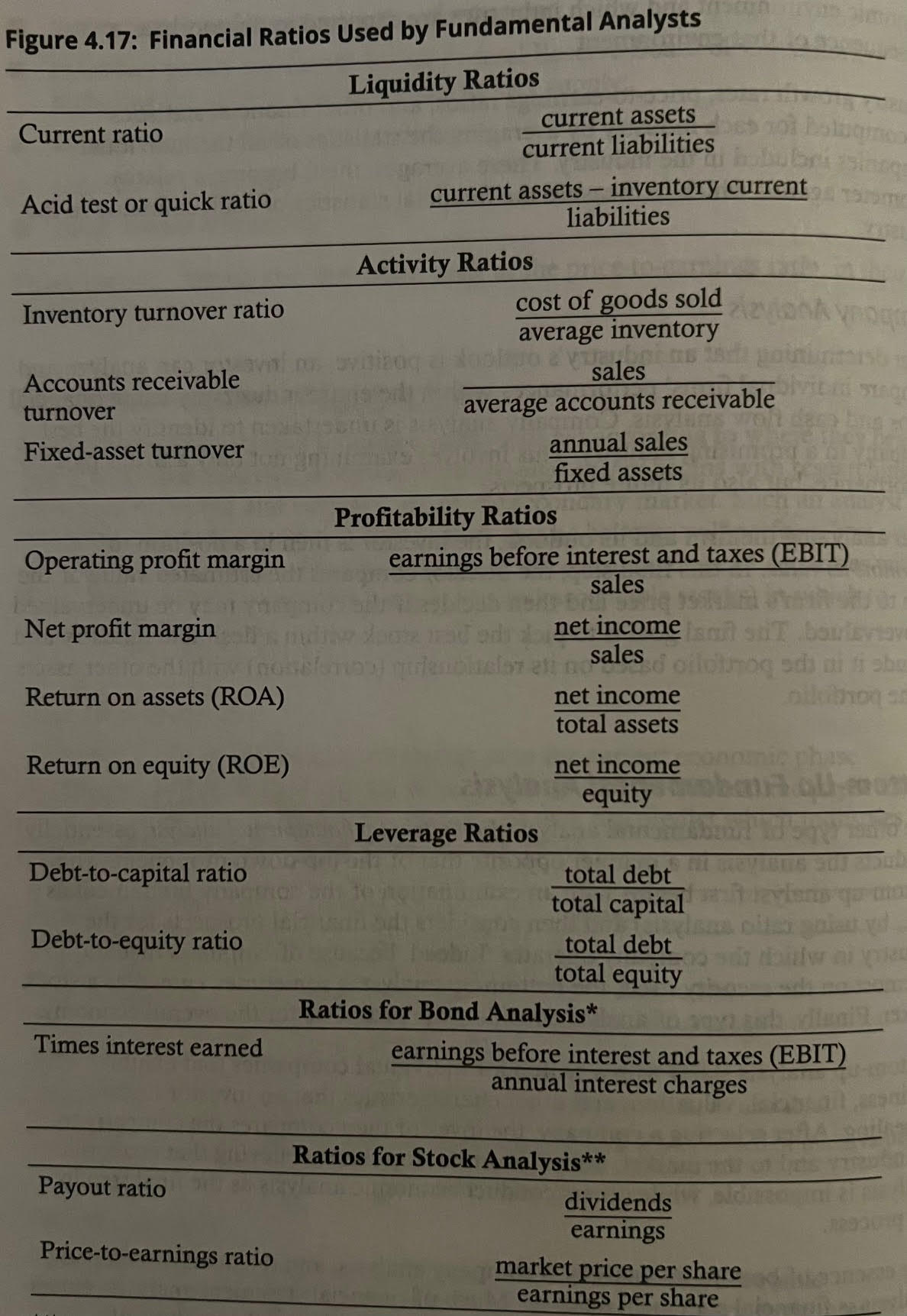
My notes on the Warren Buffett Accounting Book contain full breakdowns on these ratios and what they tell you about the company’s performance. You can then compare these ratios to the company’s previous performance and industry competitors. The Return on Equity (ROE) and Debt-to-Equity (D/E) ratios are two of the most important ones to study. D/E tells you how the company is capitalized. Companies can raise money either through Bonds (debt) or Stocks (equity). While debt isn’t a bad thing, having more of it does influence some things. For one, the company’s ROE will tend to be higher because there’s less equity. That’s a bit of an illusion though, because the company will have far more interest payments cutting into their net income and assets than a company that has very little debt. In tough economic times, a highly-leveraged company that is capitalized with a lot of debt might have a hard time paying the interest, especially if it’s young.
ROE is a good one to look at because it tells you how efficiently the company is using shareholder money to drive a return. If a company has a really high ROE, it’s best for management to keep putting its retained earnings back into operations to drive additional growth versus delivering a Dividend to shareholders. This is common among young, hot companies. Companies that have been successful for a long time usually don’t grow as fast and have more modest but consistent ROEs. Those companies — like Coca-Cola — can afford to use some of their retained earnings to pay a Dividend to shareholders. These companies also don’t need to use a lot of debt, and if they do, they can cover it fairly easily.
Book Value is one you hear about a lot. You can get this number simply by going to the Balance Sheet and subtracting Total Liabilities from Total Assets to get Total Equity, then divide the number by the total number of shares outstanding to get Book Value Per Share. Early in his career, Warren Buffett made a lot of money by buying shares of companies that were trading well below Book Value. Today, it’s harder to spot those opportunities.
P/E Ratio is another good one. This number tells you what investors are willing to pay for the company’s earnings. It is found simply by dividing the company’s stock price by its earnings per share (EPS). Think of it this way: if a company has a P/E Ratio of 25, it means that the stock is trading at “25 times earnings.” A high P/E Ratio compared to others usually means the company is overpriced; a low P/E means it could be undervalued.
For a few hardcore intrinsic value calculations, we have the Dividend Discount Models (DDM) and the Discounted Free Cash Flow Model (DFCF). DDM is used for companies that pay a Dividend; DFCF is used for companies that do not pay one. At their core, these models forecast either future Dividends or future Free Cash Flows using a selected annual growth rate, and then discount those future amounts back to today using a selected rate of return. The result is a present value — what the stock should be worth based on its future earnings potential (its intrinsic value). If this intrinsic value is higher than the current market price, the stock may be undervalued (a potential buying opportunity). If it’s lower than the current price, the stock may be overvalued. Look up the formulas online; they’re fairly easy to use. The trickiest part is deciding on a growth rate and discount percentage.
All of that being said, it may not even be worth researching stocks. There is a lot of solid research that supports the Efficient Market Hypothesis (EMH), which states that it’s very hard to beat the market; you’re better off not wasting your time with analysis and should instead invest in ETFs that simply aim to replicate the performance of an index, like the S&P 500. Especially with large-cap Stocks, the current market price likely already includes all available information. There may be opportunities to exploit small-cap Stocks and international Stocks, but the big, established companies are highly analyzed and traded by investors. This isn’t like the stock market of the mid-1900s that smart people like Warren Buffett were able to dominate. Today, your best bet is likely to invest in ETFs and hold them for as long as possible.
8️⃣ REITS, Options, and Foreign Stocks
Owning Real Estate is a great way to help diversify your investment portfolio, and fortunately there are ways to do it without actually owning a bunch of rental properties. Real Estate Investment Trusts (REITS) allow you to invest in Real Estate, short-term construction loans, and mortgages by pooling capital from investors similar to the way a Mutual Fund does. Most REITS are publicly traded on the exchanges in the secondary market and can easily be purchased like Stocks are. More than 90% of the REIT market is made up of Equity REITs, which acquire Real Estate and produce income for investors by collecting rent money and selling properties for a profit. Investors are paid in the form of quarterly Dividends.
Options and Futures contracts are called Derivatives and require trading in a Margin Account. There are several ways they can be deployed, but the best uses for Options involve earning a little bit of extra income by selling (writing) covered Calls, or to protect a big gain by hedging against a possible decline in the stock market by buying a Put or Call. The two main types of Options contracts are:
- Call Option — Gives the buyer the right to purchase a security for a specified price (exercise price) within a specified period
- Put Option — Gives the buyer the right to sell a security for a specified price (exercise prices) within a specified period
Futures contracts work similarly, except they usually involve Commodities (e.g. corn or wheat). Most Futures contracts (99% of them) are closed out before any Commodities actually change hands. Futures contracts are also written on the S&P 500 and can be used to hedge against a decline in the market. In essence, Futures allow people to “lock in” a certain price for their Commodity — for example, a cattle rancher can lock in a price at which they will sell their cattle eight months from now to protect themselves against a potential big drop in the market price of cattle.
Because they are generally not highly correlated with U.S. securities, Foreign Securities are yet another way investors can diversify their portfolio. Although you can buy individual stocks directly on international exchanges, it’s risky and is generally not recommended. If you’re going to invest in Foreign Securities, the best way to do it is to buy an International Mutual Fund that invests in a collection of foreign companies. These are traded on the U.S. exchanges and are highly liquid. To be safe, make sure the fund is invested in companies from developed nations.
One of the biggest risks with investing money in a foreign country is Exchange Rate Risk. When you buy a stock in Japan, for example, the exchange rate comes into play. Let’s say that at the current exchange rate, $100 buys you 12,000 yen. If in three months the U.S. dollar raises against the yen, that same $100 could buy you 13,000 yen. If the U.S. dollar falls against the yen, that $100 might only buy 11,000 yen. The key is to think about it in terms of your money traveling instead of you. When you plan to make an investment in Japanese securities, your U.S. dollars are, in effect, planning to make a trip to Japan. Wherever your money currently lives, you benefit when the currency of its current home (e.g. the yen) raises against the currency of its next destination. In this case, if you were to buy Japanese securities, you would want the yen to raise against the dollar (i.e. the U.S. dollar to fall against the yen). Indeed, a weakening U.S. dollar is advantageous for U.S. investors who own Foreign Securities.
9️⃣ Dealing With Taxes
Capital Gains and investment income like Dividends and Interest Income from Bonds are subject to taxation, unless they take place in some kind of tax-sheltered account, like a Roth IRA/401k or Traditional IRA/401k. In the case of the Roth IRA/401k, you’ve already paid taxes on the principal, and any capital appreciation can be withdrawn tax-free once you’ve reached age 59.5. In the case of the Traditional IRA/401k, you defer paying taxes until you reach age 59.5 — but the idea is that you’ll be retired and in a lower tax bracket when the time comes to withdraw the money and pay the taxes on it.
But in normal non-tax-sheltered accounts, you will owe taxes on Capital Gains, Dividends, and Interest Income at your Ordinary Income tax rate. The good news is that the IRS encourages long-term investing by providing reduced Capital Gains tax rates to those who hold an investment for at least one year. For Capital Gains, most people will owe 15% taxes on any investment that has been sold after holding for one year or more. For most people, this is significantly lower than what they would have owed if they had to pay taxes using their assigned tax bracket (mid-high 20s for most).
This exact same thing applies to Dividend Income that is considered “qualified.” What is a “qualified” Dividend? It’s Dividend Income received from a C Corporation. Why? Because C Corporations pay a tax on the Dividend before it even gets to you. The IRS figures you should get a bit of a break on the amount you receive since your Dividend is being double-taxed. “Non-qualified” Dividends are taxed at your Ordinary Income tax rate.
What about interest income from Bonds and other sources like CDs, money market mutual funds, and savings accounts? The large majority of Interest Income you receive will be taxed at both the federal and state levels at your Ordinary Income tax rate. There’s no preferential tax treatment on interest income like there is for Capital Gains and Dividend Income. Here’s a quick breakdown of notable securities that deliver Interest Income:
- U.S. Treasuries — Interest income received from U.S. Treasury securities is only taxed at the federal level
- Government Agency Securities — Interest income received from Mortgage-Backed Securities issued by Ginnie Mae, Freddie Mac, and Fannie Mae are taxed at both the federal and state levels
- Municipal Bonds — All Muni Bonds avoid federal taxes. If a Muni Bond is bought in the same state that it is issued in, interest income is usually exempt from both federal AND state taxes.
Mutual Funds are a little tricky when it comes to taxes. Why? By law, when a Mutual Fund earns income throughout the year — whether from Capital Gains (when it sells investments at a profit), Dividends (from Stocks it holds), or Interest (from Bonds and other fixed-income securities it holds) — it must pass that income on to shareholders before December 31 in the form of what is called a Taxable Distribution. Even if you don’t sell your Mutual Fund shares, you as an investor have to pay taxes on this annual distribution. This is one of the major drawbacks of investing in Mutual Funds. Individual Stocks and ETFs don’t have to deal with this — taxes still must be paid on these securities, but the investor controls the timing of the taxable event. In addition to the annual Taxable Distributions, investors who own Mutual Funds must also pay taxes on any Capital Gains when they eventually sell their shares of the fund at a profit. Because of all this trickiness, most Mutual Funds (not all!) should be bought in a tax-advantaged account, like a Traditional or Roth IRA/401k.
Finally, let’s talk about Tax Loss Harvesting. When you sell securities like stocks at a loss, you incur a Capital Loss. You can use these losses to help offset your tax bill. How? You can use Capital Losses to offset Capital Gains, dollar for dollar. If your Capital Gains for the year still outnumber your Capital Losses, you’ll at least pay a lot less in taxes on whatever is remaining. If your Capital Losses for the year outnumber your Capital Gains, you will owe no taxes on your Capital Gains AND you can use up to $3,000 of your leftover Capital Losses to offset the income you made at your job. If, after all that, you still have leftover Capital Losses, the remaining amount can be carried forward and used in future years.
🔟 Putting It All Together: Portfolio Building
All the investment vehicles covered in this book aren’t meant to be used in isolation — they’re tools that should be used in combination to build a strong, diversified portfolio that maximizes return and minimizes risk. While many people associate diversification with simply owning stocks from various industries or company sizes, you really only need 10 individual stocks at the very most. Real diversification goes far beyond just stocks — it’s about strategically spreading your capital across a mix of asset classes to help maximize returns while minimizing risk.
This concept is called Asset Allocation — the process of dividing your investments among categories such as equities (stocks), fixed income (bonds), cash or cash equivalents, tangible assets (like real estate), and international holdings. The right mix depends on a variety of factors, most notably your individual goals, risk tolerance, and, most importantly, your time horizon. If you’re young and decades away from retirement, you can typically afford to take more risk for potentially greater reward. If you’re closer to needing the money, a more conservative approach may be wise.
Below are four decisions that need to be carefully considered when designing your portfolio:
- What asset classes should I consider including?
- What percentage of my capital should go to each class?
- What’s the acceptable range (i.e. once it grows to 60% of the portfolio, we rebalance) for those allocations over time?
- Which specific securities should be purchased for the portfolio?
Below is an example of a “model portfolio” for a growth-minded investor who has plenty of time in front of him. Whether building the portfolio for yourself or somebody else, you would need to fully assess the financial situation and change the percentages accordingly.
- 50% large-cap equity
- 20% bonds
- 20% international equity
- 10% small-cap equity
Over time, the percentages will grow and shrink based on how the assets are performing. It’s important to watch those percentages and rebalance when they get to the high or low point of their ranges.