
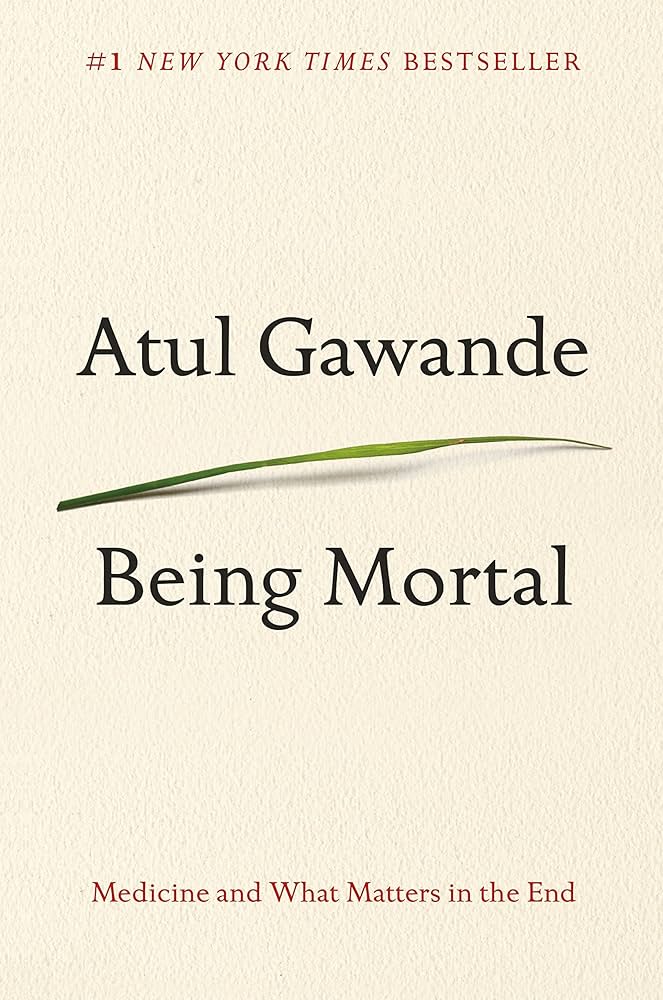
Being Mortal
Atul Gawande
 GENRE: Health & Wellness
 PAGES: 265
 COMPLETED: May 14, 2026
 RATING:
Short Summary
Modern medicine has completely transformed the way we age. Today, there is almost always some kind of treatment capable of prolonging life, but that isn’t always a good thing. In Being Mortal, Atul Gawande examines medicine’s role in the final stages of life and explores how to identify the fine line between under-treatment and over-treatment, longevity and quality of life, and simply existing versus truly living.
My Takeaways
1️⃣ In Old Age, Meaning and Purpose Matter as Much as Staying Alive
Medicine has completely transformed the way we age. In the final few years of our lives, we now have access to drugs, surgeries, treatments, and institutions that can both significantly prolong our lifespans and keep us safe.
It hasn’t always been this way. Up until the last 100 years or so, death often came far more swiftly and dramatically than it does today. The opportunity to squeeze every last drop out of life wasn’t available like it is today. While the recent advances in medicine and public health have been enormously beneficial, they have forced today’s humans to come face-to-face with a question that previous generations never had to put much thought into: How can one maintain meaning and purpose in life all the way to the end?
Purpose and meaning are critical in old age. These are important to have during all stages of life, but they are vital when we’re old and things become much harder and more uncomfortable for us both mentally and physically. There needs to be something to live for. Medicine, paired with institutions for the elderly, such as nursing homes and assisted living complexes, can keep most people alive and safe for a very long time. But there is a big difference between living and simply existing. To truly live all the way to the end, you have to find meaning and purpose beyond yourself. Otherwise, those twilight years can be miserable.
Unsurprisingly, “meaning” can mean a lot of different things. But for most elderly people, it usually involves having the freedom and flexibility to make their own choices. Without the ability to make independent choices, it becomes hard to live a meaningful life in old age — and that loss of control and autonomy is what most elderly people fear the most. It’s why so many older folks resist moving from their actual home into a retirement home. The loss of independence is a significant blow to one’s feelings of control and meaning in their life. After all, very few people want to spend their final years confined to a bed, sharing a room with a stranger, and living according to a schedule determined entirely by nurses and staff. At that point, you’re just existing, not living.
Of course, “meaning” also involves being part of something bigger than yourself. For many people, it’s spending time with family and friends, engaging in activities and hobbies they love, going to a grandchild’s sporting event, caring for a pet, being part of a church or community, and doing other spontaneous things that make life interesting and enjoyable. Most people need devotion to something beyond themselves for life to feel meaningful and endurable. And again, the ability to make choices is the foundation of it all.
The bottom line here is that medicine and assisted living facilities can keep us existing for a long time — but there’s a lot more to life than simply staying alive. When it gets to a point where medicine is prolonging life just for the sake of prolonging it, there’s a problem. The author sums it up well when he writes: “Whatever we can offer (medically), our interventions, and the risks and sacrifices they entail, are justified only if they serve the larger aims of a person’s life. When we forget that, the suffering we inflict can be barbaric.”
2️⃣ Medicine Can Sometimes Be More Harmful Than Helpful In the Final Stages of Life
As mentioned in the first takeaway, modern scientific capability has completely altered the course of human life. People now live longer and better than at any point in history. For all but the past couple hundred years, the average human lifespan was 30 years or less. It didn’t matter if you were 5 or 50 — death lurked around every corner, and every day was a roll of the dice.
That’s simply not the case today. Although death can still come at any time, medical innovations like antibiotics, vaccines, chemotherapy, anesthesia, blood pressure and cholesterol meds, heart surgery procedures, kidney transplants, and so many other advancements in public health and sanitation have contributed to a massive reduction in mortality rates for nearly all diseases and ailments we face. We can even use medicine to slow down terminal illnesses a bit.
These advancements in medicine have been matched by the huge improvements in the institutions we interact with in old age. Before the Hill-Burton Act of 1946 was passed to create a boom in hospital construction across the country, people were mostly on their own to deal with disease and illness at home. If you got seriously sick before modern hospitals became commonplace, you were kind of screwed. Eventually, hospitals became so crowded with elderly patients dealing with chronic and end-of-life illnesses that nursing homes expanded as a way to care for many of those individuals.
But most elderly folks have come to dread nursing homes because living in one usually involves sharing a room and losing much of your control over your daily schedule. Your independence is zapped; most of the control lies in the hands of the nurses and staff operating the facility. Assisted Living complexes were introduced in the 1980s as an alternative to nursing homes; a middle ground between the total freedom of independent living and the far more restrictive environment of a nursing home. Assisted Living facilities provide old people with their own private room complete with their own door lock, thermostat, kitchen, bathroom, carpeting, furniture, and more. Residents have far more freedom to organize their schedule as they wish while also receiving round the clock care from on-site nurses and support staff. It’s like an apartment for elderly people.
There’s a point here, and it’s this: While all of these developments in medicine and elderly living institutions have been highly beneficial, they have also turned the process of aging and dying into medical experiences. There will almost ALWAYS be something we can try from a medical perspective to help extend the life of someone dying of old age or of a severe terminal illness, whether it’s more combination chemo, another invasive surgery, or some kind of experimental treatment. But there comes a point in many of these cases where medicine becomes more harmful than helpful — where yet another surgery or another round of complicated drugs actually worsens or shortens the time we have left. Today’s medical technology can sustain our organs until we are well past the point of awareness and coherence. That’s really not what we want, though.
Whether it’s with our own life or the life of somebody we love, there can come a time when we realize there isn’t much to be gained by continuing to medicate and treat; to keep fiddling and fixing in an effort to prolong life at all costs. In other words, there comes a time to wave the white flag; to stop the suffering and struggle and instead spend what time is left by making peace with God, saying our goodbyes, and being with the people we love most. Relentless medication and treatment can create suffering that robs us of those opportunities. When there is no cure and the chances of returning to even a relatively decent life are 0, it becomes harmful to use medicine to keep someone alive.
The hard part is realizing when it’s time to wave that flag, and the even harder part is accepting it. But the last thing anyone wants is to become so diminished that they aren’t remotely close to their true self and can’t do any of those crucial end-of-life tasks in their final days because they’re strapped to a ventilator or are mentally incoherent. That’s tragic. Again, for most of human history the ability to needlessly prolong life wasn’t even an option because medicine was nowhere near as advanced as it is now. Death was usually swift. Now, many deaths only come after long medical struggle. This is reflected in the fact that roughly 25% of Medicare spending goes to the 5% of patients in the last stages of life.
The author sums it up well: “At least two kinds of courage are required in aging and sickness. The first is the courage to confront the reality of mortality – the courage to seek out the truth of what is to be feared and what is to be hoped . . . But even more daunting is the second kind of courage – the courage to act on the truth we find.”
3️⃣ Knowing When It’s Time: Have End-of-Life Discussions Before It’s Too Late
Because we will almost always have some sort of medical option available to extend life, many of us are faced with a very difficult question: How do we know when it’s time? How do we know when to wave the white flag?
Unfortunately, we can’t completely rely on doctors to answer that question. We like to imagine that we can wait until doctors tell us that there is nothing more they can do, but rarely is there nothing more doctors can do. Most doctors are good people who want to help. Even when things look bleak, many of them will continue offering more treatment because they fear the mistake of doing too little for their patients. What doctors sometimes don’t fully take into account, understandably, is that equally terrible mistakes are possible in the other direction – doing too much can be just as devastating to a person’s life in the final stages. Also understandably, many doctors find it very difficult to give patients and their families the cold, hard truth — it’s not easy to tell someone that they are going to die soon. Sometimes leaving the door open can unintentionally create false hope.
The best way to know when it’s time to stop the struggle is through candid discussions with loved ones. These end-of-life conversations should take place well before things get out of hand; in other words, don’t wait until a person’s final days to begin talking about it. Although discussing end-of-life preferences with a parent or loved one is among the most uncomfortable experiences anyone can ever have, these conversations are critical. They help you establish a line in the sand that shouldn’t be crossed. For many elderly and terminally ill patients, the final stages of life can be physically and mentally unbearable, and many people don’t want to suffer needlessly. Having these difficult conversations helps you understand what a loved one is willing to tolerate in order to prolong their life, and what they are not. Sometimes it’s better to stop aggressive treatment and live out whatever time is left in relative comfort than to make things worse by undergoing another round of chemo or taking on another invasive surgery where the potential upside is very small.
Several studies in this area have shown that people who have substantive discussions with their doctor and loved ones about end-of-life preferences are far more likely to die at peace, remain in control of their situation, and spare their family additional anguish. One study showed that those who saw a palliative care specialist stopped chemo sooner, entered hospice earlier, experienced less suffering at the end of their lives — and they lived 25% longer on average. Per the author: “In other words, our decision-making in medicine has failed so spectacularly that we have reached the point of actively inflicting harm on patients rather than confronting the subject of mortality. If end-of-life discussions were an experimental drug, the FDA would approve it.”
One question you can ask: “If time becomes short, what’s most important to you?” This question encourages people to identify the abilities and experiences they need in order for life to remain worth living for them. It can also lead to honest conversations about the level of suffering they are willing to endure. These end-of-life discussions are especially important when the situation looks dire: when chemotherapy is no longer effective, when things become almost unbearable, or when faced with a decision regarding a risky surgery or treatment.
Ultimately, everyone wants to have a good ending to their story. That matters a lot. In many cases, however, the final days of our lives are given over to treatments that cloud our brains and sap our bodies. Our reluctance to honestly examine the experience of aging and dying has increased the harm we inflict on people and denied them the basic comforts they need. Failing to acknowledge that the end has come — and using medicine to prolong life when there’s only a small chance of benefit accompanied by a high chance of needless suffering — can ruin our ending. Obviously, you never want to call things off too soon, but you also don’t want to wait too long. There is a fine line, and the only way to find it is by having some really difficult but honest conversations before it’s too late.