
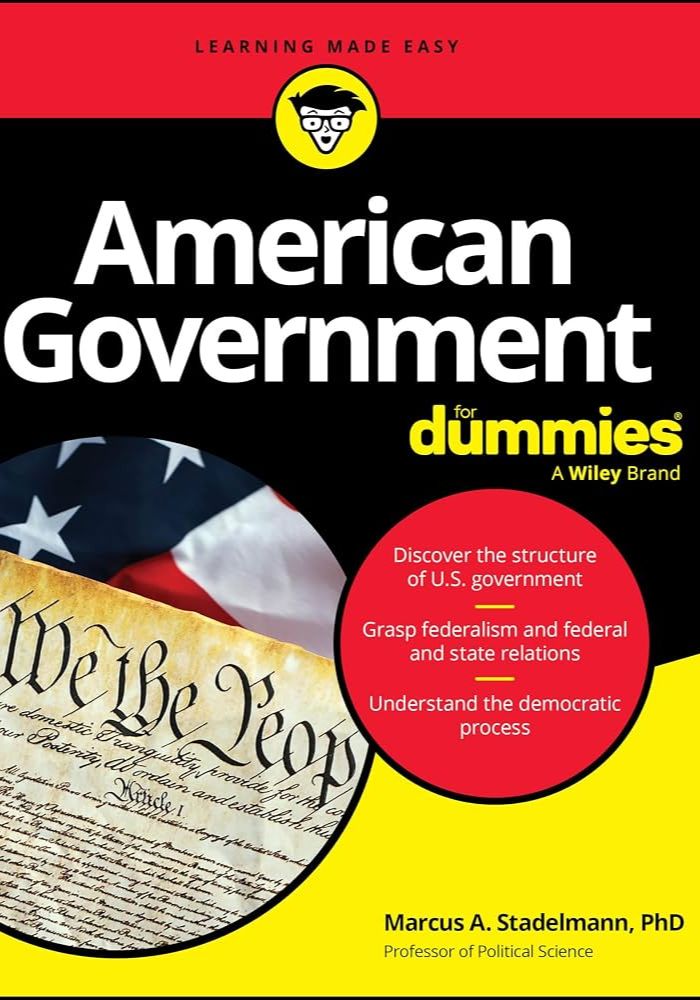
American Government For Dummies
by Marcus Stadelmann
- 316 pages
- July 17, 2026
- ⭐️ ⭐️ ⭐️ ⭐
- 316 pages
- Completed on July 17, 2026
- 316 pages
- July 17, 2026
- ⭐️ ⭐️ ⭐️ ⭐
Short Summary
American democracy has endured for more than 250 years, and much of its longevity can be traced to the Constitution and the foundational principles of our government. In American Government For Dummies, Marcus Stadelmann explains how the U.S. government was designed, how it functions, and why its structure has helped the United States become one of the world’s leading nations.
My Takeaways
1️⃣ When the Articles of Confederation Failed, the Constitution Was Born
The United States Constitution grants us the freedoms we enjoy today and serves as the foundation of the most successful democracy in the history of the world. How did such an important document come to be?
The Constitution was our attempt at forming a functional government after securing our independence from Britain. To quickly summarize, by 1732 all 13 of America’s original colonies were in place. Although there was local self-government, the colonies were controlled by the British crown. All was well until the French-Indian War broke out in the mid-1750s. To keep parts of North America under its control, the British sent troops to help fight the French and some of the Native American tribes. The British ultimately won the war, but it almost bankrupted the country. To help raise money, they decided to tax the colonies directly, which had never happened before.
The series of taxes that followed — through the Sugar Act, the Townshend Acts, and the Stamp Act — created significant tension between Britain and the 13 colonies. The colonies believed it was outrageous to be taxed without any representation in Parliament. To silence the colonists, Parliament passed the Declaratory Act on the same day it repealed the Stamp Act. This legislation gave the King and Parliament full power to enact laws on the colonies. Not long after, riots broke out in Boston and British troops were sent to silence the colonists. This led to the Boston Massacre, where British troops shot at and killed several colonists. Now the tension was boiling over.
In 1773, the Tea Act was passed, and this was one of the last straws. These taxes were designed to help Britain’s East India Company establish a monopoly over the tea trade and put colonial tea merchants out of business. On December 16, 1773, colonists disguised as Mohawk Indians boarded three British ships and dumped 342 chests of tea into the Boston Harbor. The British Empire responded by passing the Intolerable Acts of 1774, which closed the Boston Harbor until the colonists paid for the tea they had destroyed and abolished town meetings. The Intolerable Acts essentially put Massachusetts under British military control.
At this point, the colonists were ready to fight back. The First Continental Congress met in Philadelphia to respond to the British actions. They encouraged the colonists to begin stockpiling weapons in Concord, Massachusetts. The British governor of Massachusetts sent troops to seize the weapons in Concord. The troops did destroy some of the weapons, but they were attacked by colonists on their way back to Boston. A revolution was underway. Later, Thomas Jefferson drafted the Declaration of Independence and it was adopted by Congress on July 4, 1776.
At first, the British Empire didn’t take the colonists seriously. What could a few thousand disorganized troops do against Britain’s well-trained army? George Washington was appointed Commander in Chief of the Continental Army, and his men came close to defeat several times. But an alliance with France secured by Benjamin Franklin ultimately put the colonists over the top. Washington’s 1781 victory over Lord Cornwallis at Yorktown in Virginia marked the end of six long years of fighting in the Revolutionary War. The Treaty of Paris, signed in 1783, officially ended the war and recognized the United States as an independent nation.
After declaring its independence in 1776, the newly established United States of America needed a new government. The Second Continental Congress met in 1777 and developed the Articles of Confederation, which united the states and gave them most of the power. This document was finally ratified by the states in 1781, but by the mid-1780s it became clear that it wasn’t working. The problem: because the states had most of the power, the national government was not able to impose taxes to raise money to maintain an effective military. Without a strong military, the newly formed nation was vulnerable to attacks from Britain, Spain, and Russia. The states also imposed tariffs on each other without informing the national government. There was a lot of disorganization.
The Constitutional Convention took place from May-September 1787 in Philadelphia to figure out a new approach. At first, the delegates were planning to amend the Articles of Confederation. Instead, they created the Constitution. To appeal to the large and small states, the Constitution established a bicameral legislature complete with a House of Representatives and Senate. The convention also agreed to have the executive elected by an Electoral College. To avoid offending slaveholding states and to assure ratification of the Constitution, the document itself did not directly mention slavery. However, for the sake of representation in Congress, they did create the Three-Fifths Compromise, which involved the issue of slavery.
After the delegates at the convention approved the Constitution, it was time for the states to ratify it. The document needed ratification from nine of the 13 states. The states would lose a lot of their power if the Constitution passed, so ratification wasn’t guaranteed. Many people preferred a weaker national government with more power at the state level. Soon, two camps developed: the people favoring the Constitution were called the Federalists, and the ones opposing it were called the Anti-Federalists. Both sides began to publish papers and essays to influence the public. The Federalist Papers consisted of 77 essays in support of the Constitution.
During the ratification debate, the Anti-Federalists argued that the Constitution would give the national government too much power and might limit individual freedoms in the U.S. They were very concerned that the document didn’t guarantee individual liberties. To help alleviate these fears and get the Constitution ratified, a Bill of Rights was promised in February 1788. This promise got the Constitution over the hump — it was officially ratified by the states in June 1788 with the understanding that a Bill of Rights would be adopted quickly. Consisting of 10 vital amendments that guarantee basic civil liberties to all U.S. citizens, the Bill of Rights was ratified by the states in 1791.
A total of 17 amendments have been added to the Constitution since 1791, but none are more important than these first 10 contained in the Bill of Rights.
2️⃣ The Building Blocks of Our Federal Govenment Allow For Moderate Policies That Appeal to Most People
The United States is a diverse country. America is made up of people with different backgrounds, beliefs, and needs. Creating a system of government that can effectively represent such a large and varied population is challenging.
To address this challenge, the Founding Fathers designed a government structure that balances national authority (i.e. federal government) with local control (i.e. state and local government) while creating safeguards to prevent any single group or individual from gaining too much power. Below are a few of the basic, foundational elements of our federal government system:
- Federal System vs. Unitary System — We use a Federal System of government. This means we have an overarching national government, as well as subnational governments that have their own independent powers (i.e. the states and local government bodies). Our Constitution reserves powers for both the federal government and state governments. This gives the federal government the power to create policies on national issues while allowing states to govern and control many matters within their own borders. As a result, the states can listen to their citizens and create policies that appeal to them. On the other hand, some countries (e.g. France) use a Unitary System where one national government controls almost everything in the country and is largely unchecked. Alternatively, a Confederation is a system where there isn’t much of a central government — the subnational regions of a country have control of their areas with very little oversight. We operated as a Confederation under the Articles of Confederation during the first few years of the Republic before realizing that a different approach was needed. That different approach was outlined by our Founding Fathers in the Constitution.
- Presidential System vs. Parliamentary System — We use a Presidential System where the people select both the executive (President) and legislature (Congress) separately. As a result, there is a natural separation of powers where the two branches check on each other and the citizenry can vote for new representatives if their needs aren’t being met. Our Founding Fathers intentionally chose this system to create a separation of powers, develop moderate policies that were acceptable to most, and reduce the possibility of another monarchy. In a Parliamentary System, the people elect the legislature, then the legislature picks the executive (usually a Prime Minister or Chancellor). This arrangement means the executive usually has a majority in Parliament — those are the people who picked him, so they all must be on the same page. This allows the PM or Chancellor to advance and pass new laws efficiently — the executive knows in advance that his legislative proposals will get passed by a friendly Parliament controlled by his party. In this way, there is less separation of power.
- Bicameral System vs. Unicameral System — Our government is a Bicameral System, meaning there are two legislative chambers: an upper chamber (the Senate) and a lower chamber (the House of Representatives). Our Founding Fathers almost had to select a bicameral legislature when drafting the Constitution in order to appeal to all 13 states. Understanding that the large states would dominate the House of Representatives since its membership is based on population, the small states demanded a separate legislative body where they could also have political power. This led to the Senate. In a Bicameral System, after one house passes legislation, it has to be voted on and approved by the other. If not, the two houses have to talk it out and find a compromise. Britain also uses this system: they have a House of Commons and a House of Lords.
Although it’s impossible to accommodate everyone, these basic features of our federal government have helped us create a democracy that maintains order and passes policies that satisfy most people across all 50 states.
3️⃣ Our Three Branches of Government Keep Each Other In Line and Create a Separation of Powers
America’s Founding Fathers intentionally designed the federal government around the idea of a separation of powers. After securing independence from Britain, they wanted to avoid developing a similar monarch-style system where one man, or group, has the majority of the power. Their solution was to establish three separate branches of government: the Legislative Branch, an Executive Branch, and a Judicial Branch. Together, these three branches “check on each other.”
Congress represents the Legislative Branch and is comprised of the House of Representatives and the Senate.
- House of Representatives — The House fills its seats using a proportional representation format. Membership is based on state population — larger states get more representation in the House compared to smaller states — but the House can never have more than 435 total members at one time. Representatives in the House are elected by the people of their state and serve two-year terms. This two-year term structure ensures that politicians listen to and please their constituents, otherwise they’ll get voted out when they run for reelection. The House is led by the Speaker of the House. The Speaker is selected by whichever party holds the majority in the House and is second in line to the presidency behind the Vice President. The Speaker has a tremendous amount of influence in the House. This individual picks the representatives who get to speak on the House floor, which allows him to dictate how a bill is debated. He also decides which bills the House will vote on and which bills will be delayed or never brought up.
- The Senate — As the Constitution was being developed, small states expressed concern with the proportional representation format used to fill the House. They wanted an equal voice. These concerns ultimately led our Founding Fathers to develop the Senate, the upper chamber in Congress. Every state gets to elect two politicians to represent them in the Senate, and each Senator serves six-year terms. Some consider the Senate a little stronger than the House because it has a few powers that the House doesn’t have. For one, the Senate approves the President’s choice of cabinet members, U.S. Supreme Court justices, and many other appointees. Second, the Senate must ratify any foreign treaties the President negotiates. The Senate helps balance out the House, and the Vice President is the leading officer. One interesting strategy used in the Senate is the Filibuster. This is where Senators literally talk endlessly about a bill to prevent a vote on it. New Jersey Senator Cory Booker holds the record with a 25-hour Filibuster speech. The only way to break a Filibuster is for 60 senators to vote to end the talk. At that point, the Senate can move forward and vote on the bill. Silent Filibusters also exist to delay or block a vote on legislation.
Most work done in Congress happens in committees. In the House, the Rules Committee is one of the most powerful committees because it decides how long a bill can be debated and what kind of amendments can be added to it. The road for a bill to become a law is littered with land mines — there are many ways it can be killed or changed. The first step in the process is for the bill to be introduced by either the House or Senate. If it is voted through there, it moves to the other house for passage. Once voted through in both houses, it goes to the President to sign or veto. If he signs, the bill becomes a law. If he vetoes, both houses have to regroup and either change it or override the veto with a two-thirds vote. This relationship between the Legislative Branch and Executive Branch is designed to keep both sides in check, but it also means that a President whose party controls both the House and the Senate has a much easier time passing legislation.
The President and his team represent the Executive Branch. The President is elected by the Electoral College, which is comprised of representatives from all 50 states. The total number of House of Representatives and Senate members a state has determines the number of Electoral College votes it gets. For example, Texas has two Senators and 38 House members, giving the state 40 Electoral College votes. In every state but two, the candidate who wins the most popular votes automatically gets all of the state’s Electoral College votes. A candidate needs 270 Electoral Votes to become President.
Once elected, the President can fill out his cabinet. It starts with the Vice President but also includes 15 heads of executive departments who act as major advisors to the President. The cabinet includes the Secretary of State, Secretary of Defense, Secretary of Health and Human Services, Secretary of Homeland Security, and more.
The President has a lot of power, but he is checked by Congress. The two have to dance a tango. This was what the Founding Fathers were aiming for as they developed the Constitution. That said, the President can issue Executive Orders, which commands the federal government to carry out a certain task. President Biden issued 162 of these during his time in office, and President Franklin D. Roosevelt used more than 3,000 in his several terms.
The third branch of the federal government is the Judicial Branch. This branch is comprised of the federal court system, with the highest court in the land being the U.S. Supreme Court. All states have their own Supreme Court as well. To sum it up concisely: the Executive and Legislative branches make laws, and the Judicial Branch ensures those laws are constitutional when disputes arise. Although the Judicial Branch doesn’t have any power to create legislation, the Supreme Court’s decisions on key cases gives it major influence over how the Constitution and federal laws are interpreted, applied, and enforced. These Supreme Court rulings have had a significant impact on all Americans over the past 200+ years. A few examples of rulings that changed life in America at the time include Dred Scott v. Sandford and Roe v. Wade.
There are nine justices on the U.S. Supreme Court. Federal judges are appointed by the President, confirmed by the Senate, and do not have term limits. They can serve as long as they want. This allows them to vote how they truly feel without worrying about having to please constituents to earn reelection. Local and state courts are responsible for cases that arise under state law; together, they hear most of the cases in the U.S. So, then, how does a case reach the justices on the U.S. Supreme Court? If someone loses their case in federal or state court, they can appeal to the U.S. Supreme Court. That doesn’t mean the Supreme Court will take the case, however — the court gets to pick which cases it wants to hear. Historically, the U.S. Supreme Court only accepts about 3% of cases it is asked to review.
4️⃣ The Bill of Rights and Additional Constitutional Amendments Protect Our Basic Freedoms and Civil Rights
One of the biggest knocks against the Constitution when it was finalized and sent to the states for ratification in 1788 was that it lacked guidelines about individual liberties and freedoms. This was perhaps the greatest point of contention for Anti-Federalists, who opposed the Constitution. What ultimately got the Constitution over the hump was the promise of a Bill of Rights.
Officially ratified by the states in 1791, the Bill of Rights contained 10 vital amendments to the Constitution that guarantee basic civil liberties to all U.S. citizens. These 10 amendments continue to protect our individual freedoms more than two centuries later. Some of the most important include:
- 1st Amendment — This amendment protects your freedom of religion, speech, assembly, and the press. Congress cannot make a law that violates these basic rights.
- 2nd Amendment — You have the right to bear arms. Each state can impose their own restrictions, permits, and qualifications in terms of acquiring and maintaining them, but most U.S. citizens have the right to bear arms.
- 4th Amendment — Protection from unreasonable search and seizure. Any evidence that is gathered inappropriately cannot be used in a trial. The 4th Amendment also states that law enforcement needs a warrant to search your home, and a judge can only issue a warrant if there is probable cause of a crime.
- 5th Amendment — In federal criminal cases, the 5th Amendment guarantees the right to a Grand Jury for serious crimes. It also protects people from being tried twice for the same offense (think OJ Simpson), gives them the right to remain silent to avoid incriminating themselves (“pleading the Fifth”), and guarantees due process of law. The case of Miranda v. Arizona in the 1960s established Miranda Rights, which must be read to any accused criminal before they can be questioned while in custody.
- 6th Amendment — You have a right to a lawyer, no matter what kind of crime — big or small — you’ve been accused of
- 7th Amendment — This amendment says that if two people are arguing over money or property in a civil lawsuit, they have the right to let a jury — not just a judge — decide the case
- 8th Amendment — This amendment protects you against cruel or unusual punishment, excessive bail, and excessive fines
In the more than 200 years since the Bill of Rights was ratified by the states, 17 other amendments have been adopted. A few notable ones include:
- 13th Amendment — The 13th Amendment abolished slavery in the United States in 1865 following the Civil War and President Lincoln’s Emancipation Proclamation
- 14th Amendment — Passed in 1868, the 14th Amendment states that anyone born or naturalized in the U.S. is automatically a citizen
- 15th Amendment — Adopted in 1870, the 15th Amendment gave African Americans the right to vote. At the time, many were former slaves. Nearly a century later, the Civil Rights Act of 1964 and Voting Rights Act of 1965 built on the 13th, 14th, and 15th amendments by prohibiting many forms of discrimination and eliminating practices such as literacy tests that had long been used to prevent African Americans from voting.
- 16th Amendment — Adopted in 1913, the 16th Amendment gave the federal government the right to establish an income tax. Today, income tax is its largest source of revenue.
- 19th Amendment — Adopted in 1920, the 19th Amendment gave women the right to vote
In order to add an amendment to the Constitution today, it must be passed in both houses of Congress, then ratified by 75% of the states.
5️⃣ Much of the Federal Government’s Policymaking Is Focused on Four Areas: Fiscal Policy, Monetary Policy, Social Policy, and Foreign Policy
Many areas of federal policymaking can be grouped into four broad categories: Fiscal Policy, Monetary Policy, Social Policy, and Foreign Policy. Together, these areas influence the nation’s economy, society, and relationships with other countries.
Fiscal Policy refers to taxation and spending policies that affect the country’s national economic development. In other words, this area is primarily about managing the federal budget. The government obviously needs to spend money on things such as the military and social programs like Social Security and Medicare to protect and maintain the country. To pay for the stuff it needs, it generates revenue in two ways: taxes and borrowing (via government bonds). Income taxes and payroll taxes (for Social Security and Medicare) make up 80% of the government’s revenue. Because the government tends to spend more money than it brings in and borrows more money than it should, we find ourselves in trillions of dollars of debt with a massive budget deficit. Related to fiscal policy, a government shutdown occurs when the President and Congress cannot agree on funding for the upcoming fiscal year. Without funding legislation passed, the government has to shut down activities and services not deemed essential. TSA workers and air traffic control staff also go without pay while the government is down.
Monetary Policy is controlled by the federal government’s central bank, the Federal Reserve. A collection of 12 federal banks across the country, the Fed is responsible for manipulating the money supply to stimulate or cool down the economy as needed. One of the several ways it does this by tweaking the federal funds rate, which is the interest rate banks charge each other for short-term borrowing. If the economy is faltering and the Fed wants to stimulate spending, it lowers its federal funds rate, allowing banks to borrow money from each other for cheaper. This reduced borrowing rate ultimately gets passed on to consumers in the form of lower interest rates because banks have more money to lend out to people. And vice versa: if inflation is high and the Fed wants to reduce spending in the economy, it can raise the federal funds rate, in effect increasing interest rates in the marketplace. Of the four policy buckets, monetary policy is the one that the President and Congress have the least amount of control over.
Social Policy refers to the federal government’s role in creating and funding programs that support the welfare of citizens and society as a whole. One major example of Social Policy includes the Social Security Act of 1935 led by President Franklin D. Roosevelt. This act established Social Security during the Great Depression as a way to give the elderly a monthly paycheck so they wouldn’t starve during retirement. Today, the program is financed using a payroll tax on both employees and employers. A percentage of every paycheck goes toward Social Security benefits, and your employer matches the contribution. You can begin collecting benefits at age 62. Because people are living longer and there aren’t enough young workers contributing funds, the future of Social Security is very much in question. Another example of Social Policy is Medicare, which was led by President Lyndon B. Johnson in the 1960s. At the time, many elderly people were getting destroyed by medical expenses because they didn’t have health insurance after retiring. Medicare was established to solve this. As with Social Security, part of every paycheck goes toward funding Medicare. Medicaid is yet another example. This one is specifically designed for low-income and disabled people who cannot afford to pay into Medicare.
Foreign Policy refers to a country’s relations with external nations, groups, and organizations. The President primarily leads Foreign Policy efforts through his relations and partnerships with other world leaders — although the Senate must ratify any treaties he negotiates. Our Constitution gives Congress the power to declare war, but the President has historically had more control over this — since 1776, U.S. presidents have sent American troops into conflicts 125 times without Congressional support. Meanwhile, Congress has only declared war five times. One of the reasons the President has historically been the leader of Foreign Policy efforts is that most of our international agencies — including the CIA, Department of Defense, and National Security Agency (NSA) — fall under executive control. The President also has the power to issue Executive Agreements that do not require Senate approval, which gives him the flexibility to make international partnerships and policies that he feels are best for the country.
6️⃣ Presidential Candidates First Need to Earn Their Party’s Nomination by Winning State Primaries, and Interest Groups Can Help Their Campaigns
Candidates who run for President of the United States need a lot of support, stamina, funding, and luck. And even then, it might not be enough.
That’s because running for President is very demanding. Before a candidate can become President, they first need to win their party’s nomination. This isn’t easy. Although third parties exist and have made an impact in elections, the United States has primarily been a two-party system from the beginning. Today, the dominant parties are the Republicans and the Democrats. For a candidate to earn their party’s nomination, they need to win the most delegate votes at the party’s National Nominating Convention.
How does this all work? Most states use Presidential Primaries to select their preferred party candidates. There are several types of primaries, but the most common is a Direct Primary. This is essentially a statewide election in which voters registered with a certain party cast their ballots for their preferred presidential candidate in that party. Based on the results, delegates are awarded to each candidate according to the rules established by the political party. In the summer, these delegates attend the National Nominating Convention and cast their ballots for the candidates the voters in their state want to select. In this way, the Direct Primary in each state allows voters to pick a party candidate through delegates. Whichever party candidate earns the most delegate votes at the Nominating Convention earns the party nomination. In short, to earn the most delegate votes, a candidate must win enough state primaries and caucuses to secure a majority of delegates at the Nominating Convention.
A couple of states still use the Caucus system instead of a Primary. The most famous is the Iowa Caucus because it has historically been the first caucus or primary on the schedule during a presidential election year. It’s an important event because party candidates who win the most votes at the Iowa Caucus are seen as frontrunners and generally receive more media attention and funding in the weeks and months that follow. But the real prize is Super Tuesday, which takes place in March of a presidential election year. Many states hold their primaries on this day, which is why Super Tuesday usually gives a party their nominee. Still, each party’s National Nominating Convention is where presidential nominees are confirmed. After winning their party’s nomination, a presidential candidate will then need to earn 270 Electoral College votes in November to take the White House.
Throughout their presidential campaign, candidates need a ton of support and funding. Interest Groups play a major role here. Interest Groups are organizations that seek to influence public policy by supporting legislation and political candidates that are favorable to their cause while blocking those that might be harmful to them. These groups usually represent very specific segments of the population and push for policies and candidates that support their unique interests. The more members, and money, an interest group has, the more powerful it is. The NRA is an example, but the largest Interest Group in the country is the Chamber of Commerce, which was established to help lobby for and represent businesses across the country.
Although Interest Groups can’t give very much money to a political candidate directly, they can spend as much as they want on independent political expenditures to support a candidate. To do this, many interest groups establish Political Action Committees (PACs), which can contribute limited amounts of money directly to candidates. Others support or create Super PACs, which cannot donate directly to candidates but can raise and spend unlimited amounts of money on independent political expenditures like TV ads, radio spots, social media ads, direct mail, and other voter mobilization efforts, provided they do not coordinate with a campaign. As an example, Elon Musk supported a Super PAC in 2024 to support candidate Donald Trump. Through this Super PAC, Musk spent a significant amount of money on ads, events, and voter mobilization efforts to support Trump in the swing states.
But where Interest Groups spend most of their time is on Lobbying. Every Interest Group has lobbyists who basically set up meetings with lawmakers and their staff and advocate for the Interest Group they represent. They try to convince the lawmakers to side with them on certain issues that concern the Interest Group. Lobbying has become big business: In 2025, there were 13,000 lobbyists — about 41 lobbyists for every elected officeholder in Washington D.C. — and lobbyists spend $3.3B annually to support their efforts.
Through their contributions and lobbying efforts, Interest Groups can have a major impact on a candidate’s campaign and politics as a whole.