
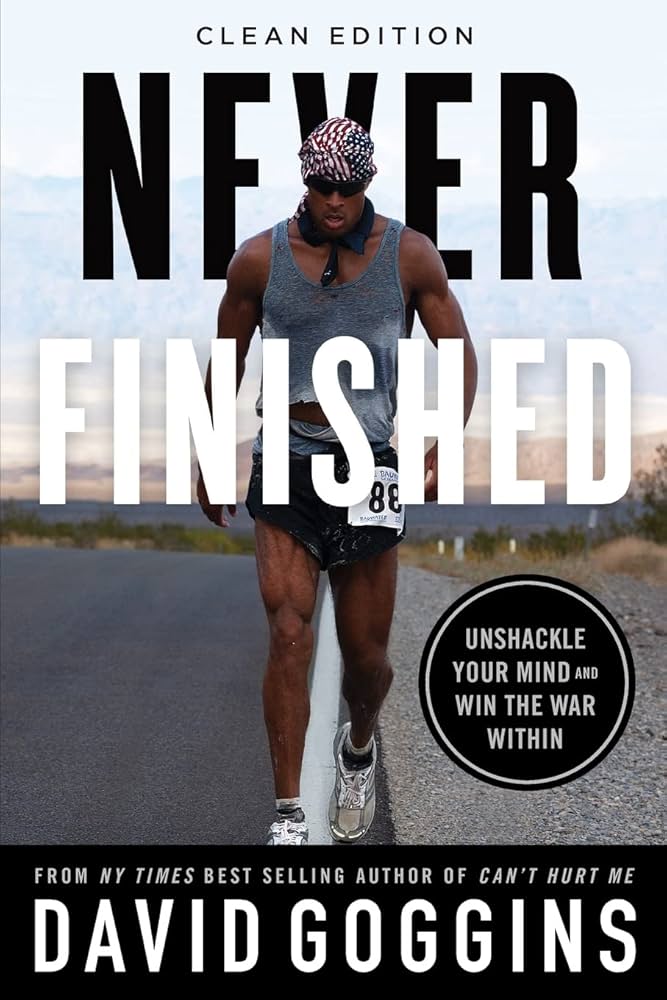
Never Finished
David Goggins
 GENRE: Personal Development
 PAGES: 312
 COMPLETED: November 23, 2025
 RATING:
Short Summary
David Goggins is known for his jaw-dropping accomplishments and his signature mantra: “Stay Hard!” In Never Finished, he dives into the mindset that helped him become the only person to complete elite training with the Navy SEALs, Army Rangers, and Air Force Tactical Air Controllers.
Key Takeaways
1️⃣ The David Goggins Resume
David Goggins is one tough dude. He grew up in the Buffalo, New York area and endured severe physical, mental, and emotional abuse from his father. In both this book and his bestselling memoir Can’t Hurt Me, he’s brutally honest about the trauma he, his mother, and his brother suffered at home. His father routinely administered violent beatings, forcing David to become tougher than nails at a young age.
When David was eight, his mother helped the family escape to Brazil, Indiana, where they lived with her parents. There, his grandpa — a military veteran — helped instill discipline and a strong work ethic in David. David compared the relationship with his grandpa to the fictional one between the Karate Kid and his mentor, Mr. Miyagi. Although he developed a strong work ethic while living with his grandpa, David struggled in school. He barely graduated high school, largely due to undiagnosed learning disabilities. After initially failing the ASVAB (a military entrance exam), he eventually passed it with the help of a tutor.
Passing the ASVAB set the table for David’s military career. Right out of high school, he joined the Air Force and entered Pararescue training before being removed due to a sickle cell trait diagnosis. He later left the Air Force altogether and fell into a rough stretch. He gained a ton of weight — at one point weighing in at more than 300 pounds — and bounced between low-paying jobs, including night security and pest control.
That’s when the real David Goggins woke up. Driven by a desire to become a Navy SEAL, he lost over 100 pounds in three months. This transformation allowed him to qualify for the grueling Basic Underwater Demolition/SEAL (BUD/S) training, which he failed multiple times due to injury and illness. He finally succeeded in 2001, graduating with BUD/S Class 235. After becoming a SEAL, he was assigned to SEAL Team 5 and completed multiple combat deployments to Iraq. He also graduated from Army Ranger School in 2004, earning the “Enlisted Honor Man” award.
To this day, David is the only person to have completed Navy SEAL training, Army Ranger School, and Air Force Tactical Air Controller training! And that was just the beginning. He has brought the same intensity and work ethic to his post-military career, completing some of the most grueling physical challenges imaginable. Below is a small sample of some of the insane ultra races he’s finished — many while pushing through serious injuries:
- Bigfoot 200
- Moab 240
- Leadville 100
- JFK 50 Mile
- Strolling Jim 40 Miler
- Zane Grey 50 Mile
- San Diego 1 Day (101 miles in 24 hours)
- Badwater 135
In 2013, he also broke the world pull-up record by completing 4,030 pull-ups in 17 hours. The list goes on and on. Outside of racing, he is now a sought-after speaker, works as an advanced emergency technician, and is a wildland firefighter in British Columbia during the summer.
2️⃣ "Stay Hard!": The David Goggins Mindset
In addition to his long list of accomplishments, David is widely known for his signature mantra: “Stay Hard!” He concludes many of his videos and social media posts with the tagline. The slogan is a reference to the mindset he lives by every day — one that prioritizes doing hard things and building confidence from within.
Nobody needs to take things to the extremes he has, but the essence of what David teaches is spot-on. The only way to grow in life is by doing difficult things and challenging yourself. Positive affirmations certainly have value, but they are more of a complimentary piece; despite what any self-help guru might proclaim, they alone will not help you build confidence in yourself. You grow by facing your fears, pushing your limits, and working your ass off to accomplish lofty goals. Nobody gets better by sitting in the comfort zone.
The things you learn about yourself in the fire are invaluable. By constantly doing hard things, you force your mind and body to adapt to the circumstances. Have a fear of public speaking? Attack it. Want to expand your knowledge? Read books and study every day. Want to improve your physique? Get in the gym at 5 a.m. every morning and work on it. Want to level up at work? Stay late and put in a few extra hours to separate yourself. The harder the habit, the more you’re going to grow.
The ultimate purpose of doing hard things is to prepare yourself for life’s challenges. Life isn’t easy. Everybody goes through really trying times. The more you put yourself in difficult positions and “callous the mind”, as David puts it, the easier things will be for you. If you join a public speaking group and work on it every week until it becomes a strength, all of a sudden that presentation at work isn’t as intimidating as it was before. If you go out and train to run a marathon, routine workouts no longer seem as daunting.
The idea is to push yourself to be better in every aspect of your life. Get 1% better every day. Unfortunately, the only way to improve is by doing things that really suck. But because doing hard things sucks, not a lot of people will voluntarily subject themselves to the suffering and discomfort it takes to grow. There are no shortcuts in life. You have to do the work.
David takes this mindset to the extreme. He’s the only person to ever complete Navy SEAL training, Army Ranger School, and Air Force Tactical Air Controller Training. He runs 240-mile races. He overcame a severe stuttering problem to become a prolific public speaker. He fights wildfires in the summer despite earning an outstanding living already. He does it because he gets it. He gets that we are either getting better or getting worse, and the only way to grow is by doing hard things that challenge you and make you suffer a bit.
The takeaway here is to look for opportunities to do difficult things. The harder and more uncomfortable, the better. The path to growth isn’t on the couch watching Netflix. And you’ll never feel fulfilled by buying material things. The path to growth and happiness in life is in the dirt. Constantly look for new challenges to overcome and goals to achieve, then push yourself to accomplish them.
Stay Hard!
3️⃣ Win the Tough Seconds
David tells us to do hard things. Got it. But whether they’re based in fear, laziness, or something else, we all face limiting thoughts when we’re about to do something we don’t want to do. Most of us let those thoughts win and keep us tucked inside the friendly confines of the comfort zone.
David encourages us to tighten up and “win” those precious moments when your mind is trying to talk you out of what you know you should do — to sleep in, skip the public speaking class, avoid the difficult test, or put off training for that marathon. Those moments right before you act are everything. Life often hinges on a handful of seconds, and you have to win those seconds.
That means digging deep inside yourself to find the willpower to overcome those negative thoughts of resistance. It means taking immediate, physical action before your mind can negotiate you into staying put. If it’s a run you’re dreading and your thoughts are whispering that you’re too tired or sore, winning the moment means grabbing your clothes and lacing up your shoes before the excuses cause you to stay put. As David writes: “Life, like Hell Week, is built on seconds that you must win, repeatedly. When you are trying to lose weight or quit drinking or using drugs, your moment of weakness can be counted in seconds, and you’ll need to be ready to win those seconds.”
Ultimately, life comes down to those precious seconds where you’re vulnerable. It’s critical that you win as many of them as you can. Over the course of your lifetime, the difference in your overall development can be massive.
4️⃣ Stop Feeling Sorry For Yourself
For some reason, pouting and feeling sorry for yourself feels good. Unfortunately, it’s completely unproductive and a massive waste of time and energy.
It’s so easy to beat yourself up when things don’t go perfectly. Any failure, big or small, tends to fling you into an endless cycle of self-criticism, frustration, and pouting. You have to resist this temptation for self-pity — all of it is a waste of time and energy and does absolutely nothing to move you forward.
Rather than pout, attack the issue. One way you can do this is by looking at shortcomings or failures with an analytical lens: try to diagnose why things didn’t go how you wanted and immediately get to work trying to improve those areas. When you look at failure in a more analytical way, you take some of the emotional sting out of it and prevent the failure from becoming unproductive. You get something from the failure, which should always be the goal. An example: On the first day of the NFL offseason, Peyton Manning used to watch every interception he threw and look for commonalities among his bad throws. He would then design targeted drills to help improve those areas. Sulking and beating yourself up serves no purpose. Cut it out. Learn from failure, then attack it.
David sums it up well in the book: “Every minute you spend feeling sorry for yourself is another minute not getting better, another morning you miss at the gym, another evening wasted without studying. Another day burned when you didn’t make any progress toward your dreams, ambitions, and deepest desires. . . . The only thing that ever matters is the present moment. Yet too many people let their depression or regret hijack their day. They let their feelings about the past hijack their lives. . . . I don’t care what you’ve been through. I can feel bad for you. I can have sympathy for you, but my sympathy won’t get you anywhere. . . . Don’t feel sorry for yourself. Get strategic. Attack the problem.”
5️⃣ Goggin-isms: Words to Live By
The quotes below provide a window into David’s mindset. They touch on everything from discipline and leadership to personal growth and the dangers of self-pity. Each quote is pulled directly from the book.
Page 13: “There are two levels to belief. There’s the surface level, which our coaches, teachers, therapists, and parents love to preach. ‘Believe in yourself’, they all say, as if the thought alone can keep us afloat when the odds are against us in the battle of our lives. But once exhaustion sets in, doubt and insecurity tend to penetrate and dissipate that flimsy brand of belief. Then there’s the belief born in resilience. It comes from working your way through layers of pain, fatigue, and reason, and ignoring the ever present temptation to quit until you strike a source of fuel, you didn’t even know existed.”
Page 32: “I wanted to be better. I knew I had to start living every day with a sense of urgency. Because that is the only way to turn the odds in your favor.”
Page 33: “I learned that it is the rare warrior who embraces the adversity of being born into hell and then, with their own free will, chooses to add as much suffering as they can find to turn each day into a Boot Camp of resiliency. Those are the ones who don’t stop at good enough. They aren’t satisfied with just being better than they used to be. They are forever evolving and striving for the highest level of self.”
Page 39: “None of us have any clue what’s coming for us or when our time might run out, which is why I do my best to ignore anything that is counterproductive. I’m not suggesting we act like robots, but we need to understand that forward motion gives our lives momentum.”
Page 48: “You can’t be afraid to disappoint people. You have to live the life you want to live.”
Page 93: “It’s all well and good to have success and reach a certain level, but I really don’t care what you did yesterday. Maybe you finished Ultraman or graduated from Harvard. I do not care. Respect is earned every day by waking up early, challenging yourself with new dreams or digging up old nightmares, and embracing the suck like you have nothing and have never done a damn thing in your life.”
Page 111: “If you want to maximize minimal potential and become great in any field, you must become imbalanced, at least for a period of time. You’ll need to funnel every minute of every single day into the pursuit of that degree, that starting spot, that job, that edge. . . . There are no days off, and there is no downtime when you are obsessed with being great. That is what it takes to be the best ever at what you do. Know that your dedication will be misunderstood. Some relationships may break down. The savage is not a socialized beast, and an imbalanced lifestyle often appears selfish from the outside.”
Page 132: “When a half-hearted job doesn’t bother you, it speaks volumes about the kind of person you are. And until you start feeling a sense of pride and self-respect in the work you do, no matter how small or overlooked those jobs might be, you will continue to sell yourself short.”
Page 140: “It’s so easy to be great nowadays because so many people are focused on efficiency: getting the most for themselves with the least amount of time and effort. Let all of them leave the gym early, skip school, take sick days. Commit to becoming the one person with a never-ending task list. This is where you make up the difference in potential. By learning to maximize what you do have, you will not only level the playing field but also surpass those born with more natural ability and advantages than you.”
Page 141: “Discipline builds mental endurance because when effort is your main priority, you stop looking for everything to be enjoyable.”
Page 141: “When you become disciplined, you don’t have time for that. Your insecurities become alarm bells reminding you that doing your chores or homework to the utmost of your ability and putting in extra time on the job or in the gym are requirements for a life well-lived. A drive for self-optimization and daily repetition will build your capacity for work and give you confidence that you can take on more. With discipline as your engine, your workload and output will double, then triple.“
Page 143: “Today, I burn with an inner drive shaped by doing the things I don’t want to do over and over again. And it won’t let me relax until I’ve done what needs to be done every day.”
Page 148: “Every minute you spend feeling sorry for yourself is another minute not getting better, another morning you miss at the gym, another evening wasted without studying. Another day burned when you didn’t make any progress toward your dreams, ambitions, and deepest desires.”
Page 149: “The only thing that ever matters is the present moment. Yet too many people let their depression or regret hijack their day. They let their feelings about the past hijack their lives. . . . I don’t care what you’ve been through. I can feel bad for you. I can have sympathy for you, but my sympathy won’t get you anywhere. . . . Don’t feel sorry for yourself. Get strategic. Attack the problem.”
Page 208: “Everything we do is an opportunity to get better at the game of life itself. Whether or not we realize it, every interaction, each task is a reflection of your mindset, values, and future prospects. It’s an opportunity to be the person you’ve always wanted to be.”
Page 209: “We can’t rely on others to get us where we want to be. We need more personal ownership and self-leadership.”
Page 218: “When you deliberately and consistently confront your fear of heights or particular people, places, and situations that unsettle you, those seeds germinate, and your confidence grows exponentially. You might still hate jumping off high things or swimming beyond the waves, but your willingness to keep doing it will help you make peace with it.”
Page 240: “Setting an example through action rather than words will always be the most potent form of leadership. You don’t have to be a great public speaker or have an advanced degree. Those things are fine and have their place, but the best way to lead a group is to simply live the example and show your team or classmates, through dedication, effort, performance, and results, what is truly possible.”
Page 259: “No matter what you are dealing with, your goal should be to maximize the resources and capabilities you do have. If you suffered a freak injury or received a diagnosis that changes everything, what does your new maximum effort level look like? Not only does this keep your mind engaged and your demons at bay, you actually might achieve things the old you never could have conceived.”
Page 269: “I’m often asked how I’d feel if my body rebelled and I could no longer run, ride my bike, or compete in any sport. It’s an easy answer because I already know what I’d do. It might take a few months for me to work through my frustration and recalibrate, but then, I’d go be great at something else.”
Page 278: “You cannot allow what someone else may or may not think about you or the issues you’re dealing with to stop your progress.”