
Glucose Revolution
Jessie Inchauspé
 GENRE: Health & Wellness
 PAGES: 225
 COMPLETED: October 5, 2025
 RATING:
Short Summary
Glucose spikes send our bodies on a wild ride. In Glucose Revolution, Jessie Inchauspé breaks down how glucose works, why sharp spikes hurt our health, and practical strategies for achieving a flatter glucose curve.
Key Takeaways
1️⃣ What Is Glucose? Plants and Photosynthesis
Glucose. We’ve all heard of it, but what is it? In short, glucose is fuel. It’s a molecule our cells rely on to make energy and support growth, and it enters our bloodstream following the digestion of certain foods. It’s what the mitochondria in each of our cells use to create Adenosine Triphosphate (ATP). ATP is the primary energy currency of cells, and the production and release of ATP allows us to think, contract our muscles, and do everything else we need to do. Put simply — our cells need a huge amount of fuel to stay alive, and glucose is the body’s fastest and most readily available source of energy. It’s the preferred source.
Glucose is energy for our body that comes from food. But what kind of food? The answer is food coming from plants. That’s because glucose is a molecule produced by plants through the process of Photosynthesis. Plants create their own glucose to grow, and they do this via Photosynthesis — by turning carbon dioxide (from the air) and water (from the soil) into glucose using the energy of the sun. Glucose then allows the plant to grow bigger and stronger. It does this by using glucose to make three different things:
- Starch — Photosynthesis can’t provide a plant with the glucose it needs when it’s cloudy or dark. To solve this issue, plants make extra glucose when it’s sunny out and pack it away into reserves for later use. This extra glucose is rounded up into long chains of glucose called starch. Potatoes, rice, oatmeal, wheat, beans all contain a lot of starch — and therefore a lot of glucose. Any food made from flour also contains starch. Pie crust, cookies, pastries, pasta are examples. Potato chips are also very starchy and contain a lot of glucose.
- Fiber — A plant can also use glucose to make fiber. Fiber is what allows the plant to grow tall without falling over, and it’s found in trunks, branches, flowers, and leaves — but there is fiber in roots and fruits as well. Plants in general are high in fiber. Think fruits and vegetables. Fiber does not become glucose inside our body because we aren’t able to digest it. Rather, fiber is a prebiotic that the bacteria in our gut breaks down for us. We don’t have to worry about fiber causing glucose spikes in our body.
- Sugars (Fructose and Sucrose) — If you were to lick glucose, it would taste sweet. But plants transform some of their glucose into an extra-sweet molecule called fructose, which is about two times sweeter. Plants then turn fructose into fruit that dangle from their branches. Fruit — which is high in fructose and therefore very sweet — is eaten by animals, and its seed is eventually pooped out elsewhere. This allows plants to spread far and wide. This is how most fructose is used by plants, but some of it links up with glucose to create sucrose. Fructose + Glucose = Sucrose. Sucrose helps the plant with energy storage, but humans decided to turn it into table sugar.
Starch, fiber, fructose, and sucrose are the various forms glucose can take in plants, and they all exist because of Photosynthesis. But we are not plants — we can’t make glucose from the air and the sun to grow. The way we get the glucose we need is by eating it from plant sources (see the next takeaway).
2️⃣ The Glucose Family: Carbohydrates
Our cells need a ton of fuel to survive, and we get the energy we need by eating foods that can be broken down by the body into glucose — our quickest and most readily available energy source. Photosynthesis helps plants make starch, fiber, and sugars (fructose and sucrose), and our body converts these food sources into different things when we eat. The diagram below sums it up:
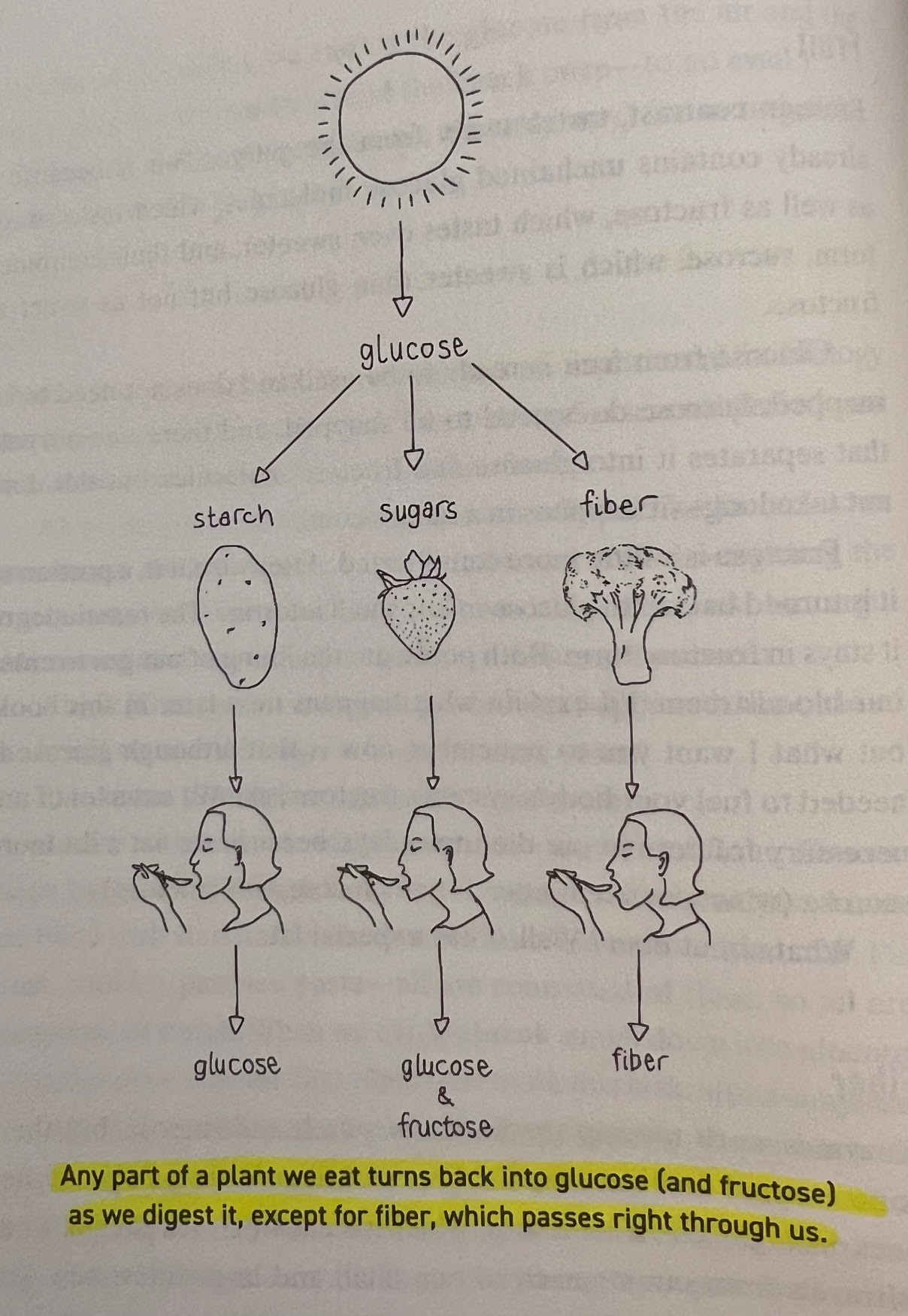
In short, our body converts starch to glucose very quickly, and it converts sugar from fruit to glucose and fructose. Foods in these categories are very quick sources of energy. Fiber is a different story — there is no enzyme in the body to snap the bonds of fiber and turn it into glucose. Therefore, when we eat fiber (e.g. vegetables), it remains fiber. In fact fiber is a prebiotic, meaning it can’t be digested by the body — instead, our gut bacteria consume it for us. These four — starch, fiber, fructose, and sucrose — are like siblings whose mother is glucose. Because they are related, in the 1970s scientists gave them a name: Carbohydrates. Carbohydrates = Starch and Fiber and Sugars (glucose, fructose, and sucrose).
Again, glucose is the preferred energy source for our body. Our body likes it so much that it can take any excess amount of glucose and store it inside of our liver and muscles as Glycogen. Think of glycogen as emergency energy reserves of glucose that can be released back into the bloodstream anytime our glucose levels are low and our cells need some energy. Endurance athletes take advantage of this process by eating tons of carbohydrates (i.e. “carb-loading”) and filling up their glycogen stores before an event. During the event, as they are rapidly ripping through glucose, their liver and muscle cells will release the extra glucose into the bloodstream to help them continue.
Although glucose is our preferred energy source, most cells can switch to using fat for fuel instead. This is the basis of the Atkins diet and other keto diets — they purposely restrict carbohydrates in an effort to drive glucose levels so low that our cells begin burning fat for fuel instead. This leads to weight and fat loss. In a life-or-death type of situation, the body will burn muscle and convert it to glucose for fuel — but this is sort of a last resort if both glucose and fat levels are very low.
3️⃣ Processed Foods: Stripping Fiber, Increasing Starch and Sugar
Today’s grocery stores are packed with processed foods that are high in two main types of fast-digesting carbohydrates: starch and sugar. While fiber is technically also a carbohydrate, it’s often the first thing food companies strip away. Why? Because fiber doesn’t help their bottom line.
Fiber can make foods spoil faster because it holds moisture, and it isn’t able to be converted to glucose in the body for quick energy — as mentioned, it mainly feeds our gut microbiome. For these food companies, if fiber can’t give the customer energy via glucose and it reduces shelf life, what’s the point of including it? To solve this “problem,” companies strip fiber during milling and food engineering, leaving behind a more shelf-stable product that’s mostly starch and sugar. Then they often add even more sugar or starch to boost flavor. These ingredients light up the brain’s reward system, triggering dopamine and encouraging us to buy more of the product. Humans love dopamine, and sweet and starchy foods are an easy way to get a hit. That hit leaves us wanting more and more.
A simple example of this is whole wheat bread vs. white bread. Whole wheat bread keeps more of its original fiber, which is why it has a darker color. More fiber means less starch and sugar — and this leads to a smaller glucose spike. White bread has had almost all its fiber stripped away, leaving more room for starch and sugar, causing a much faster and bigger glucose spike. The same principle applies to brown rice vs. white rice. On the sugar side, think cherries vs. jelly beans. Both contain sugar, but jelly beans are loaded with a super-concentrated dose, while cherries also come with fiber, water, and nutrients that lead to smaller glucose spikes.
What does all of this mean for our glucose levels? Food that has had fiber stripped away has higher concentrations of starch and sugar and leads to a bigger glucose spike that our body has to deal with. And unfortunately, many processed foods (e.g. cereals) are now engineered to do just that. Ultimately, food companies are out to make a profit. Their attempt at doing that is to make things last longer on shelves by stripping fiber from plants and increasing the concentration of starch and sugar. The result is food that leads to towering spikes in our glucose levels and makes us feel like crap.
4️⃣ The Consequences of Too Much Glucose
When we eat food — especially the starch and sugar found in carbohydrates — it is digested and glucose enters the bloodstream. This causes an increase in blood sugar levels. The two go hand in hand — blood sugar is a measure of the amount of glucose in the bloodstream. Several studies have shown that a fasting glucose level somewhere between 75 and 85 mg/dL is ideal.
The problem arises when we eat too many starchy and sugary carbohydrates and too much glucose enters our bloodstream at one time. This is a glucose spike. And our body attempts to clear the extra glucose by packing it into our liver and muscle cells so our mitochondria can make ATP and power us through our day. If there’s still any leftover, it’s stored as fat (i.e. triglycerides). But the consequences of glucose spikes go beyond just storing fat — they accelerate cellular aging through four major processes:
- Free Radicals — These are unstable molecules with unpaired electrons that randomly snap and modify our DNA. They literally poke holes in our cells, which can lead to mutations in our genetic code. And as outlined in other books, mutations can lead to the development of cancer.
- Oxidative Stress — It’s not unusual to have free radicals in our body. But when you flood the body with glucose, there are too many free radicals to neutralize. When this happens, scientists say that we are in a state of “oxidative stress” — and heart disease, Type II diabetes, cognitive decline, and accelerated aging are all closely linked with oxidative stress. Fructose is an even bigger driver of oxidative stress than glucose, which is one of the reasons sweet foods full of sugar are worse than starchy ones.
- Glycation — When glucose molecules bump into other molecules in the body, it causes a reaction, and the second molecule is said to be “glycated.” This is another way of saying “damaged.” Glycation is a normal and inevitable part of life, and it’s why we age, why our organs slowly deteriorate, and why we eventually die. We can’t stop this process, but we can slow it down or speed it up. The more glucose and fructose we put into our body, the faster this process will happen. In fact, fructose molecules glycate 10 times as fast as glucose and generate that much more damage. The key to avoiding excessive glycation and slowing down the aging process is to keep your glucose and fructose levels relatively low and avoid big spikes.
- Inflammation — The combination of too many free radicals, oxidative stress, and glycation leads to a generalized state of inflammation in the body. Chronic inflammation contributes to very serious health issues like stroke, heart disease, liver disease, and so much more. We want as little inflammation in the body as possible! To help this, we need to keep our glucose and fructose levels low and avoid big spikes.
Our blood sugar levels fluctuate all day. If you were to plot the points throughout the day, you’d see your glucose curve. Big spikes in our curve happen when we eat food high in starchy and sugary carbohydrates, which are turned into globs of glucose in the body. In addition to causing the issues outlined above, these spikes — and especially the ensuing crashes — have a big impact on how we feel. Our mood, sleep, feeling of fullness, weight, skin condition, immune system, risk for heart disease, and more are all affected by these spikes in our glucose levels. The spikes also affect our fasting glucose levels — over time, years of daily spikes slowly contribute to an increase in fasting glucose that could eventually lead to becoming pre-diabetic or developing Type II diabetes.
The best thing we can do is to aim for a flat glucose curve — one that has very few spikes and crashes. A consistently flat glucose curve makes us feel more alert, focused, full, and energized. I’ve noticed this in my own life — it’s almost like you’re a little more “locked in.” A flatter glucose curve also helps us avoid the larger-scale issues that come with free radicals, oxidative stress, glycation, and chronic inflammation — all of which slowly degrade our cells and make us age faster. Below are a few examples of some of the big issues that are very tightly linked with chronically high glucose levels, in addition to Type II diabetes:
- Alzheimer’s — Alzheimer’s and glucose are so closely connected that the disease is sometimes called “ Type III Diabetes.” People with Type II diabetes are four times more likely to develop Alzheimer’s than non-diabetics.
- Cancer — Cancer feeds on glucose (the Warburg effect). As mentioned, free radicals can lead to DNA mutations in our cells, and these mutations are one of the prerequisites of cancer. Cancer also spreads faster when insulin is present in the body. Insulin is usually only high if there’s too much glucose in the bloodstream. The proof is in the data: people with fasting glucose levels of higher than 100 mg/dL — classified as pre-diabetes — have over double the likelihood of dying from cancer. Flattening glucose and insulin curves is therefore an important step in preventing cancer.
- Heart Disease — As Peter Attia documents in his book Outlive, Apolipoprotein B is the type of cholesterol, along with inflammation, that really drives heart disease. As we’ve seen, both glucose and fructose contribute to the development of fat, also-known-as triglycerides. Triglycerides can eventually become ApoB in our body. Rather than total cholesterol, a good measurement to look at is either ApoB level or triglycerides-to-HDL ratio. To assess the latter, divide triglycerides (in mg/dL) by HDL level (in mg/DL) — you want a number smaller than two.
Bottom line, glucose is essential for life, but keeping spikes in check protects your energy in the short term and your brain, heart, and cells in the long term.
5️⃣ How the Body Clears Glucose: Insulin, Glycogen, and More
When glucose enters our system after a meal, the body needs to clear excess amounts of it from the bloodstream in order to reduce the free radical formation, glycation, and inflammation outlined in the previous takeaway. How does it do that? The pancreas produces and releases a hormone called insulin — and insulin has one main job: clear excess glucose from the bloodstream by packing it into “storage lockers.” Its preferred storage lockers are:
- The Liver — Our liver can store quite a bit of glucose by turning it into a new form called Glycogen, which can later be released back into the bloodstream as glucose when we really need it. The liver can hold about 100 grams of glucose in glycogen form (the amount of glucose in two large McDonald’s fries). That’s half of the 200 grams of glucose we need for energy every day.
- Muscles — The second storage locker is our muscles. The mitochondria inside our cells use the glucose to create ATP and power us through our day. Our muscle cells can also hold glucose as glycogen: the muscles of a typical adult can hold about 400 grams of glucose as glycogen. That’s the equivalent of seven large McDonalds fries.
- Fat / Triglycerides — Although our liver and muscle cells can hold quite a bit of glucose, we still manage to eat too much. When our liver and muscle cells are topped off with glycogen, insulin has no other choice but to pack any leftover glucose into our fat cells as triglycerides. In fat cells, glucose cannot be transformed into glycogen — it is just pure fat. Not what we want.
Now, our cells are not always willing to allow insulin to pack glucose inside them. When we are constantly eating glucose, it puts a lot of stress on the pancreas to create enough insulin to clear the bloodstream. That’s not ideal. But an equally bad problem is something called insulin resistance. This occurs when your cells get so used to insulin stuffing them with glucose that they become resistant to the insulin itself. This means it takes MORE insulin to do the same work. Eventually, it gets to the point where the insulin can’t clear the bloodstream of excess glucose, leading to chronically high glucose levels in the body. This is Type II diabetes. Patients with Type II diabetes have to inject insulin into their body to help them clear their bloodstream.
But back to the storage lockers. The storage lockers outlined above are where our body packs excess glucose from the bloodstream to avoid the many issues that come with too much glucose. Fructose is a different story, however. Fructose is usually not stored in our liver and muscle cells as glycogen — fructose is generally stored in the liver and across the body as fat. This is not good. As the author writes: The fat our body creates from fructose has a few unfortunate destinies: first, it accumulates in the liver and drives the development of nonalcoholic fatty liver disease. Second, it fills up fat cells in our hips, thighs, and face and between our organs, and we gain weight. Finally, it enters the bloodstream and contributes to an increased risk of heart disease. (You may have heard of it as low-density lipoprotein [LDL] or “bad” cholesterol.)
This is one of the main reasons you want to avoid sugar and sweet treats. Fructose spikes are simply far worse than glucose spikes — although we want to keep both of these curves flat. Avoiding fructose means that fewer molecules we eat end up on our body as fat. But in the end, we really shouldn’t be too upset with our body for putting on fat — instead, we should thank it for trying to protect us from oxidative stress, glycation, and inflammation!
If we want to lose fat, it’s imperative that we keep glucose and fructose levels low. What we’re trying to do is empty our fat cells of the fat they contain so they can deflate like balloons and reduce in size. But that process can never occur if our glucose levels are high. Why? Because the body uses glucose as its preferred source of energy. We need to give the body no other option but to turn to its No. 2 source of fuel, which is fat. We do this by avoiding starchy and sugary carbohydrates, because these food sources lead to big glucose and insulin spikes.
Where we don’t mind a little glucose and insulin is after a workout, because insulin encourages growth by packing those cells with glucose. After a workout, our damaged muscle cells are extremely insulin sensitive and desperately need protein and glucose to rebuild themselves after a workout, so a spike isn’t the worst thing in this situation. Ideally, most of your carbs (i.e. glucose) should be taken around your workouts, both before to drive performance and after to help the muscles recover and grow.
6️⃣ Flatten Your Glucose Curve: Hacks to Help
At this point, it’s clear that we want a glucose curve that is relatively low and flat and free of towering spikes. When we look at our bloodwork, we want fasting glucose to be relatively low. It’s not that glucose is bad — we need it for energy and would die without it. But our society today tends to eat way, way too much of it. Consistent glucose spikes cause us to feel crappy, accelerate our aging, and can lead to very serious health issues.
One of the best things we can do for our health is to be conscious of how many starchy, sugary carbohydrates we’re consuming. These are the real enemies that cause big spikes. But it doesn’t mean you have to avoid them entirely — there’s an art and a science to eating glucose. Below are a few hacks to maintain a relatively flat curve.
Hack No. 1 = Eat Carbs Last. There’s a correct order to eat your food. It goes fiber first, protein and fat second, starches and sugars last. Put simply, eat everything else before carbs. Why? Fiber, protein, and fat are not transformed into glucose, so they will sort of “clog up” your digestive system and cause the glucose from the starches and sugars to hit your bloodstream much slower. The slower the trickling of glucose into your bloodstream, the flatter your glucose curve and the better you’ll feel. This means we can eat the exact same meal — but by eating the carbs last, we’ll have a much flatter curve. This also has the added benefit of making us feel fuller for longer. In short — never eat starchy and sugary carbs first or on their own!
Hack No. 2 = Have a Salad Starter. This sort of plays off of the previous hack. The leafy greens of a salad are high in fiber, and fiber is not transformed into glucose when it enters our body. So, by having a salad before your full meal, you can help prevent a big glucose spike that might come later when carbs hit your plate.
Hack No. 3 = Look Beyond Calories. It’s true that being in either a calorie surplus or a calorie deficit is all that matters when it comes to gaining or losing weight on the scale. However, not all calories are the same. First off, what is a calorie? A calorie is a measure of how much a certain food can heat up water. Scientists find out how many calories are in something by burning it and seeing how much it heats up water. But just because a 200 calorie Greek yogurt generates the same amount of heat as a 200 calorie doughnut does not mean these items have the same impact on your health. Fructose, glucose, fiber, protein, and fat are all different molecules. Fructose is primarily processed by the liver and is, usually, stored as straight fat. Protein can be converted into glucose but only very slowly, and fat barely affects glucose levels at all. Fiber isn’t converted into glucose at all but instead feeds gut bacteria. In short, you need to be aware of the labels and understand how the calories of a certain food are broken down.
7️⃣ More Hacks to Flatten Glucose Curve!
Hack No. 4 = Be Careful With Breakfast. After about 7-8 hours of fasting during a night of sleep, you have to be very careful with what you eat for breakfast because the body is very sensitive to glucose. This decision will have a big impact on how you feel the rest of the day. A sugary, starchy breakfast will send your glucose and fructose levels to the moon right away. That means an equally big crash. Your breakfast should center around protein and fat. It’s not bad at all to have something starchy, like toast or a bagel, but eat it alongside protein — and eat it last. Try to keep sugar to a minimum. Doing so will help you feel and perform well throughout the day.
Hack No. 5 = Sugar Is Sugar. There’s no such thing as good sugar and bad sugar. Whether it’s from a glass of OJ, a dash of honey, a piece of fruit, or some candy, sugar is broken down into glucose and fructose in the body. All of these sources of sugar are made of glucose and fructose molecules — they are just packaged and named differently. Because fructose is generally not used to fuel our cells and is usually stored as fat, try to avoid it as much as possible. If you’re going to have some sugar, get it from a piece of fruit — preferably berries because they have the most fiber and smallest amount of sugar. And try to eat any kind of sugar or dessert at the end of a meal, as Hack No. 1 calls for. Fruit juice is bad because it contains a huge amount of sugar compared to a single piece of fruit and lacks fiber.
Hack No. 6 = Eat Big Meals, Avoid Snacking. Your glucose curve is flatter when you eat three or four big meals and avoid snacking between them. You don’t need to eat six different times throughout the day. Doing so just increases your chances of spiking your glucose levels.
8️⃣ Even More Hacks to Flatten Glucose Curve!
Hack No. 7 = Consume Vinegar Before Eating. Vinegar is just alcohol that has been taken apart by bacteria. If you leave a glass of wine on a table for a week, it will turn into acetic acid — which is the main compound in vinegar. Surprisingly, the acetic acid in vinegar helps prevent big glucose spikes — in one study, participants who drank vinegar before eating a meal rich in carbs reduced their glucose spike by 8-30%. How does it do this? Acetic acid temporarily inactivates an enzyme that transforms sugar and starch into glucose in the body. As a result, sugar and starch are transformed into glucose more slowly, and the glucose hits our system more softly. It also helps our muscles take in glucose faster. These two benefits result in a smaller glucose spike. To take advantage of this, drink a tablespoon of apple cider vinegar in water about 20 minutes before a meal. You can also capitalize by adding vinegar dressing to your salad.
Hack No. 8 = Move After Eating. Recall that glucose is what our cells use to create ATP, and ATP is what allows us to move and contract our muscles. We can use this fact to our advantage by moving after we eat. When we eat starchy, sugary carbohydrates, the glucose will either overwhelm the mitochondria in our cells and lead to free radicals, fat gain, and inflammation or it can be used to fuel our activities. When we move our body after eating, we increase the likelihood that the glucose will be used by our contracting muscles. Rule of thumb — walk, workout, do pushups, do calf raises, or contract your muscles in some way within 30-60 minutes of eating. This leads to a much smaller glucose spike, and you feel so much less lethargic after the meal. Weight lifting has been shown to decrease glucose spikes by up to 30% and the size of further spikes over the next 24 hours by 35%.
Hack No. 9 = Never Let Carbs Go Naked. Try to avoid eating carbs alone. As a few of the hacks have already touched on, the glucose spikes that come from eating starchy and sugary carbs can be curbed by first consuming fiber, protein, or fat. When you do have carbs, try to always make sure they are accompanied by one or several of these foods to reduce the speed at which glucose hits the bloodstream. This will blunt the glucose spike, which will keep you full for longer and make you feel more energized and focused.