
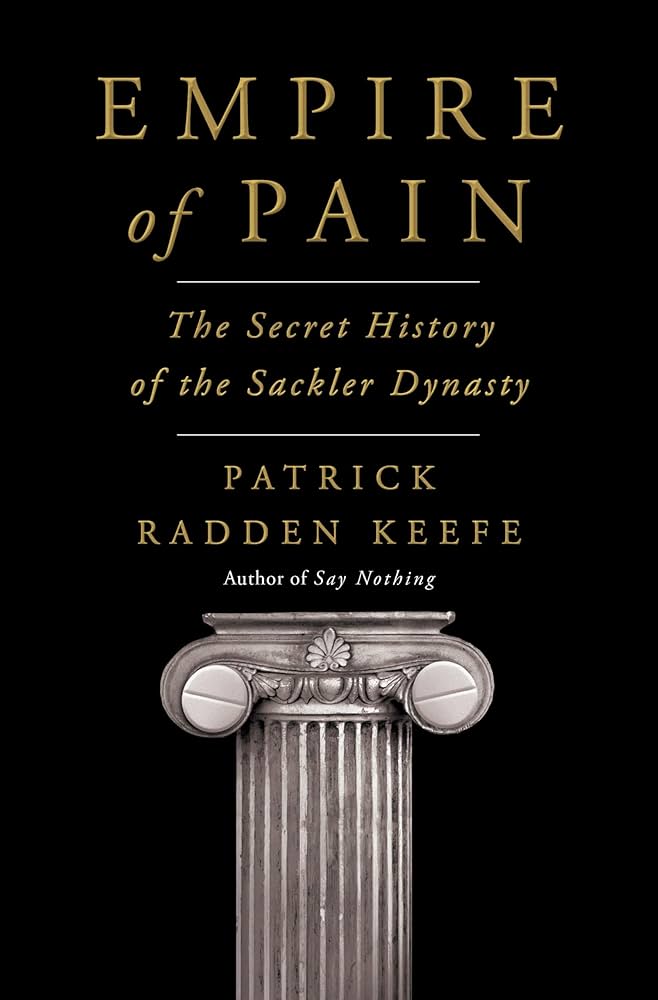
Empire of Pain
Patrick Radden Keefe
 GENRE: Health & Wellness
 PAGES: 560
 COMPLETED: August 31, 2025
 RATING:
Short Summary
The Sackler family is one of the most infamous families you likely have never heard of. As depicted in Empire of Pain, they were the driving force behind the creation and deceptive marketing of OxyContin — a blockbuster painkiller that ignited the opioid crisis still ravaging communities across the United States today.
Key Takeaways
1️⃣ Meet the Sacklers: Engineers of the Opioid Crisis
Although other painkillers were used at the time, the development and aggressive marketing of OxyContin in the 1990s was a major turning point that really launched the opioid crisis. At their pharmaceutical firm Purdue Pharma, the Sackler family — led by Richard Sackler and his teams — developed and launched OxyContin, a painkiller that relied on the opioid Oxycodone and was (and still is) used to treat chronic pain. Richard Sackler was mostly concerned with making money and was very aggressive about marketing OxyContin to doctors and pharmacists. Under his leadership, Purdue used misleading and unethical marketing strategies to persuade doctors and the public into thinking OxyContin was a drug that was not addictive and was unlikely to be abused. These claims were false, but they worked: OxyContin became one of the biggest blockbusters in pharmaceutical history, generating $35 billion in revenue.
Since OxyContin’s introduction, more than 600,000 Americans have died from opioid-related addiction and overdoses. These opioid overdoses have become the leading cause of accidental death in America. Many people who abused OxyContin eventually turned to street opioids like Heroin and Fentanyl, which only made the crisis worse. Put simply, we did not have an opioid crisis before OxyContin. After the introduction of OxyContin, we did. For their role in recklessly marketing OxyContin, misleading the public about its addictive properties, and downplaying the drug’s risks, the Sacklers became the defendants in more than 2,500 lawsuits — including suits filed by all 50 states.
Thanks in large part to the huge sales of OxyContin, the Sackler family at one point ranked inside the top 20 wealthiest families in the world with a fortune of $14 billion. The family was also very involved in philanthropy, often trading donations for the right to put the Sackler name on museums, scholarships, art galleries, and medical facilities around the world. This helped the family build a false reputation of prestige and generosity. Eventually, as the opioid crisis got worse, that reputation came crashing down — along with their name on these institutions. Today, the Sacklers are remembered less for their philanthropy and more for their role in fueling an opioid crisis that has killed more than half a million people.
2️⃣ The Sackler Rise: Arthur Sackler
As it pertains to this story, the Sackler family’s success really started with brothers Arthur, Mortimer, and Raymond Sackler. Arthur Sackler was the main figure who helped the Sacklers establish a foundation of power and fame.
Arthur graduated from NYU in the 1940s with a medical degree and spent the first years of his career at an institution called Creedmore. At the time, mental illness was a mysterious and poorly understood problem that nobody really had an answer for. Arthur was among the growing faction of medical practitioners who believed the solution to many mental health issues could be solved by using pills and medication to alter brain chemistry. By the 1950s, pharmaceutical companies were beginning to pump out specific pills to address specific diseases.
Because so many new products were hitting the market, pharmaceutical companies turned to ad agencies to develop creative ways to help persuade doctors and patients to use their products. And this is where Arthur Sackler excelled and made most of his fortune — as an advertiser, not a doctor. He was an elite salesman and marketer who owned William Douglas McAdams, an ad agency that specialized in promoting products sold by pharmaceutical companies. Arthur had worked there as a side hustle since 1942 and was so good at creating ad campaigns that he eventually became the president and owner.
Arthur’s aggressive marketing strategies and focus on brand recognition for clients like Pfizer ushered in a new age in the field of medical advertising. Suddenly, there were entanglements between the people who prescribe mediations (e.g. doctors) and those who make and market the products (e.g. pharmaceutical companies). The pharmaceutical companies were pumping out pills, and they wanted doctors to prescribe them. This focus among drug companies to persuade doctors to prescribe their pills is really when many of the conflicts of interest and other corruption in the medical industry began to take off, and these problems are still around today. As the owner of a prominent ad agency, Arthur was at the center of it all. He was greedy and saw the opportunity to make a lot of money.
So did pharmaceutical executives. In 1960, the company Roche developed a “minor tranquilizer” called Librium to treat a variety mental health issues. Tranquilizers had already been in use, but most of them were designed for major psychological issues that most people never experienced. Librium was a minor tranquilizer that could be used to combat a wide range of issues like anxiety, depression, phobias, and obsessive thoughts. Roche turned to Arthur and his agency to market the product.
And this is where the Sackler family’s reputation for shady practices began. Arthur used a variety of misleading marketing tactics to help persuade doctors to prescribe Librium. Many of the claims in Arthur’s ads and marketing materials sent to doctors overstated Librium’s effectiveness, and they seemed to downplay or ignore the possibility of side effects and addictive properties. But they worked: Librium became the greatest success in the history of drugs at the time. Librium was quickly followed by Valium, a similar tranquilizer released by Roche in 1963 that worked in smaller doses and was even more addictive. Arthur used the same aggressive tactics to market Valium, and by 1968 it had overtaken Librium as the most prescribed drug in America.
Later evidence revealed that Roche deliberately concealed the addictive properties of both Librium and Valium. Patients across the world became addicted to them, and Valium ultimately became the most abused prescription drug of its time. But these two drugs made the company rich. And because he was responsible for marketing Librium and Valium, Arthur became incredibly rich as well.
Indeed, Arthur Sackler built most of his fortune on two highly addictive tranquilizers. As the author writes: “The original House of Sackler was built on Valium.” And it’s worth noting that Arthur, for the rest of his life, usually tried to hide or downplay the source of his immense wealth: pharmaceutical advertising. He didn’t want people to know that most of his money came from marketing addictive, sometimes dangerous drugs.
This was how the Sacklers built the foundation of their empire. The next big leap in their fortune came when Arthur and his brothers purchased a small pharmaceutical company called Purdue Frederick in 1952. Decades later, Arthur’s nephew Richard Sackler would transform that company — renamed Purdue Pharma — into a giant with the development of OxyContin. But in the early years, it was a small firm with only a handful of run-of-the-mill products.
The big takeaway here is that Arthur accomplished two notable things: he established the Sackler fortune by selling addictive tranquilizers, and he helped usher in a new era of medical advertising. As it turned out, Richard used many of Arthur’s aggressive marketing tactics to sell OxyContin, and these marketing strategies were largely to blame for the opioid epidemic that followed.
3️⃣ What Are Opioids?
Thousands of years ago, somebody figured out that if you slice the head of an opium poppy, it will ooze a milky paste, and this substance has medicinal benefits. As the people discovered, consuming this substance helps stimulate dreamy sleep, calms the nerves, and induces a very nice feeling of comfort and euphoria. Most importantly, it makes pain go away.
Welcome to the world of opioids. Although the benefits of ingesting this plant material are great, opioids are also dangerous. They are highly addictive, meaning that over time your body becomes used to a certain dosage and needs more of it to get the same benefits. That’s not good, because the more opioids you consume, the greater your risk of overdose. In the case of opioids, overdose happens when you consume so much of the substance that it sends you into a state of relaxation so profound that you stop breathing. You enter a permanent sleep.
There are many opioids: Morphine, Oxycodone, Heroin, and Fentanyl are some of the most well-known. Morphine was the first to be isolated from the opium poppy and developed into a drug in the 1800s. The person who did it named the substance Morphine after Morpheus, the God of Dreams in Greek mythology. Today, the small island of Tasmania produces about half of the world’s legal supply of opium poppies.
In 1898, chemists in Germany working for the pharmaceutical company Bayer — the very same team that developed aspirin — chemically modified Morphine into a new drug: Heroin. Bayer began to mass market Heroin as a safer alternative to Morphine, claiming they had somehow managed to remove the addictive properties of Morphine. They were wrong. In reality, Heroin was six times as powerful as Morphine and just as addictive. Patients who were prescribed Heroin became hooked. Overdoses came by the dozens. By 1913, Bayer realized it had made a huge mistake and stopped manufacturing the drug. Today, it is a dangerous street drug.
What seems to make opioids so addictive is their ability to remove physical and emotional pain. As the author writes, “Opioids can deliver you, if only for a few minutes, from physical or emotional pain, from discomfort, from anxiety, from need. It is like no other human experience.”
Although opioid abuse existed before Purdue Pharma developed OxyContin, an all-out crisis unfolded in the years following the drug’s release in 1995. The company’s aggressive and misleading marketing of the drug was a huge reason for the epidemic.
4️⃣ Birth of MS Contin and OxyContin
When Arthur, Mortimer, and Raymond Sackler bought Purdue Pharma in 1952, it was a small pharmaceutical company that offered standard remedies like earwax remover, treatments for diarrhea, and disinfectants. It was an obscure firm that didn’t have any major innovative products — nothing like the pharmaceutical giant it would later become.
That all changed in the late 1960s and 1970s, when the Sacklers began to place greater emphasis on creating new drugs. In 1966, the Sacklers bought Napp Laboratories and used it as a research and development playground to experiment with new drugs. In the late 1970s, Napp hit the jackpot when it produced a genuinely innovative product: a Morphine pill. Until that point, Morphine — an opioid — had been administered on a drip or in a series of shots. But Napp developed a special coating system for pills that allowed a drug to slowly release into the bloodstream over time. They called this slow release system Continus, and they decided to use it to build a Morphine painkiller. The result was the birth of a new drug: MS Contin.
MS Contin was released in the UK in 1980 and was an immediate success. The drug was primarily used by cancer patients to deal with the severe pain of their treatment. Before MS Contin, patients had to come to the hospital to have their Morphine administered. MS Contin changed all of that — it allowed patients to take their Morphine at home by swallowing a painkiller. It was an incredible breakthrough for pain management. After gaining FDA approval, Purdue Pharma began offering MS Contin in the U.S. in 1984. It went on to generate $170 million per year in sales, dwarfing anything Purdue had sold before. The Sackler fortune exploded.
The only problem is that the patent on MS Contin was set to expire in a few years. Patents are what drive huge profits in the pharmaceutical industry. They give you the exclusive right to sell a certain product, creating a sort of temporary monopoly on the drug that blocks competitors out. Once the patent expires, competitors can create generic versions of the drug and sell them at lower prices. This means there is a limited window to make huge money.
With MS Contin’s patent expiring soon, Purdue Pharma knew it had to create a different drug to keep the money flowing in. By this time, Richard Sackler — son of Raymond and nephew of Arthur — was primarily leading the firm. He and his teams decided to use the Contin time-release system as a delivery mechanism for another opioid, Oxycodone. Doing this allowed them to secure another patent by creating an entirely new painkiller. They called the new painkiller OxyContin, and it was twice as potent and addictive as MS Contin. Unlike Percocet, a rival painkiller that combines Oxycodone with Acetaminophen (Tylenol), OxyContin is basically 100% Oxycodone wrapped in a time-release formulation. Addicts quickly discovered they could crush the pills to bypass the coating and snort or inject the full payload in one quick hit.
While MS Contin was primarily targeted at the limited marketplace of cancer patients, Purdue positioned OxyContin as a painkiller for anyone dealing with chronic pain. This made the drug more accessible, leading to the opioid epidemic. More on that in the next takeaway.
5️⃣ Reckless Marketing of OxyContin
Maybe the biggest reason for the opioid epidemic was Richard Sackler and Purdue Pharma’s aggressive and deceptive marketing of OxyContin. At first, OxyContin was positioned and marketed as a solution for cancer patients in severe pain. But Richard and his team at Purdue had an idea one day: why not also target people dealing with all kinds of chronic pain? That shift opened up an ocean of potential patients.
At the time, doctors were cautious about prescribing opioids like Morphine and Oxycodone. For centuries, opioids — drugs derived from the opium poppy — had been known to be highly addictive. Opioids were primarily administered to cancer patients who were dealing with excruciating pain. But around the 1970s and 1980s, a movement was developing — one where pain was being reexamined. Certain medical professionals and drug companies were trying to reduce or eliminate the stigma around opioids in order to sell drugs for everyday aches and chronic pain.
Purdue Pharma was the leader of this movement. They knew astronomical money could be made in the treatment of chronic pain. After all, 50 million Americans suffered from some form of it. This was the market they wanted to pursue — all they had to do was convince doctors to prescribe it. So, they used deceptive marketing to promote OxyContin as a remedy for any and all chronic pain. It helped that Oxycodone was misunderstood. Some doctors didn’t fully understand that Oxycodone was twice as powerful as Morphine. This created an opportunity for Richard and Purdue, and they capitalized on it by marketing OxyContin as a safer and less extreme alternative to Morphine. In other words, rather than correcting the misunderstanding, Purdue exploited it.
What’s really bad here is that Richard and Purdue Pharma knew that OxyContin was addictive and had the potential to be abused, yet they intentionally ignored and concealed those facts in their marketing and communications about the drug. To convince doctors, they actually argued that OxyContin was safer than other opioids on the market because of their 12-hour slow-release delivery mechanism into the bloodstream. They claimed that their product had little risk of addiction, which was totally false and a complete lie!
These same claims were made when Purdue was working with the FDA to earn approval for OxyContin. This approval process was very shady. It’s likely that Purdue incentivized Curtis Wright, the lead FDA official on the case. Not long after the FDA approved OxyContin in 1995, Wright accepted a job at Purdue and began earning a $400,000 salary. There is evidence that he reached out to Purdue before he left the FDA.
Once OxyContin was approved, Richard Sackler and Purdue went all out to get their drug in the hands of doctors and patients. They assembled a massive sales force whose only mission was to persuade physicians to prescribe OxyContin for any scenario involving moderate or severe pain. Sales reps were ordered to challenge any concerns from doctors about the drug potentially being addictive. They were told to use the slow-release delivery system as a reason for why the drug was not a significant risk for addiction. The explanation they used was that OxyContin’s slow release into the bloodstream led to fewer “peaks and valleys” when using it, which made addiction less likely. Their overall goal was to persuade doctors that the fear around Oxycodone being addictive were unfounded and that the drug had little risk of abuse.
Purdue’s sales reps used every shady tactic available to accomplish this — distributing non–peer reviewed studies, paying doctors through speakers’ bureaus, funding research that supported their claims, and showering physicians with free meals and luxury trips. They even offered patients a free 30-day trial of OxyContin to encourage use. As the author writes, “Purdue convinced doctors of the drug’s safety with literature that had been produced by doctors who were paid, or funded, by the company.”
Driving the sales force was a lucrative bonus program that incentivized them to sell OxyContin at all costs. In 2001, Purdue paid $40 million just in bonuses. The company’s unethical and aggressive marketing strategy worked: just four years after its release, OxyContin sales topped $1 billion, surpassing Viagra. This set the stage for what would become a terrible opioid epidemic.
6️⃣ OxyContin: Lies and Fraudulant Claims
As OxyContin became widely prescribed for chronic pain, the additive nature of Oxycodone took over. Millions of people became addicted to the drug and began abusing it. Many people crushed the pills, stripped the time-release coating, and snorted or injected the payload of pure Oxycodone. Others purposely swallowed more pills than prescribed. Overdose reports skyrocketed. Small communities were ravaged. A black market developed.
Despite mounting evidence of abuse, overdoses, and deaths, Richard Sackler and Purdue Pharma continued their aggressive marketing campaigns that falsely reassured doctors the drug was not addictive. Purdue executives, including Richard, became aware of the overdose cases as early as 1997. Instead of accepting responsibility, he blamed the victims, labeling them as criminals, junkies, and addicts with prior drug problems. This was completely baseless: many “normal people” became addicted to the drug while taking it under a doctor’s care. When doctors raised concerns about overdoses, Richard looked for ways to overcome their hesitation so prescriptions — and sales — would continue. He and Purdue were convinced that they were helping people, even as evidence showed otherwise.
Purdue’s aggressive marketing — which was littered with lies and fraudulent claims — and failure to take any responsibility for the opioid crisis they helped cause led a team of prosecutors in Virginia to pursue criminal felony charges against the company and its executives. After five years of exhaustive investigation, Purdue found a way to prevent the prosecutors from filing any criminal charges against the executives. Instead, the company eventually pled guilty to felony misbranding in federal court in 2007. Three of the top executives — none of them named Sackler — pleaded guilty to misdemeanor charges.
What the investigation had found was that Purdue completely lied and deliberately misled doctors and the public. As the author writes, “Purdue turned over videotapes showing their own instructional sessions for the salesforce, in which company supervisors explicitly encouraged them to make claims that Purdue officials knew were not true.” These lies were at the heart of the company’s aggressive marketing strategies, which many people believe are the reason the drug became so widely prescribed. Some of the biggest lies were:
- Addictiveness — Purdue claimed their Contin time-release coating prevented addiction. In fact, company tests showed OxyContin was highly addictive even before its launch. Yet sales reps loved to tell doctors there was, “less than a 1% chance of addiction.”
- Abuse — Purdue also claimed the drug could not be abused. Internal studies proved otherwise, showing people could crush and inject it. Still, doctors were told injection was impossible.
- Sales Videos — Part of Purdue’s marketing plan was a series of videos featuring testimonials from people who had supposedly used OxyContin to relieve pain. It turns out that several of the people in these videos became addicted to the drug, and some of them even died from overdose.
To sum it up, The New York Times reported: “Purdue Pharma acknowledged in the court proceeding today that ‘with the intent to defraud or mislead,’ it marketed and promoted OxyContin as a drug that was less addictive, less subject to abuse, and less likely to cause other narcotic side effects than other pain medication.”
Unfortunately, the guilty plea and $600 million fine only amounted to a slap on the wrist. Purdue continued its aggressive marketing and sales tactics, telling doctors that the drug was a safe opioid that would not cause addiction. By 2008, the U.S. was in the throes of a full-blown opioid emergency, and Purdue did absolutely nothing to stop the monster it had helped cause.
7️⃣ From OxyContin to Heroin and Fentanyl
In 2010, many years after OxyContin’s original release in the 1990s, Purdue Pharma released a reformulated, “tamper-proof” version of the drug that made it harder to crush up and snort or inject the drug. It was called OxyContin OP. The company tried to use this innovation to show that they were addressing the opioid crisis, but in reality this move was made to reset the clock on the drug’s expiring patent. The FDA and other researchers later concluded that OxyContin OP had very little, if any, positive impact because the No. 1 method for abusing the drug was, and always had been, swallowing too many pills.
But there was plenty of negative impact. OxyContin OP caused many serious addicts who preferred snorting or injecting the drug to become frustrated and seek out an alternative way to get their high. This was a major factor in the rapid rise of hardcore drugs like Heroin and Fentanyl. Heroin was a stronger, cheaper, and more widely available street drug that many OxyContin addicts turned to when they could no longer abuse the drug as easily. The two provided a similar high: in fact, the potency of OxyContin led to its reputation as “Heroin in a pill.” Sensing an opportunity, Mexican drug cartels began smuggling huge amounts of cheap Heroin into the U.S. This marked a major turning point. By the early 2010s, the prescription opioid epidemic had morphed into a Heroin epidemic.
The takeaway here is that OxyContin served as a gateway drug to more deadly opioids like Heroin and Fentanyl, further igniting what was already an awful opioid crisis. By 2010, prescription opioids had killed 200,000 people. But in the years following OxyContin OP, there was a rapid rise in the number of Heroin-related deaths, and according to the American Society of Addiction Medicine, four out of five people who started using Heroin during this period did so after initially abusing prescription painkillers like OxyContin.
As the author summarizes: “That was how what had been a national, decade-long prescription drug epidemic morphed, right around 2010, into a Heroin epidemic. . . . In subsequent years, scholars would sift through statistics related to the sudden rise in Heroin overdoses beginning in 2010 and conclude that many of the Americans who were taking Heroin had started out taking OxyContin and other prescription drugs.”
8️⃣ Lack of Action and Remorse
Probably the most egregious part of the Sackler story is not just what they did, but what they failed to do. In addition to lying about the addictiveness of OxyContin when promoting it to doctors, Purdue completely ignored the mounting evidence of pill mills, overprescribing, and skyrocketing overdose deaths tied to their drug.
The company kept detailed records of their top-selling regions and tracked doctors who prescribed the most OxyContin. They knew where pill mills were developing. They were aware of how their drug was being abused. And yet they took basically zero action to stop any of it. Instead, they only ramped up their efforts to sell OxyContin:
- They continued to aggressively market OxyContin using lies and fraudulent claims
- As U.S. doctors became weary of the drug, they launched an international expansion of the drug
- They organized speaker bureaus and paid physicians to tout opioids as safe and “non-addictive”
- They spent hundreds of millions of dollars lobbying state and federal officials to protect their interests
- They poured enormous sums into lawyers and legal defenses to fight the hundreds of lawsuits that came their way
- When the Centers for Disease Control and Prevention (CDC) stepped in and issued new guidelines in 2016 urging doctors to prescribe opioids only as a last resort, they fought to block them
Worst of all, even as the evidence of abuse and addiction became undeniable, the Sacklers continued to take the money while refusing to take any accountability or show any remorse. Purdue as a company eventually pleaded guilty to felony charges, but individual Sackler family members never admitted wrongdoing. In depositions, Richard Sackler and other members of the family and company displayed almost no empathy for victims, insisting their drug did more good than harm by providing pain relief.
9️⃣ Getting Away With It
It’s hard not to feel like the Sacklers got off easy. By the 2010s, Purdue Pharma and the Sackler family were facing a huge number of lawsuits. Nearly every state, along with thousands of cities, counties, and hospitals, sued the company for its role in leading the opioid crisis. The lawsuits primarily focused on Purdue’s role in deceptive marketing, downplaying the risks of addiction, and a reckless push to maximize sales of OxyContin. Purdue had sold more than $35 billion worth of the drug since its launch in the 1990s, but despite those enormous profits, the company claimed it was out of money.
That was no accident. Anticipating legal trouble, the Sacklers had spent years quietly pulling billions of dollars out of Purdue, transferring the wealth into trusts and offshore accounts. By the time the lawsuits hit, Purdue was basically broke. In 2019, the company filed for bankruptcy, which, by law, immediately halts any and all litigation. The Department of Justice eventually brought felony charges against Purdue. The company pleaded guilty to three federal criminal counts, including conspiracy to defraud the United States. Purdue agreed to pay more than $8 billion in fines and penalties — but because Purdue was bankrupt and lacked the assets to pay, much of that figure was symbolic.
The Sacklers themselves did not face criminal charges and never served a second in prison, though millions of people came to blame them for the opioid epidemic. As part of its bankruptcy settlement, the Sacklers agreed to contribute around $6 billion of their own money to fund addiction treatment programs across the country. In exchange, they secured legal immunity from future opioid-related lawsuits, meaning they can never again be sued for anything related to opioids. This was an extremely controversial protection that sparked outrage among victims’ families and lawmakers who felt the family was escaping real accountability. It’s a disappointing ending to the Sackler story, and the family remains one of the richest groups in the world.