


Short Summary
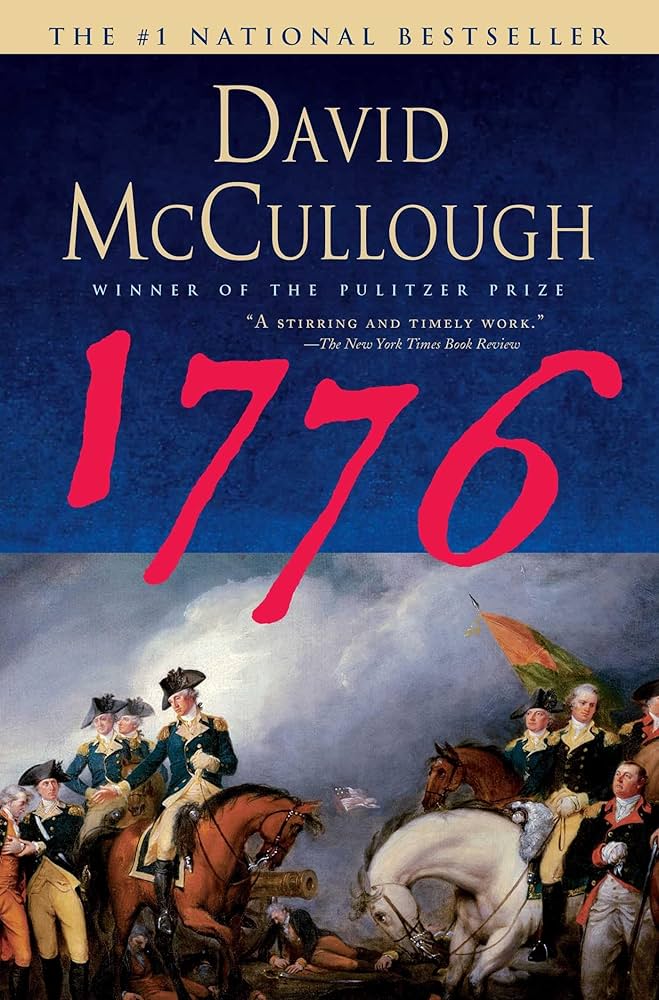
1776 was a turning point for America. In his book of the same name, David McCullough outlines a few of the early battles led by George Washington that helped America secure its independence.
Key Takeaways
1️⃣ The Revolutionary War: America's Fight for Independence
Up until 1776, the people living in the 13 colonies on the east coast of America were part of the British empire led by King George III. But in 1775, that all began to change after the King and his Parliament decided to put an end to the growing rebellious acts put on by the Americans, such as the Boston Tea Party a few years prior. Historic and bloody battles at Lexington and Concord, and Bunker Hill, in 1775 had only made tensions worse, and George Washington took command of the Continental Army on July 3 of that year.
This book covers a few key battles led by Washington in the year 1776. This was the same year the Declaration of Independence was adopted, on July 4, and American troops began fighting for something much bigger than themselves — complete independence from Britain. From the beginning, the British looked at the Americans as “rebels.” In their eyes, the Americans were rebelling against the King, and the British troops had every intention of crushing the uprising.
As one would expect, the American rebels were completely overmatched. They were fewer in numbers, poorly trained, short on weapons and ammunition, and had no navy to speak of. The Continental Army didn’t even have uniforms, unlike the clean redcoats worn by the British troops. On top of that, King George hired highly-trained German troops to help his cause. It was sort of a David vs. Goliath situation — a group of untrained farmers and tradesmen against the world’s most formidable military force. The British also had the upper-hand in the leadership department — they were led by the experienced general William Howe, while the Americans were under the command of Washington, who had never led a full-scale army before. In fact, in personal letters Washington himself admitted that he didn’t feel qualified for the job of leading the Americans.
Although the British were superior, it came with a blind spot: overconfidence. Again and again during the Revolutionary War, their tendency to underestimate Washington and his ragtag army allowed the Americans to fight on.
2️⃣ Dorchester Heights, Henry Knox, and Driving the Brits Out of Boston
One of the key landmarks early in the war was Boston, and the British largely controlled it. With Boston under their command, they were able to use sea channels to import reinforcements, food, and supplies. The Americans occupied the outskirts of the city, and one of Washington’s big goals was to drive the British out of Boston.
The problem was that the British had far more gun powder, weaponry, and men. The American army was also shrinking rapidly thanks to disease and troops coming to the end of their contracts. The Americans were very vulnerable, and Washington could not understand why the British didn’t march in and finish the job. Their failure to act gave the Americans a window of opportunity, and they took advantage by driving the redcoats out of Boston. They did this by gaining the high ground at Dorchester Heights, a key area above the city that was undefended at the time.
How did a weak, underpowered army gain hold of such a pivotal area? The answer was Henry Knox, a bookseller turned artillery officer who pulled off a near-miracle by tracking down and hauling back 60-tons of guns and cannons located at Fort Ticonderoga on Lake Champlain. Fort Ticonderoga was previously occupied by the British before a group of Americans managed to overtake them earlier in the year. Knox told Washington he could retrieve the weaponry, and he backed up his claims by executing a two-month long, 300-mile trip in the dead of winter. It was a near impossible mission. He went on to play a critical role throughout the Revolutionary War and served as America’s first Secretary of War. Today, Fort Knox is named after him.
Knox’s heroics gave the Americans new life, and much-needed weaponry. Washington responded by organizing a surprise move on Dorchester Heights on the night of March 4, 1776. Both sides recognized that Dorchester Heights was the key to Boston. The move was executed perfectly, and the Americans took control of the high ground over Boston. By dawn, the British awoke to find cannons aimed directly at the city and their fleet. The threat of bombardment made Boston indefensible. General Howe had little choice: he evacuated the city on March 17, taking thousands of redcoats and loyalists with him.
The fortification of Dorchester Heights drove the British out of one of their strongest holdings in America. It was a stunning victory for Washington and the Continental Army. But it wasn’t a war-ending event by any means. In fact, the British were already contemplating leaving Boston, believing New York was a better strategic position. After being driven out of Boston, that’s exactly where they headed next.
3️⃣ Brits Dominate at the Battle of Long Island
After being forced out of Boston, the British headed to New York. Unlike in Boston, where they were largely contained within the city, New York was a place where they had complete control of the waters thanks to an enormous naval presence that allowed them to strike from almost any direction. Washington had almost no navy and was in a constant state of paranoia about where the British might attack.
Washington believed it was crucial to make a stand at New York because it was such an important battleground for a continent that was now attempting to become independent of British rule. But once again, he found himself dealing with several disadvantages. Maybe the biggest was that it would be almost impossible to win New York without commanding the sea. Because there were so many potential entry points into the city from the surrounding harbor, the sea was by far the most important piece of the puzzle. He was also dealing with an army that continued to diminish thanks to disease, lack of shelter, insufficient ammo, and desertion. With an estimated 30,000 British troops ready to fight, the Americans were again severely outnumbered.
Washington decided that the only way to hold New York was to defend Long Island, which served as the tip of the spear to the city. If New York was the key to the continent, then Long Island was the key to New York. He therefore sent several thousand troops to Long Island around July of 1776, which is the same time the Continental Congress in Philadelphia announced that the 13 colonies were renouncing their allegiance to the King and officially declaring independence from Britain. This declaration took the war up a notch — the Americans were now committing treason and had no choice but to fight for their freedom.
In late July, the British made their first move, sending hundreds of ships and an estimated 32,000 troops to Staten Island, which was a sort of entry point to Long Island and Brooklyn. At the time, it was the largest, most powerful force ever sent by Britain or any nation. On August 27, the British officially launched a strike on Long Island and completely overmatched the Americans on the battlefield, forcing them to retreat to Brooklyn.
At this point, the Americans were sort of trapped in Brooklyn up against the East River. The British were ready to go in for the kill and end the war decisively. But rather than strike immediately, General Howe hesitated for some reason. This allowed Washington to lead his amateur army of 9,000 men out of Brooklyn in what was a perfectly executed overnight silent retreat across the East River that the British were not expecting. It was a miraculous escape that allowed the Americans to stay in the fight. General Howe was later heavily criticized for not attacking sooner and allowing the Americans to retreat. In some ways, we owe Howe for keeping our hopes for independence alive!
All told, the Battle at Long Island was the largest ever fought in North America at the time. It was a resounding victory for Britain. Brooklyn and all of its forts and artillery were now in British control, and the Americans were on the run back to New York.
4️⃣ The Great Retreat: Rebels on the Run
Having lost Long Island and Brooklyn, Washington and the Americans had no choice but to retreat back into New York. They were on the run, and they would continue to be on the run for a while.
Many people pinned the losses of Long Island and Brooklyn on Washington for being indecisive. Because the British controlled the sea, he could not figure out where they would attack. As a result, his army was too spread out and disorganized. But in reality, the Americans never stood a chance, no matter what Washington did. The British were simply too powerful and too experienced at the time. It was a miracle the Americans weren’t wiped out completely and lived to see another day. Any army in Washington’s position likely would have been destroyed, yet he managed to preserve his forces for the battles ahead.
The retreats back into Brooklyn, then New York, were the beginning of a long string of withdrawals for the underdog Americans. After a short stay in New York, Washington ordered an evacuation from the city in September 1776 as the British closed in on their position. New York was now firmly in Britain’s possession.
The British continued to push forward. The Americans won a small skirmish at Harlem Heights, but were eventually forced to flee the area. Later, at Fort Washington, the Americans were again overpowered in battle and had to retreat from that position. The loss at Fort Washington was especially bad, as nearly 3,000 American soldiers were captured and taken prisoner. The Americans were also forced to retreat from their positions at Kips Bay and White Plains. By November, Washington and his army were fleeing south toward New Jersey.
At this point, things looked terrible for the Americans. Their army was overmatched, they had lost New York entirely, and they were on the run. Almost everyone was now very worried that the British had their sights on Philadelphia, where Congress was stationed. To make matters worse, General Lee, one of Washington’s most trusted men, was captured by the British while trying to rejoin the rest of the army. People were rightfully very scared. When the British offered to pardon any American who surrendered and pledged allegiance to the King, thousands took them up on the offer.
The string of retreats eventually led the Americans to cross the Delaware River and regroup.
5️⃣ Americans Strike Back: Famous Crossing of the Delaware
Vulnerable and pinned up against the Delaware River, the Americans needed a miracle to avoid total collapse. They got one on December 13, 1776, when General Howe inexplicably suspended British military operations until spring.
At the time, the Americans held position on the far side of the Delaware River, while the British occupied the area on the near side close to the town of Trenton. Sensing that the war could be over without a drastic move, Washington decided to take the offensive and attack Trenton across the river. Trenton was largely occupied by German troops (called “Hessians”) who were hired by the King to support the British army.
The attack commenced on Christmas night of 1776. Led by Washington, the American army crossed the icy Delaware River in extremely challenging conditions and overmatched the Hessians, capturing 900 and killing or injuring more than 100 in a successful taking of Trenton. The famous crossing of the Delaware and move on Trenton was a complete surprise to the British, and it completely reinvigorated the American army. Washington was hailed as a hero.
The British responded by sending a unit led by Lord Charles Cornwallis toward Trenton. In another savvy move, Washington evacuated Trenton and flanked Cornwallis’s rear at Princeton. This was yet another unexpected successful battle for the Americans, as they took another 300 British prisoners and Cornwallis narrowly escaped.
These wins at Trenton and Princeton at the end of 1776 were enormous and marked a turning point in the war for the Americans. The British were on the verge of winning the war outright, and the American army was weak, exhausted, undermanned, and on the run. These battles turned the momentum and gave the Americans new life and energy heading into 1777. The Revolutionary War between the two sides continued until the British surrendered at Yorktown (1781) and the Treaty of Paris was signed (1783).
6️⃣ Winning the Revolutionary War Was a Miracle
This war often does not get enough recognition for how brutal it was. By the time it ended, 25,000 Americans had lost their lives in the Revolutionary War. At the time, this was 1% of the entire population — in percentage of lives lost, it was the deadliest war in American history, except for the Civil War.
The men who fought for our independence endured horrendous conditions and sustained suffering in the form of disease, hunger, desertions, defeat, fear, and more. Their courage is what allowed us to break free of British rule and become the truly independent nation we are today. Considering how overpowered we were in the early years of the war, it was a complete miracle that we later won it.
Washington’s leadership was critical throughout the war. Time and again, he guided a small, underpowered army through seemingly impossible odds, skillfully turning retreats into opportunities and keeping the fight alive when it looked like the British were on the verge of putting an end to it. His leadership earned him global respect, and he ultimately became the first president of the United States.
The resilience of the Continental Army was very important, but it was not the only reason we won the war. French support — including troops, naval power, and supplies — played a decisive role, tipping the balance against Britain and helping secure independence. Benjamin Franklin was instrumental in capturing this support. Still, the American victory was truly miraculous in many ways, and it’s a great example of determination and overcoming adversity.